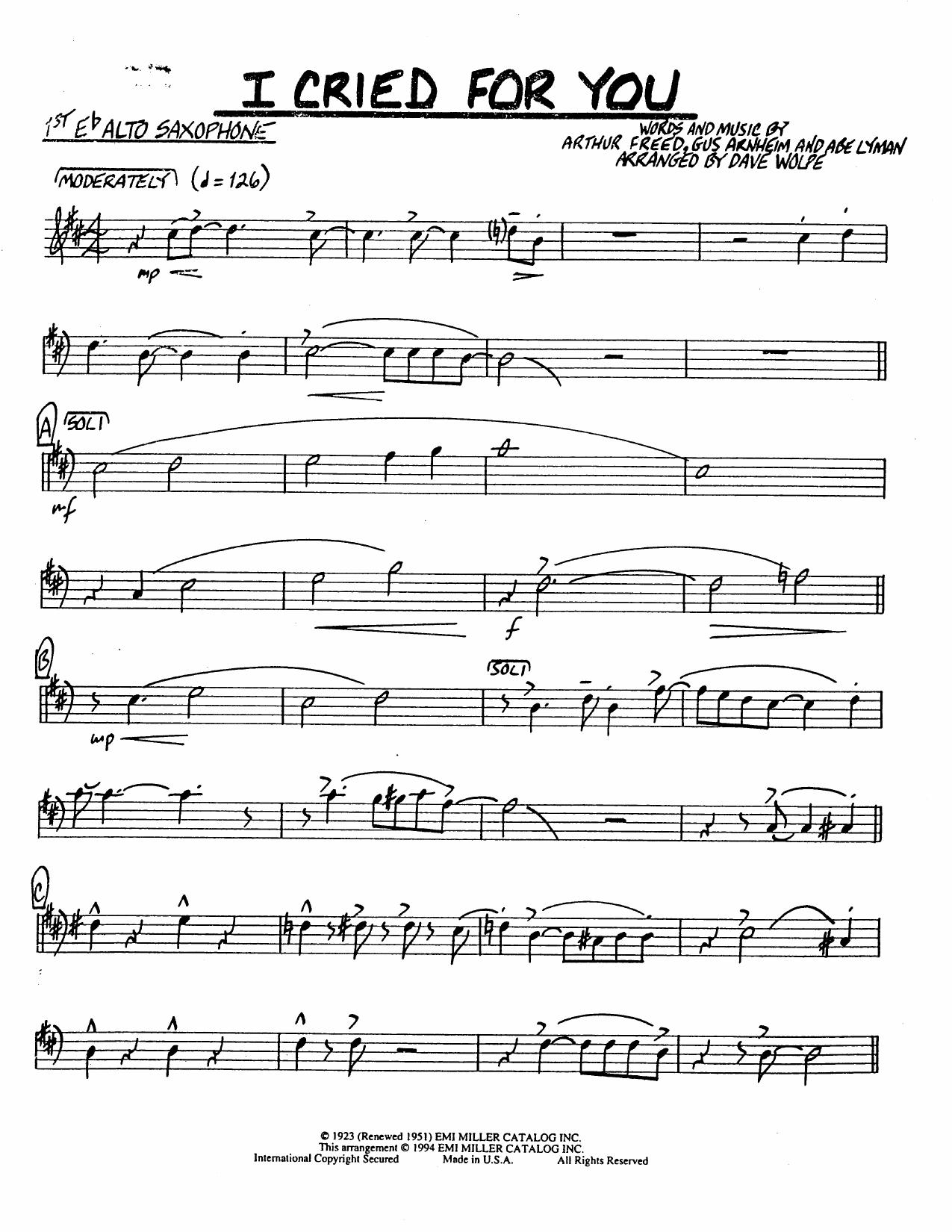
I Cried For You (D.Wolpe)
Composed by Gus Arnheim
Arranged by Dave Wolpe
- Ensemble: Big Band
- Pages: 54
- Instruments (17): 1st Eb Alto Saxophone, 2nd Eb Alto Saxophone, 1st Bb Tenor Saxophone, 2nd Bb Tenor Saxophone, Eb Baritone Saxophone, 1st Bb Trumpet, 2nd Bb Trumpet, 3rd Bb Trumpet, 4th Bb Trumpet, 1st Trombone, 2nd Trombone, 3rd Trombone, Bass Trombone, Bass, Guitar, Drums, Piano
- Difficulty: advanced
- Content: Individual Parts
- Format: PDF Download (Instant)
- Price: $24.99
Gus Arnheim, Arthur Freed, and Abe Lyman penned "I Cried For You" in 1923, anchoring it firmly in the golden age of early American popular song before it gracefully transitioned into a staple of the swing era jazz repertoire. While initially introduced as a wistful vocal tune, the composition gained enduring jazz-credibility through classic interpretations by iconic vocalists like Billie Holiday and instrumental recordings that treated its sweeping, nostalgic melody as a vehicle for expressive swing improvisation. The tune bridges the gap between early 1920s parlor sentimentality and the sophisticated harmonic language of mid-century big band jazz, offering a timeless framework for ensemble interplay. Dave Wolpe’s masterful big band setting breathes new life into the standard through a polished medium-swing groove that balances driving rhythmic momentum with lush, sophisticated ballad-esque styling. Operating at a comfortable, conversational medium tempo, the arrangement establishes an inviting, late-night club atmosphere. The emotional landscape shifts fluidly between bittersweet introspection and buoyant, swinging optimism. Wolpe builds the chart's energy organically, utilizing rich, extended chord voicings in the brass that evoke the classic Count Basie or Nelson Riddle aesthetics, yet maintaining a distinctly modern clarity that lets the counterlines breathe beneath the primary thematic statements. True to Wolpe’s signature arranging style, the chart features meticulously crafted sax soli sections that blend seamlessly with crisp, conversational background brass figures. The melody is introduced initially by the lead alto saxophone supported by warm, muted brass pads, before the full ensemble opens up into a robust, driving shout chorus. Technical demands are thoughtfully managed, making this chart an ideal centerpiece for advanced high school ensembles looking to stretch their stylistic versatility, as well as collegiate and community big bands seeking a crowd-pleasing standard with authentic historical resonance. Solos are open for interpretation, allowing featured horn players to stretch out over standard changes while the rhythm section maintains an infectious, pocket-driven swing feel. The dynamic contrast within the chart provides ample educational opportunities for directors focusing on section balance, swing subdivision, and stylistic phrasing. From the subtle dynamic nuances of the intro to the powerhouse full-ensemble release heading into the final chorus, every section of the 17-instrument lineup is given meaningful musical material. The arrangement rewards precision in articulation—particularly regarding short-long swing eighth-note interpretations and carefully placed dynamic swells—ensuring that performers and audiences alike experience the timeless elegance of the swing era executed with professional flair. Achieving an authentic performance of this Dave Wolpe arrangement requires careful attention to the medium-swing feel, avoiding any tendency to rush the tempo. The rhythm section is the engine: the drummer should maintain a light, driving ride cymbal pattern with a crisp hi-hat on beats two and four, while the bassist walks a steady, acoustic-styled quarter-note line that locks tightly with the piano's rootless comping voicings. Horn players must focus on uniform articulation, ensuring that all unaccented eighth notes are properly swung while back-beat accents remain sharp and punchy. Brass players should utilize cup or bucket mutes where indicated to achieve that warm, smoky ensemble blend without forcing their tone. During the sax soli, the section needs to lock their intonation and phrasing closely to the lead alto, projecting dynamically over the understated background figures from the rhythm section. Rehearsals should initially isolate the shout chorus to balance the brass countermelodies against the driving sax lines before integrating the full ensemble dynamics. Q: What instruments and parts are included in this big band arrangement? A: This standard 17-instrument big band arrangement includes full instrumentation: 5 saxophones (Alto 1, Alto 2, Tenor 1, Tenor 2, Baritone), 4 trumpets, 4 trombones, and a standard 4-piece rhythm section consisting of piano, guitar, bass, and drums, spanning a comprehensive 54-page score and parts set. Q: What is the difficulty level of this Dave Wolpe chart? A: This arrangement is graded as medium-advanced, making it exceptionally well-suited for advanced high school jazz ensembles, college bands, and community big bands looking for a polished, rewarding challenge. Q: What is the historical style and musical context of "I Cried For You"? A: Originally composed in 1923 by Gus Arnheim, Arthur Freed, and Abe Lyman, this piece evolved from a traditional pop tune into a cherished jazz standard famously interpreted by vocal and instrumental icons throughout the swing era. Q: What makes this specific arrangement by Dave Wolpe unique? A: Wolpe’s arrangement stands out due to its clever blend of lush, extended harmonic voicings, tightly knit saxophone solis, and a dynamic shout chorus that captures the authentic elegance of classic mid-century big band scoring. Q: What is the recommended performance tempo and duration for this piece? A: The arrangement is set in a comfortable, driving medium-swing feel (typically around quarter note = 120-126 BPM), resulting in a performance duration of approximately 3 to 4 minutes depending on the length of improvised solo choruses.
Questions and answers
- What is included in the I Cried For You (D.Wolpe) PDF?
- The verified current file contains individual parts across 54 pages.
- How many instruments or parts are listed for I Cried For You (D.Wolpe)?
- The verified instrumentation list contains 17 entries for this Big Band arrangement.
- Who is credited for I Cried For You (D.Wolpe)?
- Composer: Gus Arnheim. Arranger: Dave Wolpe.
- What difficulty is listed for I Cried For You (D.Wolpe)?
- The verified difficulty level is advanced.
- Can I preview I Cried For You (D.Wolpe) before buying?
- Yes. The product page provides a preview generated from the current PDF file.
- How is I Cried For You (D.Wolpe) delivered?
- After successful payment, the digital PDF is made available for download. The displayed price is $24.99.
Musicians Also Search For
I Cried For You Dave Wolpe PDF • I Cried For You Dave Wolpe sheet music • I Cried For You arranged by Dave Wolpe • Dave Wolpe big band charts • Dave Wolpe jazz arrangements PDF • I Cried For You Gus Arnheim sheet music • I Cried For You Gus Arnheim big band arrangements • Gus Arnheim big band charts • I Cried For You big band arrangements • I Cried For You big band PDF download • I Cried For You jazz sheet music • big band sheet music download • I Cried For You individual parts download • I Cried For You sheet music PDF • buy I Cried For You sheet music • download I Cried For You PDF • I Cried For You jazz charts • best Dave Wolpe big band arrangements • Gus Arnheim arranged by Dave Wolpe • I Cried For You printable sheet music • big band repertoire PDF