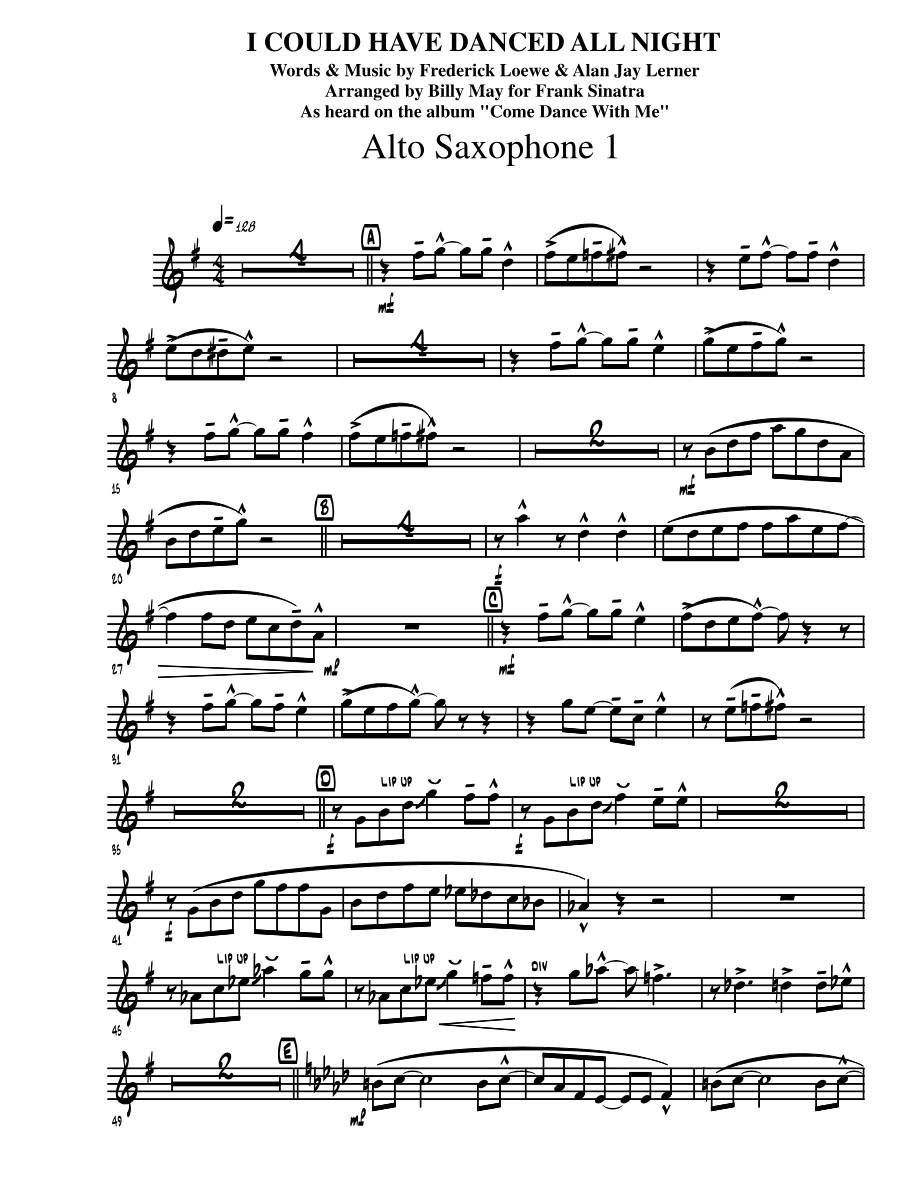
I Could Have Danced All Night (Billy May)
Composed by Frederick Loewe
Arranged by Billy May
- Ensemble: Big Band
- Pages: 32
- Instruments (16): Alto Saxophone 1, Alto Saxophone 2, Tenor Saxophone 1, Tenor Saxophone 2, Baritone Saxophone, Trumpet in Bb 1, Trumpet in Bb 2, Trumpet in Bb 3, Trumpet in Bb 4, Trombone 1, Trombone 2, Trombone 3, Bass Trombone, Piano/Conductor, Bass, Drum Set
- Difficulty: medium
- Content: Individual Parts
- Format: PDF Download (Instant)
- Price: $24.99
Frederick Loewe and Alan Jay Lerner’s timeless creation from *My Fair Lady*, “I Could Have Danced All Night,” underwent a brilliant metamorphosis when filtered through the imaginative mind of arranger Billy May. Originally introduced on Broadway in 1956 and later immortalized on film by Audrey Hepburn (voiced by Marni Nixon), the tune swiftly crossed over from show tune staple to jazz standard territory. Vocalists and instrumentalists alike were drawn to its infectious, ascending melodic contour. However, it was the fertile ground of mid-century studio jazz and big band albums that allowed arrangers to completely reimagine its harmonic and rhythmic framework, turning a theatrical expression of euphoria into an absolute powerhouse of swinging orchestration. Brimming with irrepressible energy, this chart drives forward at a bright, buoyant medium-up swing tempo. The overall mood is jubilant, sophisticated, and theatrical, yet underpinned by the gritty, blues-infused swagger that defined West Coast big band writing of the 1950s. Rather than treating the waltz-adjacent or modal hints of the original show tune delicately, May converts the material into a 4/4 driving machine. The arrangement is characterized by sparkling brass countermelodies, cascading woodwind flourishes, and a sense of perpetual motion that mirrors the breathless excitement of the lyrics, evoking late-night smoky club rooms coupled with the polished gloss of Hollywood studio sessions. Billy May’s signature style is stamped indelibly across every measure of this score, most notably through his legendary use of "munge" style saxophones—where reed sections play with a stylized, breathy vibrato and puckered tone—alongside snapping, harmon-muted brass stabs. The arrangement bypasses standard, predictable block voicing in favor of witty, transparent textures that constantly redistribute the thematic weight between the brass and saxes. A meticulously crafted shout chorus builds relentless tension through chromatic voice-leading and dynamic swells before releasing into a roaring full-ensemble climax. The harmonic palette is rich with sharp secondary dominants and unexpected modal shifts, keeping both the performers and the listener perpetually on edge. Ensembles tackling this chart will find that the melody is shared democratically across sections, though the primary focus rests heavily on tight ensemble interplay and articulation uniformity. While not featuring extensive, open-ended improvised solo sections, the arrangement demands immense rhythmic precision, particularly in navigating May’s signature syncopated figures and abrupt dynamic contrasts. The technical challenges lie less in extreme individual ranges and more in stylistic cohesion; the band must execute tongue-slurs, precise staccatos, and subtle pitch bends with absolute unity. Advanced high school, collegiate, and professional big bands will find this arrangement an exceptionally rewarding centerpiece for a concert program or festival set. Its unique blend of Broadway pedigree and West Coast jazz ingenuity guarantees an enthusiastic audience response, while providing advanced student musicians a masterclass in mid-century swing phrasing, section blending, and stylistic attitude. The primary technical challenge in executing Billy May’s arrangement of "I Could Have Danced All Night" lies in achieving absolute rhythmic unanimity across the ensemble during rapid, syncopated figures. Conductors should enforce a crisp, forward-moving swing feel with an energized macro-beat, ensuring the quarter-note pulse never drags, even during softer transitional passages. Pay close attention to articulation markings: short notes must be clipped and dry, while accented lines require a warm, vocal weight without sacrificing punch. Saxophone sections should lean into May’s distinctive textural demands, utilizing a focused, slightly reedy tone quality that avoids heavy classical vibrato. Brass players must master the required use of cup and straight mutes, ensuring seamless blends during harmonized soli statements. During rehearsal, isolate the intricate rhythmic unisons between the low brass and baritone saxophone to lock in the groove before layering the upper register brass counterlines. Balance is critical during the dynamic swells of the shout chorus; the accompanying horns must dynamically shade under the primary melodic lead voices to maintain structural clarity. Q: What instruments and parts are included in this arrangement? A: This arrangement is scored for a 9-instrument big band lineup consisting of Alto Saxophone, Tenor Saxophone, Baritone Saxophone, Trumpet, Trombone, and a standard rhythm section. The complete packet comprises a 32-page conductor and instrumental part set tailored for compact or flexible jazz ensembles. Q: What is the difficulty level of this chart? A: This piece is best suited for advanced high school, collegiate, and professional jazz ensembles. The primary challenges involve complex syncopation, precise stylistic articulation, and maintaining stamina at a bright swing tempo rather than extreme technical range requirements. Q: What is the historical style and context of this arrangement? A: The arrangement reimagines Frederick Loewe’s classic 1956 Broadway tune through the lens of West Coast big band jazz. Arranger Billy May infuses the theater standard with mid-century swing aesthetics, shifting the meter into a driving 4/4 groove. Q: What makes this specific Billy May arrangement unique? A: It features May’s signature arranging hallmarks, including witty harmonic substitutions, playful brass mute work, and his trademark breathy saxophone textures ("munge" style). These elements transform a familiar show tune into a sophisticated, high-energy jazz showcase. Q: What is the performance duration and recommended tempo? A: The arrangement is designed to be performed at a bright, buoyant medium-up swing tempo (approximately quarter note = 180–192 BPM), resulting in a performance duration of roughly 3 to 4 minutes depending on the chosen swing feel.
Questions and answers
- What is included in the I Could Have Danced All Night (Billy May) PDF?
- The verified current file contains individual parts across 32 pages.
- How many instruments or parts are listed for I Could Have Danced All Night (Billy May)?
- The verified instrumentation list contains 16 entries for this Big Band arrangement.
- Who is credited for I Could Have Danced All Night (Billy May)?
- Composer: Frederick Loewe. Arranger: Billy May.
- What difficulty is listed for I Could Have Danced All Night (Billy May)?
- The verified difficulty level is medium.
- Can I preview I Could Have Danced All Night (Billy May) before buying?
- Yes. The product page provides a preview generated from the current PDF file.
- How is I Could Have Danced All Night (Billy May) delivered?
- After successful payment, the digital PDF is made available for download. The displayed price is $24.99.
Musicians Also Search For
I Could Have Danced All Night Billy May PDF • I Could Have Danced All Night Billy May sheet music • I Could Have Danced All Night arranged by Billy May • Billy May big band charts • Billy May jazz arrangements PDF • I Could Have Danced All Night Frederick Loewe sheet music • I Could Have Danced All Night Frederick Loewe big band arrangements • Frederick Loewe big band charts • I Could Have Danced All Night big band arrangements • I Could Have Danced All Night big band PDF download • I Could Have Danced All Night jazz sheet music • big band sheet music download • I Could Have Danced All Night individual parts download • I Could Have Danced All Night sheet music PDF • buy I Could Have Danced All Night sheet music • download I Could Have Danced All Night PDF • I Could Have Danced All Night jazz charts • best Billy May big band arrangements • Frederick Loewe arranged by Billy May • I Could Have Danced All Night printable sheet music • big band repertoire PDF