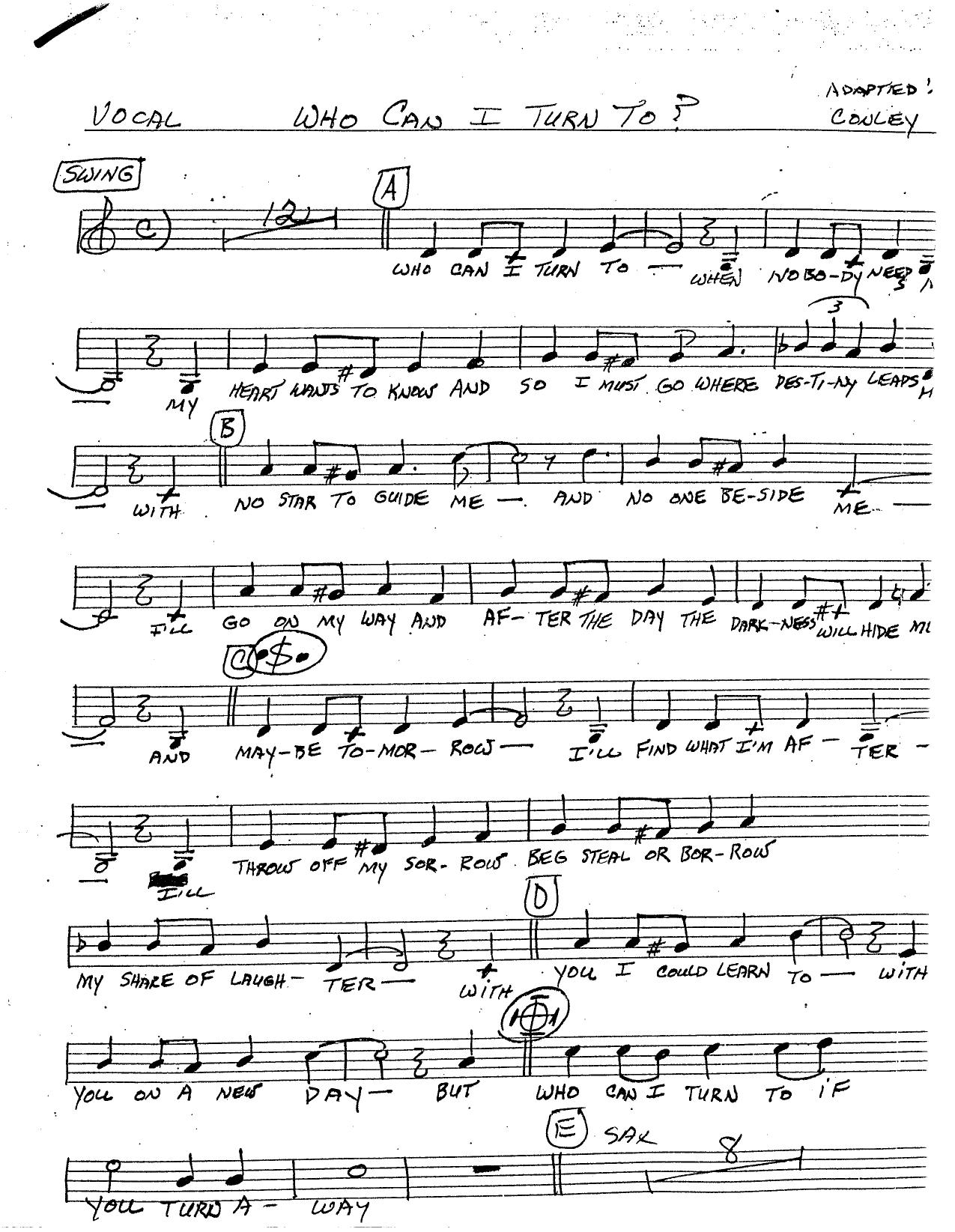
Who Can I Turn To (M.Congley)
Composed by Anthony Newley
Arranged by M.Congley
- Ensemble: Big Band
- Style: Jazz Standard
- Pages: 31
- Instruments (15): Vocal, Alto Sax 1, Alto Sax 2, Tenor Sax 1, Tenor Sax 2, Baritone Sax, Trumpet 1, Trumpet 2, Trumpet 3, Trombone 1, Trombone 2, Bass Trombone, Piano, Drums, Bass
- Difficulty: medium
- Content: Individual Parts
- Format: PDF Download (Instant)
- Price: $24.99
Anthony Newley and Leslie Bricusse penned "Who Can I Turn To (When Nobody Needs Me)" for the 1964 Broadway musical *The Roar of the Greasepaint – The Smell of the Crowd*, but it was the masterful 1965 recording by Tony Bennett that cemented the composition as an immortal Great American Songbook standard. Adpated frequently by jazz luminaries like Bill Evans and Sarah Vaughan, the song's inherent melancholic beauty and sophisticated harmonic framework make it a prime vehicle for emotive jazz interpretation. It bridges traditional Broadway vocal styling with mid-century modal-adjacent jazz sophistication, relying on descending chromatic lines and a yearning melodic contour that invites deep expressive freedom. This sophisticated big band setting conceived by M.Congley transforms the bittersweet classic into a sweeping, emotionally resonant ballad with a lush, cinematic framework. Unfolding at a patient, expressive rubato-to-medium ballad tempo, the arrangement establishes a deeply contemplative mood characterized by rich, extended chord voicings and gossamer woodwind textures. The emotional arc moves from quiet, introspective vulnerability to a soaring, passionate climax before dissolving back into a tender, whispered denouement. Congley utilizes the full dynamic spectrum of the 15-piece ensemble, creating waves of dense brass pads and delicate countermelodies that constantly reinvent the harmonic landscape underneath the vocal line. Congley’s arranging hand is immediately recognizable in the sophisticated reharmonizations and intricate horn-soli passages that frame the vocal delivery. Instead of relying on standard stock voicings, the chart employs open-position harmonies in the saxes and subtle, impressionistic flugelhorn and muted trumpet counterlines that evoke the cool-school sophistication of the late 1960s West Coast sound. A tastefully sculpted dynamic swell leads into a dramatic transitional interlude, bypassing a traditional aggressive shout chorus in favor of a harmonically dense, rubato-inflected development section that showcases the ensemble’s collective breath control and intonation. The vocalist commands the narrative center of the chart, supported by sensitive ensemble writing where the alto and tenor saxophones frequently weave delicate obbligatos around the lyric. While the vocal carries the primary weight of the storytelling, the chart leaves ample room for an expressive, internalized instrumental solo—ideally suited for tenor saxophone or flugelhorn—that mirrors the vocal’s aching vulnerability. Technically, the arrangement demands exceptional control of soft dynamics, precise intonation on stacked fourths and major seventh chords, and a mature sense of rubato timing. Advanced high school, collegiate, and professional big bands will find this chart an extraordinary vehicle for developing ensemble sensitivity, dynamic contrast, and deep stylistic maturity. Success with this arrangement hinges on the ensemble's ability to maintain a transparent texture and impeccable intonation during extended, lushly voiced passages. The conductor must carefully balance the rhythm section—ensuring the piano and guitar voicings remain sparse and impressionistic—so the horn pads can breathe without muddying the harmonic color. Pay close attention to the tempo fluidity; while a steady underlying pulse is essential, the chart thrives on expressive push-and-pull, particularly during transitional rubato phrases. Horn players should prioritize a warm, centered tone with minimal vibrato in the quiet sections to preserve the modern, cool-jazz aesthetic. Brass players must exercise extreme restraint during the dynamic swells, ensuring that peak emotional moments remain sonically rich rather than forced or brassy. Rehearsals should initially focus on sectional balance and intonation of the complex chord extensions before integrating the vocal soloist. Q: What instruments and parts are included in this arrangement? A: This chart is scored for a 15-instrument ensemble comprising a Vocalist, two Alto Saxophones, two Tenor Saxophones, a full complement of brass and rhythm, across a comprehensive 31-page master score and set of parts. Q: What is the difficulty level of this arrangement? A: This chart is best suited for advanced high school, collegiate, and professional big bands due to its demand for sophisticated harmonic intonation, dynamic control, and mature ballad phrasing. Q: What is the musical style and historical context of the piece? A: Rooted in the jazz standard tradition established by Tony Newley and popularized by vocal icons like Tony Bennett, this arrangement reinterprets the 1964 Broadway classic through a sophisticated, mid-century-inspired contemporary jazz lens. Q: What makes M.Congley's arrangement unique? A: The chart stands out for its impressionistic reharmonizations, open-position woodwind voicings, and a dramatic, cinematic emotional arc that favors rich textural development over a traditional aggressive shout chorus. Q: What is the recommended performance tempo and duration? A: The piece is designed as an expressive, patient ballad performed at a flexible, contemplative tempo, typically lasting around 4 to 5 minutes depending on rubato pacing and solo extensions.
Questions and answers
- What is included in the Who Can I Turn To (M.Congley) PDF?
- The verified current file contains individual parts across 31 pages.
- How many instruments or parts are listed for Who Can I Turn To (M.Congley)?
- The verified instrumentation list contains 15 entries for this Big Band arrangement.
- Who is credited for Who Can I Turn To (M.Congley)?
- Composer: Anthony Newley. Arranger: M.Congley.
- What difficulty is listed for Who Can I Turn To (M.Congley)?
- The verified difficulty level is medium.
- What style is listed for Who Can I Turn To (M.Congley)?
- The catalog lists the style as Jazz Standard.
- Can I preview Who Can I Turn To (M.Congley) before buying?
- Yes. The product page provides a preview generated from the current PDF file.
- How is Who Can I Turn To (M.Congley) delivered?
- After successful payment, the digital PDF is made available for download. The displayed price is $24.99.
Musicians Also Search For
Who Can I Turn To M.Congley PDF • Who Can I Turn To M.Congley sheet music • Who Can I Turn To arranged by M.Congley • M.Congley big band charts • M.Congley jazz arrangements PDF • Who Can I Turn To Anthony Newley sheet music • Who Can I Turn To Anthony Newley big band arrangements • Anthony Newley big band charts • Who Can I Turn To big band arrangements • Who Can I Turn To big band PDF download • Who Can I Turn To jazz sheet music • big band sheet music download • Who Can I Turn To individual parts download • Who Can I Turn To sheet music PDF • Who Can I Turn To Jazz Standard charts • Jazz Standard big band arrangements • buy Who Can I Turn To sheet music • download Who Can I Turn To PDF • Who Can I Turn To jazz charts • best M.Congley big band arrangements • Anthony Newley arranged by M.Congley • Who Can I Turn To printable sheet music • big band repertoire PDF