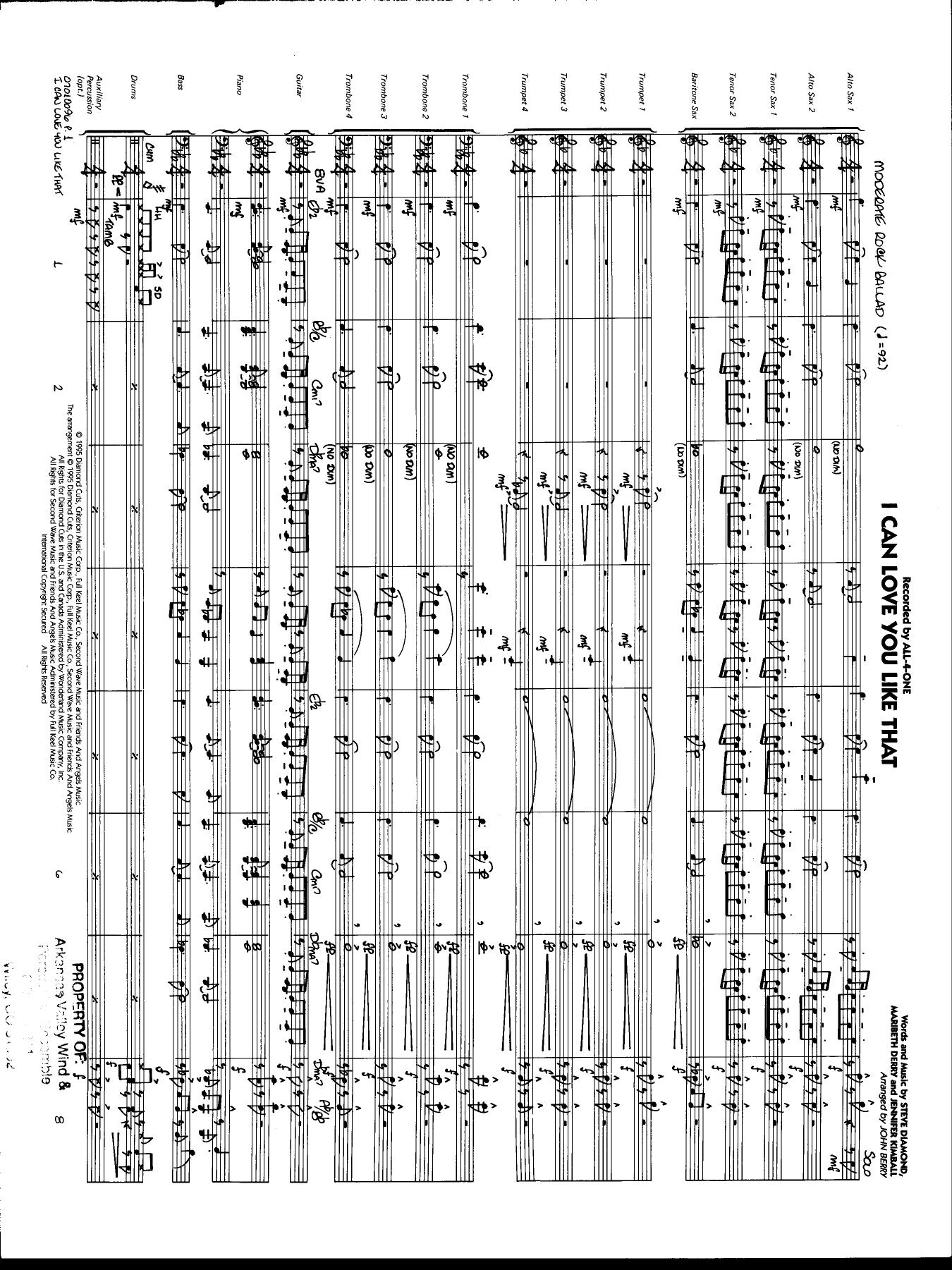
I Can Love You Like That (J.Berry) sheet music preview

I Can Love You Like That (J.Berry)

Composed by Diane Warren

Arranged by John Berry

  • Ensemble: Big Band
  • Pages: 49
  • Instruments (18): Alto Sax 1, Alto Sax 2, Tenor Sax 1, Tenor Sax 2, Baritone Sax, Trumpet 1, Trumpet 2, Trumpet 3, Trumpet 4, Trombone 1, Trombone 2, Trombone 3, Trombone 4, Guitar, Piano, Bass, Drums, Auxiliary Percussion
  • Difficulty: medium
  • Content: Individual Parts
  • Format: PDF Download (Instant)
  • Price: $24.99

Originally crafted by legendary hitmaker Diane Warren, the iconic ballad "I Can Love You Like That" gained international prominence in the mid-1990s through soaring vocal harmony arrangements that captivated adult contemporary and pop audiences alike. While its roots lie in the commercial pop landscape of the decade, the underlying harmonic architecture—characterized by rich suspension chords, smooth voice-leading, and a deeply emotional melodic contour—translates with remarkable elegance into the jazz idiom. This big band adaptation reimagines the familiar vocal anthem as a lush, expressive instrumental ballad, bridging the gap between nostalgic 90s radio pop and sophisticated contemporary jazz orchestration. Subtitled with a gorgeous ballad tempo, this arrangement unfolds in a comfortable, relaxed 4/4 feel that prioritizes lyricism, dynamic control, and rich tonal blending over aggressive swing syncopation. The emotional character is deeply romantic, reflective, and sweeping, evoking a cinematic mood reminiscent of late-night supper club performances or West Coast studio recordings. John Berry’s scoring approach avoids heavy-handed predictability, instead treating the ensemble like a living, breathing vocal choir. The chart features velvety sax solis, warm brass voicings with flugelhorns trading off for muted trumpets, and a rhythm section texture that relies on subtle bossa or half-time ballad feels to maintain momentum without rushing the emotional pacing. The arrangement opens with a delicate piano and guitar intro before handing the primary melodic statements to the lead alto saxophone and flugelhorn, allowing the rich lower-register woodwinds to provide a velvety foundation. As the chart builds toward its emotional apex, a sophisticated modulation lifts the ensemble into a dense, harmonically advanced shout chorus that showcases the full dynamic range of an 18-piece big band without ever sacrificing warmth. Solos are thoughtfully integrated, offering a featured soloist ample room for expressive rubato phrasing. Technical demands center less on breakneck fingerwork and far more on blend, intonation, extended breath control, and precise control over soft dynamics—making it an exceptional vehicle for developing musical maturity. Advanced high school ensembles, collegiate jazz orchestras, and professional community big bands will find this chart to be an ideal centerpiece for a concert program seeking emotional depth and stylistic variety. Because it avoids ultra-complex modal shifts or double-time bebop acrobatics, directors can use it as a masterclass in ballad playing, forcing students to listen across sections, balance dense chord clusters, and shape phrases with vocal-like inflection. It provides a refreshing, crowd-pleasing change of pace from standard up-tempo burners while demanding the highest level of musicianship and ensemble listening. Success with this arrangement hinges almost entirely on meticulous attention to balance, intonation, and dynamic shading. The tempo should remain steady and unhurried, allowing the rhythm section to lay down a warm, pulsing foundation that supports the horns without dragging. Conductors must carefully monitor the brass section; muted passages should blend seamlessly into the saxophone pads rather than cutting through aggressively. Key technical challenges include executing smooth, connected phrasing across wide leaps in the woodwind sections and maintaining pristine pitch stability during exposed, high-register chord clusters. Pay close attention to the dynamic markings—the transition from the quiet, intimate opening verses to the expansive, soaring ensemble climaxes requires strict adherence to sub-tone playing in the saxes and controlled air support from the brass. Rehearsal time should be dedicated to sectional tone matching, ensuring that the lead alto and lead trumpet blend effortlessly with the surrounding players to achieve that signature studio-orchestra sheen. Q: What instrumentation and parts are included in this arrangement? A: This chart is scored for a standard 18-instrument big band, featuring Alto Saxophone 1 & 2, Tenor Saxophone 1 & 2, Baritone Saxophone, 4 Trumpets, 4 Trombones, Piano, Guitar, Bass, Drums, and a comprehensive conductor score spanning 49 pages. Q: What is the difficulty level of this John Berry big band chart? A: This arrangement is graded as medium-advanced, making it well-suited for high school jazz ensembles with strong section leaders, as well as collegiate and professional bands looking for a sophisticated ballad. Q: What is the musical style and historical background of this piece? A: Styled as a lush, contemporary jazz ballad, this arrangement reimagines Diane Warren's famous 1990s pop hit through the lens of a sophisticated big band, transforming a vocal anthem into a rich instrumental showcase. Q: What makes this specific arrangement unique? A: John Berry’s chart stands out for its vocal-like scoring approach, utilizing dense harmonic voicings, velvety saxophone solis, and a tasteful mid-chart modulation that elevates a pop melody into a rich jazz art form. Q: What is the recommended performance duration and tempo feel? A: The arrangement is designed as a relaxed, expressive ballad in 4/4 time, typically clocking in around 4 to 5 minutes depending on the length of the featured solo sections and the conductor's preferred rubato phrasing.

Questions and answers

What is included in the I Can Love You Like That (J.Berry) PDF?
The verified current file contains a conductor score and individual parts across 49 pages.
How many instruments or parts are listed for I Can Love You Like That (J.Berry)?
The verified instrumentation list contains 18 entries for this Big Band arrangement.
Who is credited for I Can Love You Like That (J.Berry)?
Composer: Diane Warren. Arranger: John Berry.
What difficulty is listed for I Can Love You Like That (J.Berry)?
The verified difficulty level is medium.
Can I preview I Can Love You Like That (J.Berry) before buying?
Yes. The product page provides a preview generated from the current PDF file.
How is I Can Love You Like That (J.Berry) delivered?
After successful payment, the digital PDF is made available for download. The displayed price is $24.99.

Musicians Also Search For

I Can Love You Like That John Berry PDFI Can Love You Like That John Berry sheet musicI Can Love You Like That arranged by John BerryJohn Berry big band chartsJohn Berry jazz arrangements PDFI Can Love You Like That Diane Warren sheet musicI Can Love You Like That Diane Warren big band arrangementsDiane Warren big band chartsI Can Love You Like That big band arrangementsI Can Love You Like That big band PDF downloadI Can Love You Like That jazz sheet musicbig band sheet music downloadI Can Love You Like That conductor score PDFI Can Love You Like That individual parts downloadI Can Love You Like That sheet music PDFbuy I Can Love You Like That sheet musicdownload I Can Love You Like That PDFI Can Love You Like That jazz chartsbest John Berry big band arrangementsDiane Warren arranged by John BerryI Can Love You Like That printable sheet musicbig band repertoire PDF

All arrangements by John Berry All Diane Warren sheet music