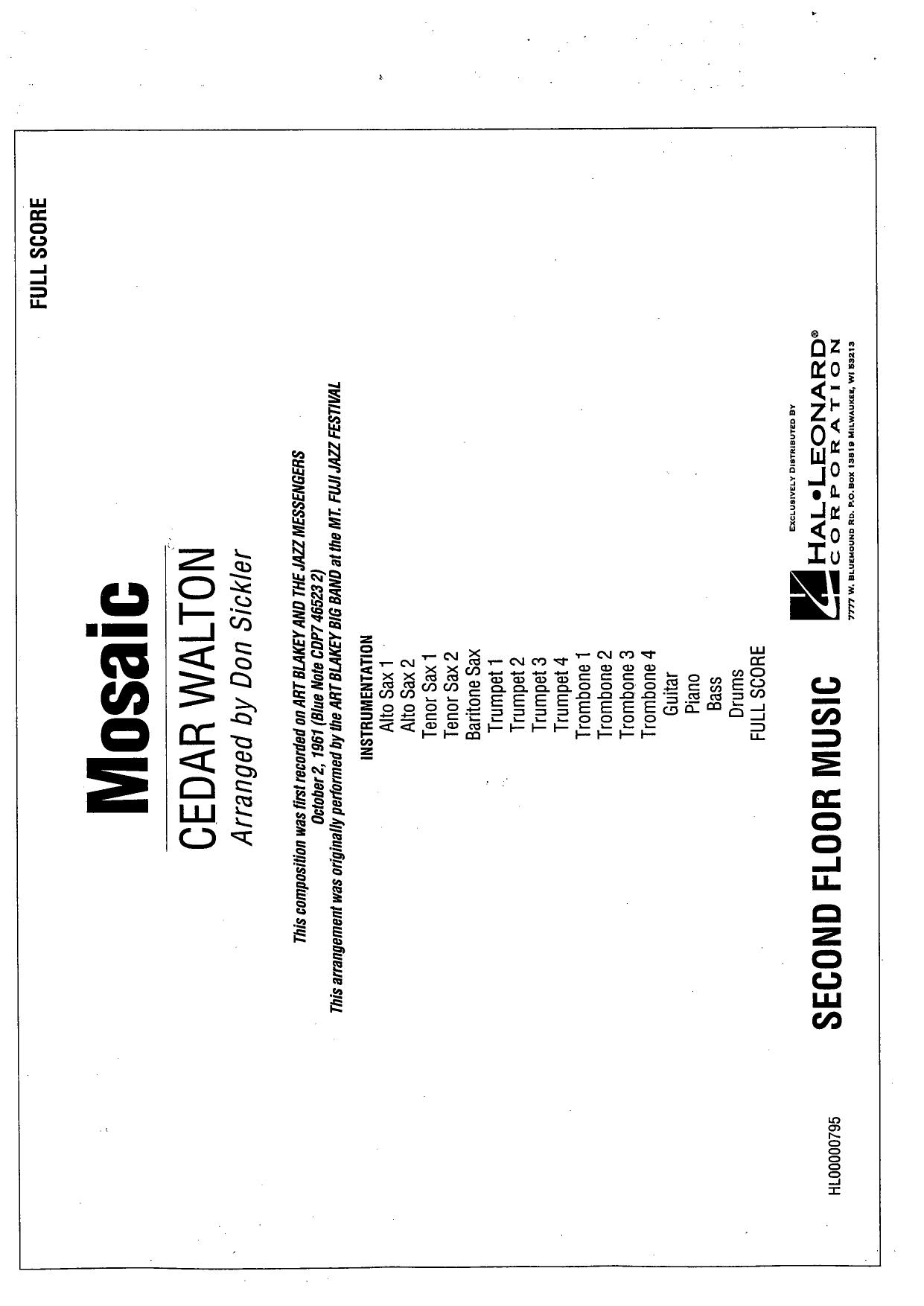
Mosaic (D.Band)
Composed by Wayne Shorter
Arranged by Don Sickler - Art Blakey Big Band
- Ensemble: Big Band
- Style: Jazz Standard
- Pages: 28
- Instruments (17): Alto Sax 1, Alto Sax 2, Tenor Sax 1, Tenor Sax 2, Baritone Sax, Trumpet 1, Trumpet 2, Trumpet 3, Trumpet 4, Trombone 1, Trombone 2, Trombone 3, Trombone 4, Guitar, Piano, Bass, Drums
- Difficulty: medium
- Content: Individual Parts
- Format: PDF Download (Instant)
- Price: $24.99
Originally penned by visionary saxophonist and composer Wayne Shorter during his legendary tenure with Art Blakey and the Jazz Messengers, "Mosaic" stands as a monumental pillar of 1960s post-bop composition. First introduced to the jazz lexicon on the Messengers' celebrated 1961 Blue Note release of the same name, the tune encapsulates the sophisticated harmonic frameworks, driving rhythmic momentum, and intricate linear counterpoint that defined the hard bop era's intellectual vanguard. Shorter’s writing marries the urgency of the blues-infused rhythm section with labyrinthine modal excursions, creating a canvas that is as challenging as it is deeply rewarding. Translating Shorter's combustible small-group architecture into a sprawling big band canvas, master arranger Don Sickler captures the fierce, combustible energy of the Art Blakey Big Band while expanding the sonic palette into rich, orchestral dimensions. Driven by an assertive, relentless medium-up swing groove in 4/4, the arrangement pulses with an infectious urban vitality. The mood shifts masterfully between tense, brooding harmonic suspensions and explosive, high-octane brass declarations. Sickler’s chart evokes the smoke-filled atmosphere of classic jazz clubs while leveraging the dynamic breadth of a 17-piece ensemble, building an escalating narrative of tension and release that commands the listener's absolute attention. Sickler’s arranging methodology shines through in his meticulous voice-leading and texturing, which honors Shorter's original harmonic ambiguity while introducing brilliant block-chord voicings for the saxes and searing, counter-punctal lines for the brass. The chart features meticulously crafted horn solis that seamlessly integrate modern jazz vocabulary with traditional big band section interplay. Trumpets and trombones are deployed not merely as harmonic padding, but as independent melodic agents weaving through complex chord changes. The shout chorus serves as a masterclass in modern big band writing, utilizing extended extensions and sharp rhythmic unisons that push the ensemble to its dynamic peak before resolving into a breathless head reprise. Carrying the intricate, angular melody requires pristine articulation and deep stylistic cohesion from the saxophone section, while the rhythm section must maintain an unwavering, propulsive swing feel that anchors the chart's structural shifts. Open solo spaces provide a premiere platform for advanced improvisers to stretch out over challenging modern changes, demanding a strong command of modal and chromatic vocabulary. Advanced collegiate, community, and professional jazz orchestras will find this chart an extraordinary vehicle for cultivating ensemble blend, stamina, and sophisticated stylistic awareness. It stands out in a repertoire list as a definitive test of a modern big band's technical precision and intellectual grasp of post-bop idioms. Unlocking the brilliance of this arrangement requires precision, endurance, and an astute ear for post-bop harmony. The tempo should be kept steady and forward-driving—avoid rushing the up-tempo swing feel, as clarity in the complex inner voicings depends on an anchored rhythm section. The drummer should emulate Art Blakey's signature assertive ride cymbal and dynamic snare accents without overpowering the horn sections. Brass players must pay close attention to articulation markings, ensuring that accented notes are clipped and punchy, while legato lines flow seamlessly through Shorter's wide intervals. Saxophone sections should rehearse their interwoven lines independently to achieve a unified voice before integrating with the full band. Balance is critical during the dense harmonic clusters; inner-voicing horns must project clearly beneath the soaring lead trumpet parts. Rehearsals should focus heavily on the dynamic contrast between the brooding, hushed transitional passages and the explosive tutti shout choruses to maximize the dramatic arc of the performance. Q: What instruments and parts are included in this arrangement? A: This 17-instrument big band arrangement includes parts for two alto saxophones, two tenor saxophones, baritone saxophone, four trumpets, four trombones, and a full rhythm section (piano, bass, drums, guitar), accompanied by a comprehensive 28-page conductor score. Q: What is the difficulty level of this arrangement? A: This chart is best suited for advanced collegiate, community, and professional jazz orchestras due to its complex post-bop harmonies, intricate horn solis, and demanding solo sections. Q: What is the style and historical context of "Mosaic"? A: Composed by Wayne Shorter and famously recorded by Art Blakey and the Jazz Messengers, this piece represents the sophisticated hard bop and early post-bop movements of the early 1960s. Q: What makes Don Sickler's arrangement unique? A: Sickler expertly scales down Shorter's adventurous small-group writing into a massive 17-piece canvas, utilizing advanced block-voicing techniques, intricate counterpoint, and dynamic shout choruses tailored for the Art Blakey Big Band style. Q: What is the recommended tempo and performance duration? A: The arrangement is set to a driving medium-up swing feel in 4/4 time, typically resulting in a performance duration of approximately 6 to 7 minutes depending on the length of the open improvised solos.
Questions and answers
- What is included in the Mosaic (D.Band) PDF?
- The verified current file contains a conductor score across 28 pages.
- How many instruments or parts are listed for Mosaic (D.Band)?
- The verified instrumentation list contains 17 entries for this Big Band arrangement.
- Who is credited for Mosaic (D.Band)?
- Composer: Wayne Shorter. Arranger: Don Sickler - Art Blakey Big Band.
- What difficulty is listed for Mosaic (D.Band)?
- The verified difficulty level is medium.
- What style is listed for Mosaic (D.Band)?
- The catalog lists the style as Jazz Standard.
- Can I preview Mosaic (D.Band) before buying?
- Yes. The product page provides a preview generated from the current PDF file.
- How is Mosaic (D.Band) delivered?
- After successful payment, the digital PDF is made available for download. The displayed price is $24.99.
Musicians Also Search For
Mosaic Don Sickler - Art Blakey Big Band PDF • Mosaic Don Sickler - Art Blakey Big Band sheet music • Mosaic arranged by Don Sickler - Art Blakey Big Band • Don Sickler - Art Blakey Big Band big band charts • Don Sickler - Art Blakey Big Band jazz arrangements PDF • Mosaic Wayne Shorter sheet music • Mosaic Wayne Shorter big band arrangements • Wayne Shorter big band charts • Mosaic big band arrangements • Mosaic big band PDF download • Mosaic jazz sheet music • big band sheet music download • Mosaic conductor score PDF • Mosaic sheet music PDF • Mosaic Jazz Standard charts • Jazz Standard big band arrangements • buy Mosaic sheet music • download Mosaic PDF • Mosaic jazz charts • best Don Sickler - Art Blakey Big Band big band arrangements • Wayne Shorter arranged by Don Sickler - Art Blakey Big Band • Mosaic printable sheet music • big band repertoire PDF