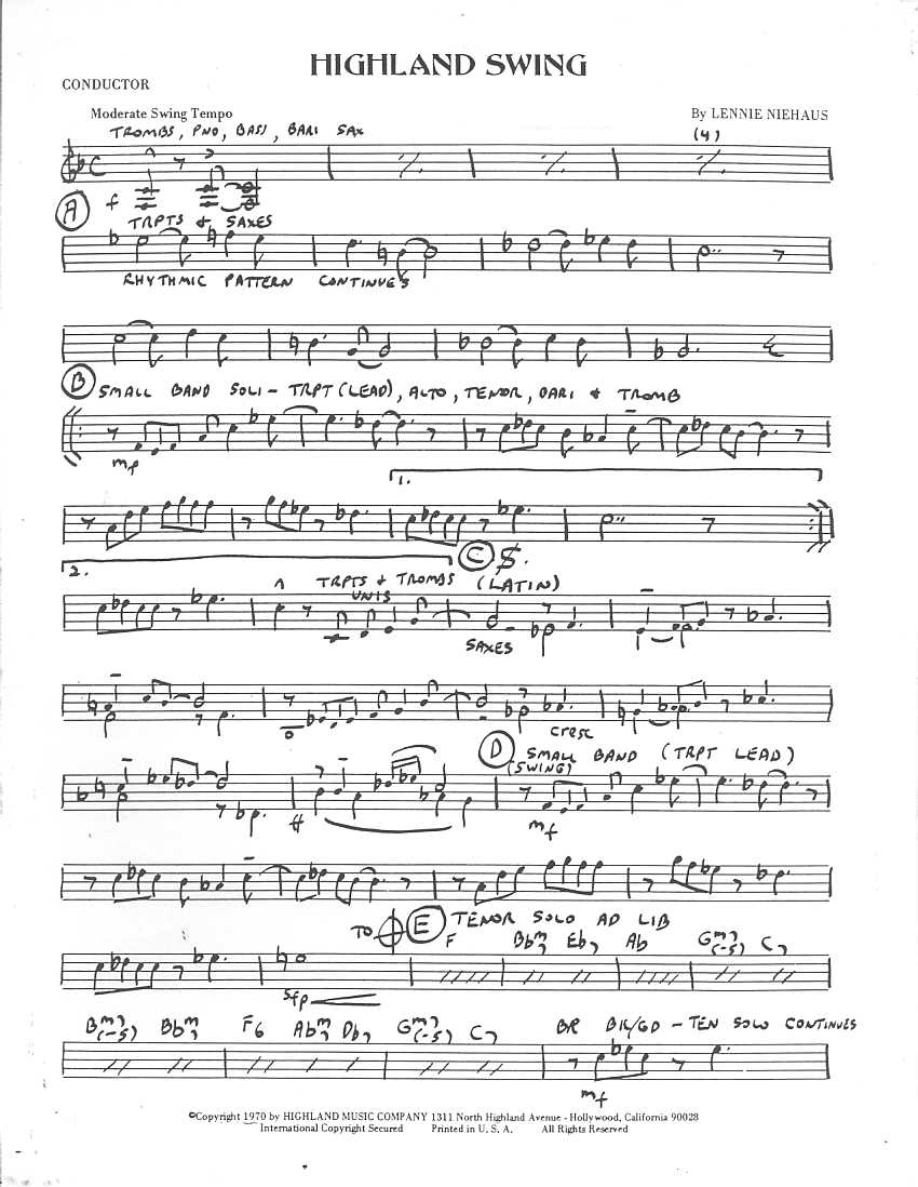
Highland Swing (L.Niehaus) sheet music preview

Highland Swing (L.Niehaus)

Composed by Lennie Niehaus

Arranged by Lennie Niehaus

  • Ensemble: Big Band
  • Pages: 37
  • Instruments (17): 1st Eb Alto Saxophone, 2nd Eb Alto Saxophone, 1st Bb Tenor Saxophone, 2nd Bb Tenor Saxophone, Eb Baritone Saxophone, 1st Trombone, 2nd Trombone, 3rd Trombone, 4th Trombone, 1st Bb Trumpet, 2nd Bb Trumpet, 3rd Bb Trumpet, 4th Bb Trumpet, Piano, Bass, Drums, Guitar
  • Difficulty: medium
  • Content: Individual Parts
  • Format: PDF Download (Instant)
  • Price: $24.99

Lennie Niehaus’s "Highland Swing" stands as a masterclass in West Coast cool jazz composition and arrangement, capturing the sophisticated, counterpoint-driven aesthetic that defined the California jazz scene of the 1950s. While Niehaus is widely celebrated for his pivotal work as an alto saxophonist and arranger with the Stan Kenton Orchestra—as well as his prolific film scoring career—his writing for standard big band instrumentation highlights a unique knack for marrying intricate bebop-derived line writing with crisp, economic, and highly accessible swing phrasing. "Highland Swing" bridges traditional swing vitality with the modern harmonic language of post-war jazz, offering an infectious blend of jaunty melodic contours and driving momentum that feels simultaneously timeless and distinctly mid-century. Driven by an energetic, buoyant medium-up swing feel, the composition opens with a captivating thematic statement that cleverly hints at modal or folk-like inflections within a strictly bebop-oriented framework. The harmonic landscape is rich yet transparent, utilizing Niehaus’s signature voice-leading techniques where the saxophones and brass weave interlocking countermelodies rather than relying on thick, congested block chords. The mood is relentlessly optimistic, swinging, and urbane, evoking the polished sophistication of a West Coast jazz club. The rhythm section functions as a lithe, interactive engine, where the drummer is encouraged to use crisp ride-cymbal patterns and sharp snare accents to support the horns without over-comping, while the bass line maintains a steady, walking harmonic foundation. Niehaus treats the 16-piece big band ensemble as an agile chamber jazz orchestra. The melody is initially introduced by the saxophones—led by the two alto players—before being answered and expanded by tightly coordinated brass interjections. A standout structural feature is the interplay between the trumpet and trombone sections, which frequently engage in call-and-response passages designed to test the band's articulation and dynamic control. The arrangement includes well-defined solo opportunities, allowing featured players in the horn section to stretch out over accessible blues-inflected changes. The shout chorus builds tension masterfully through sequential harmonic shifts and escalating rhythmic syncopation, ultimately releasing into a high-energy restatement of the main theme that demands absolute precision in tongue-and-finger coordination. Advanced high school, collegiate, and professional community big bands will find this 37-page chart an ideal vehicle for developing ensemble cohesion, stylistic purity, and articulation discipline. Because Niehaus avoids excessive volume demands in favor of linear clarity, the ensemble must rely on balance and intonation rather than sheer force to make an impact. This makes "Highland Swing" an exceptionally rewarding festival or concert selection, offering audiences a refreshing alternative to heavy, brass-dominated East Coast stormers while giving every section of the big band substantive, engaging musical material to execute. Conductors approaching "Highland Swing" should prioritize a light, buoyant swing articulation over heavy, accented downbeats, keeping eighth notes strictly in a triplet feel rather than overly dotted. The primary technical challenge lies in the nimble, bop-infused unison lines shared across the saxophone section; directors should isolate these passages during early rehearsals, practicing them slowly with a metronome to ensure uniform tongue placement and release. Brass players must exercise restraint during ensemble background figures, ensuring that dynamic levels remain a tier below the featured soloists or lead melody voices. Pay close attention to subtle dynamic markings and crescendos leading into structural transition points to maximize the dramatic impact of Niehaus's harmonic movement. No special mute effects are required, allowing the natural, bright acoustic blend of the standard big band to shine through cleanly. Q: What instruments and parts are included in this big band arrangement? A: This 37-page arrangement is scored for a standard 16-piece big band instrumentation, comprising Alto Sax 1, Alto Sax 2, Tenor Sax 1, Tenor Sax 2, Baritone Sax, 4 Trumpets, 4 Trombones, Piano, Guitar, Bass, and Drums. Q: What is the difficulty level of Lennie Niehaus's "Highland Swing"? A: This chart is graded as medium-advanced, making it ideal for accomplished high school ensembles, collegiate jazz bands, and professional community groups seeking to refine their swing articulation and section balance. Q: What musical style and historical era does this piece represent? A: "Highland Swing" exemplifies the West Coast cool jazz and bebop-inflected big band style of the 1950s, combining intricate, linear counterpoint with an infectious, driving swing groove. Q: What makes this specific arrangement unique compared to standard swing charts? A: Unlike heavier, brass-heavy arrangements, Niehaus utilizes transparent voicings, interlocking horn countermelodies, and sophisticated linear writing that treats the 16-piece ensemble like an agile chamber jazz orchestra. Q: What is the performance tempo and expected duration of this arrangement? A: The piece is set at a lively, medium-up swing tempo (approximately quarter note = 180–192 BPM) and typically runs for about 3.5 to 4 minutes in performance.

Questions and answers

What is included in the Highland Swing (L.Niehaus) PDF?
The verified current file contains a conductor score and individual parts across 37 pages.
How many instruments or parts are listed for Highland Swing (L.Niehaus)?
The verified instrumentation list contains 17 entries for this Big Band arrangement.
Who is credited for Highland Swing (L.Niehaus)?
Composer: Lennie Niehaus. Arranger: Lennie Niehaus.
What difficulty is listed for Highland Swing (L.Niehaus)?
The verified difficulty level is medium.
Can I preview Highland Swing (L.Niehaus) before buying?
Yes. The product page provides a preview generated from the current PDF file.
How is Highland Swing (L.Niehaus) delivered?
After successful payment, the digital PDF is made available for download. The displayed price is $24.99.

Musicians Also Search For

Highland Swing Lennie Niehaus PDFHighland Swing Lennie Niehaus sheet musicHighland Swing arranged by Lennie NiehausLennie Niehaus big band chartsLennie Niehaus jazz arrangements PDFHighland Swing Lennie Niehaus big band arrangementsHighland Swing big band arrangementsHighland Swing big band PDF downloadHighland Swing jazz sheet musicbig band sheet music downloadHighland Swing conductor score PDFHighland Swing individual parts downloadHighland Swing sheet music PDFbuy Highland Swing sheet musicdownload Highland Swing PDFHighland Swing jazz chartsbest Lennie Niehaus big band arrangementsHighland Swing printable sheet musicbig band repertoire PDF

All arrangements by Lennie Niehaus All Lennie Niehaus sheet music