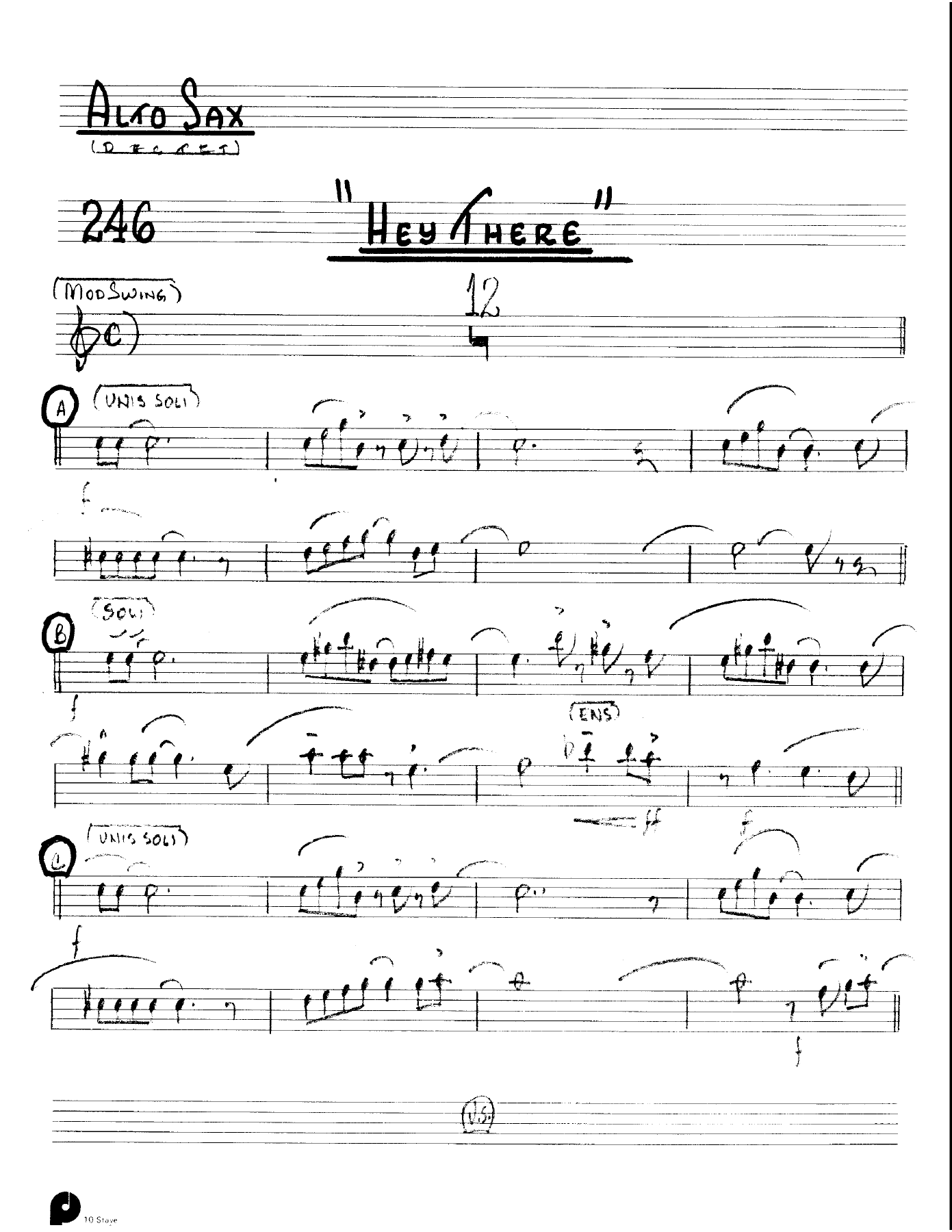
Hey There (Kenton Dectet #246)
Composed by Richard Adler
Arranged by Stan Kenton Dected 176
- Ensemble: Small Ensemble
- Style: Jazz Standard
- Pages: 26
- Difficulty: easy
- Content: Sheet Music
- Format: PDF Download (Instant)
- Price: $12.99
Richard Adler's timeless melody, "Hey There," originally composed for the 1954 Broadway musical *The Pajama Game*, quickly transcended its theatrical origins to become a beloved jazz standard. Its poignant lyrics and memorable, singable tune made it an instant hit, famously popularized by Rosemary Clooney and Johnnie Ray, and later embraced by countless jazz vocalists and instrumentalists. The song embodies the sophisticated yet accessible charm of mid-20th-century American popular music, a period when Broadway tunes frequently crossed over into the jazz repertoire, providing rich harmonic and melodic foundations for improvisation and arrangement. Its enduring appeal lies in its simple, heartfelt narrative and its capacity to evoke a sense of longing and tender romance, making it a staple in the Great American Songbook. This particular arrangement, "Hey There (Kenton Dectet #246)," by the Stan Kenton Dectet 176, reimagines the classic as a medium-slow swing ballad, imbued with the distinctive harmonic and textural palette characteristic of Kenton's smaller ensembles. Set primarily in the key of F major, the arrangement maintains a tender, introspective mood throughout, building subtly in intensity. The Kenton Dectet 176's approach is marked by its sophisticated voicings, often employing close harmony and rich, sometimes unexpected, chord extensions that add a layer of melancholic beauty without sacrificing the melody's inherent simplicity. Expect lush, interwoven lines that highlight the unique timbres of the small ensemble, creating a sound that is both intimate and expansive. The arrangement opens with a lyrical exposition of the melody, likely carried by a featured instrument (such as trumpet or alto saxophone) over a gently moving harmonic background provided by the rest of the dectet. This initial statement establishes the reflective character before transitioning into beautifully crafted soli sections where the ensemble's voices blend in intricate counterpoint. While this arrangement may not feature extended open solos, there are ample opportunities for expressive melodic interpretation within the composed lines. Technical challenges include maintaining precise balance and blend within the close voicings, executing subtle dynamic shifts, and articulating the swing feel with a relaxed yet consistent pulse. The reward for performers lies in navigating the Kenton Dectet 176's signature harmonic language and contributing to a cohesive, emotionally resonant performance that honors both Adler's original composition and Kenton's innovative arranging style. "Hey There (Kenton Dectet #246)" is ideally suited for college and advanced high school jazz ensembles, as well as community and professional small groups seeking a sophisticated and challenging ballad. The demands on individual musicians include strong sight-reading skills, an understanding of jazz ballad interpretation, and the ability to contribute to a refined ensemble sound. Its relatively compact form and rich musical content make it an excellent choice for concert programs where a moment of lyrical beauty and harmonic depth is desired, offering a refreshing contrast to more up-tempo or overtly virtuosic pieces. This arrangement of "Hey There" thrives on a medium-slow swing feel, approximately quarter note = 88-96 bpm. The conductor should emphasize a relaxed, lyrical approach to the swing eighth notes, avoiding any stiffness. Key technical challenges include achieving precise intonation and balance within the Kenton Dectet 176's characteristic close voicings, particularly in the brass and saxophone soli sections. Encourage musicians to listen across sections to blend their individual lines into a unified harmonic tapestry. Dynamic contrasts are crucial; practice the subtle swells and decays to enhance the emotional arc. There are no specific extended techniques like plungers or falls required, but expressive vibrato and nuanced articulation will elevate the performance. Rehearsal time should be dedicated to isolating challenging harmonic passages to ensure clarity and proper voice leading, focusing on the blend of the inner voices. Q: What instruments are included in this arrangement? A: This arrangement is for a small ensemble, specifically a dectet, reflecting the Stan Kenton Dectet 176's instrumentation. The exact instrumentation will be detailed on the score, but typically includes a combination of trumpets, trombones, saxophones, and a rhythm section. Q: What is the difficulty level of "Hey There (Kenton Dectet #246)"? A: This arrangement is considered advanced intermediate to advanced. It requires strong sight-reading, excellent intonation, and a mature understanding of jazz ballad interpretation and ensemble blend, making it suitable for college, advanced high school, and professional ensembles. Q: What musical style and historical context does this arrangement represent? A: This arrangement is a jazz standard in a medium-slow swing ballad style. It reimagines Richard Adler's classic 1954 Broadway tune through the sophisticated harmonic and textural lens of the Stan Kenton Dectet 176, showcasing mid-20th-century jazz arranging. Q: What makes this arrangement unique compared to other versions of "Hey There"? A: Its uniqueness stems from the distinctive arranging style of the Stan Kenton Dectet 176, characterized by lush, often close, harmonic voicings, intricate soli sections, and a sophisticated approach to a classic melody, rather than relying on extensive improvisation or a big band sound. Q: What is the typical performance duration of this arrangement? A: Given its medium-slow ballad tempo and 26-page length, a typical performance of "Hey There (Kenton Dectet #246)" would likely range from approximately 4 to 6 minutes, depending on the chosen tempo and any optional improvised sections.
Musicians Also Search For
Hey There Stan Kenton Dected 176 PDF • Hey There Stan Kenton Dected 176 sheet music • Hey There arranged by Stan Kenton Dected 176 • Stan Kenton Dected 176 small ensemble charts • Stan Kenton Dected 176 jazz arrangements PDF • Hey There Richard Adler sheet music • Hey There Richard Adler small ensemble arrangement • Richard Adler small ensemble charts • Hey There small ensemble arrangement • Hey There small ensemble PDF download • Hey There jazz ensemble sheet music • small ensemble sheet music instant download • Hey There sheet music with parts • Hey There Jazz Standard chart • Jazz Standard small ensemble arrangements • buy Hey There sheet music online • download Hey There PDF • Hey There jazz chart • best Stan Kenton Dected 176 small ensemble arrangements • Richard Adler songs arranged by Stan Kenton Dected 176 • Hey There printable sheet music • small ensemble repertoire PDF