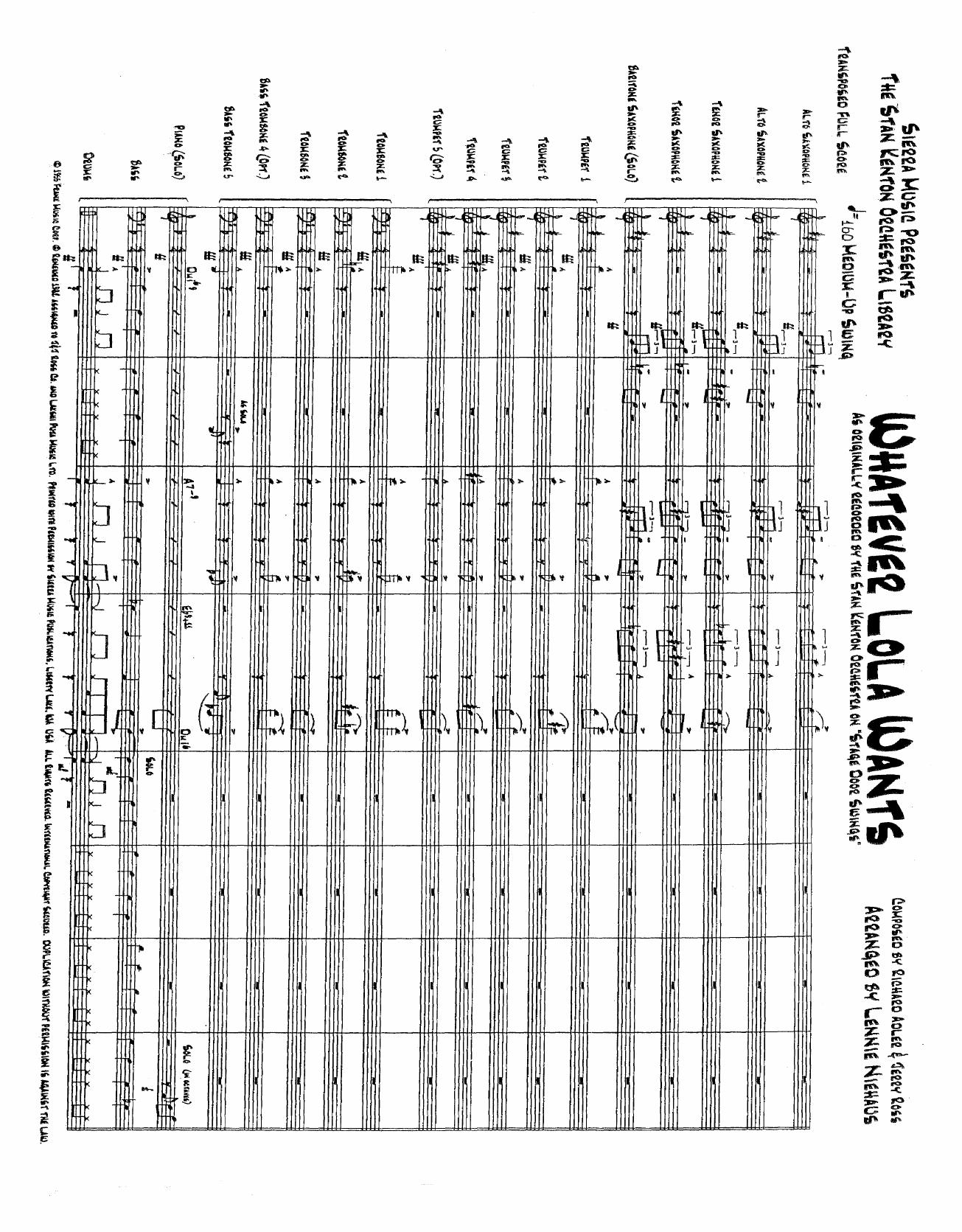
Whatever Lola Wants (L.Niehaus)
Composed by Richard Adler
Arranged by Lennie Niehaus
- Ensemble: Big Band
- Pages: 67
- Instruments (19): Alto Saxophone 1, Alto Saxophone 2, Tenor Saxophone 1, Tenor Saxophone 2, Baritone Saxophone (Solo), Trumpet 1, Trumpet 2, Trumpet 3, Trumpet 4, Trumpet 5, Trombone 1, Trombone 2, Trombone 3, Trombone 4, Bass Trombone 5, Guitar, Bass, Drums, Piano (Solo)
- Difficulty: advanced
- Content: Individual Parts
- Format: PDF Download (Instant)
- Price: $24.99
Originating from the 1955 hit Broadway musical *Damn Yankees* by Richard Adler and Jerry Ross, "Whatever Lola Wants" quickly transcended its theatrical roots to become a sultry, unmistakable jazz and pop standard, famously popularized by artists like Sarah Vaughan and Dinah Washington. The composition is built upon an irresistible, slinky Latin-infused groove intertwined with driving mid-tempo swing, capturing the seductive, high-stakes narrative of the original stage production. Its memorable chromatic descent and playful, confident melody make it an instant crowd-pleaser that bridges the gap between classic Broadway sophistication and mid-century cool jazz. Lennie Niehaus’s masterful big band arrangement injects the West Coast cool aesthetic into the chart while maintaining the inherent dramatic flair of the original theme. Known for his pristine counterpoint, immaculate reed voicings, and economical yet swinging harmonic structures—honed through his legendary tenure with the Stan Kenton Orchestra—Niehaus constructs an arrangement that relies on crisp articulation, subtle dynamic contrasts, and sophisticated chord extensions rather than sheer volume. The chart opens with an instantly recognizable vamp that sets a provocative mood before sliding effortlessly into a crisp, pocket-driven groove featuring interlocking horn countermelodies and tightly knit saxophone solis. Throughout the chart, the melodic weight is shared dynamically across the sections, with the alto and tenor saxophones taking charge of the primary thematic statements, underpinned by brass punches that punctuate the arrangement with precision and wit. The dynamic architecture builds toward a clever, tension-filled shout chorus that avoids heavy-handed bombastic playing in favor of sharp, linear interplay characteristic of Niehaus’s West Coast writing style. Solo opportunities are strategically integrated to allow a featured soloist—ideally an alto saxophonist or trumpeter—to stretch out over accessible, swinging changes that keep the audience engaged while highlighting individual improvisational flair. Advanced high school ensembles, collegiate jazz orchestras, and professional community big bands will find this chart to be an exceptionally rewarding addition to their repertoire. While it does not demand the blistering technical endurance of aggressive up-tempo bebop charts, it requires a high degree of stylistic maturity, impeccable rhythmic precision, and clean section blending to execute Niehaus's nuanced articulations properly. Directors will appreciate how the 67-page comprehensive score and 19-instrument breakdown provide transparent roadmap guidance, making it an ideal vehicle for teaching stylistic consistency, ensemble breathing, and subtle theatricality within a straight-ahead jazz framework. Success with this Lennie Niehaus arrangement hinges on nailing the delicate balance between the sultry Latin-inflected opening groove and the relaxed, driving swing sections. The tempo should be kept steady and unhurried; rushing the pulse destroys the inherent swagger of the chart. Directors must insist on uniform articulation across all sections, particularly the short, punchy accented notes that pepper the brass background figures. Saxophone sections should focus on a dry, light tone quality reminiscent of the Cool School, avoiding excessive vibrato so that the close voicings speak with absolute clarity. The rhythm section is the engine here: the bassist should walk with a buoyant, forward-moving feel, while the drummer maintains a crisp, understated ride cymbal pattern that locks tightly with the piano's comping syncopations. During the shout chorus, resist the urge to over-blow; let Niehaus’s tightly crafted dynamic swells do the work, ensuring the lead trumpet stays on top of the texture without forcing the tone. Q: What instruments and parts are included in this big band arrangement? A: This arrangement is scored for a standard 19-instrument big band instrumentation, featuring Alto Saxophone 1, Alto Saxophone 2, Tenor Saxophone 1, Tenor Saxophone 2, Baritone Saxophone, four trumpets, four trombones, guitar, piano, bass, drums, and a comprehensive conductor score spanning 67 total pages. Q: What is the difficulty level of this chart? A: This arrangement is well-suited for advanced high school, collegiate, and professional jazz bands, sitting comfortably at an intermediate-to-advanced difficulty level due to its demand for precise stylistic articulation rather than extreme technical endurance. Q: What is the musical style and historical context of "Whatever Lola Wants"? A: Originally composed by Richard Adler for the 1955 Broadway musical *Damn Yankees*, this arrangement refashions the famous theatrical tune into a cool jazz vehicle, blending a seductive Latin groove with mid-century West Coast swing sensibilities. Q: What makes Lennie Niehaus's treatment of this standard unique? A: Niehaus avoids heavy, bombastic big band clichés, instead utilizing immaculate reed voicings, linear counterpoint, and clever dynamic interplay that highlight clarity, wit, and sophisticated West Coast cool harmony. Q: What is the recommended performance tempo and approximate duration? A: The chart is designed to be played at a medium, unhurried tempo with a strong groove feel, typically resulting in a performance duration of around 3 to 4 minutes depending on solo choruses.
Questions and answers
- What is included in the Whatever Lola Wants (L.Niehaus) PDF?
- The verified current file contains a conductor score and individual parts across 67 pages.
- How many instruments or parts are listed for Whatever Lola Wants (L.Niehaus)?
- The verified instrumentation list contains 19 entries for this Big Band arrangement.
- Who is credited for Whatever Lola Wants (L.Niehaus)?
- Composer: Richard Adler. Arranger: Lennie Niehaus.
- What difficulty is listed for Whatever Lola Wants (L.Niehaus)?
- The verified difficulty level is advanced.
- Can I preview Whatever Lola Wants (L.Niehaus) before buying?
- Yes. The product page provides a preview generated from the current PDF file.
- How is Whatever Lola Wants (L.Niehaus) delivered?
- After successful payment, the digital PDF is made available for download. The displayed price is $24.99.
Musicians Also Search For
Whatever Lola Wants Lennie Niehaus PDF • Whatever Lola Wants Lennie Niehaus sheet music • Whatever Lola Wants arranged by Lennie Niehaus • Lennie Niehaus big band charts • Lennie Niehaus jazz arrangements PDF • Whatever Lola Wants Richard Adler sheet music • Whatever Lola Wants Richard Adler big band arrangements • Richard Adler big band charts • Whatever Lola Wants big band arrangements • Whatever Lola Wants big band PDF download • Whatever Lola Wants jazz sheet music • big band sheet music download • Whatever Lola Wants conductor score PDF • Whatever Lola Wants individual parts download • Whatever Lola Wants sheet music PDF • buy Whatever Lola Wants sheet music • download Whatever Lola Wants PDF • Whatever Lola Wants jazz charts • best Lennie Niehaus big band arrangements • Richard Adler arranged by Lennie Niehaus • Whatever Lola Wants printable sheet music • big band repertoire PDF