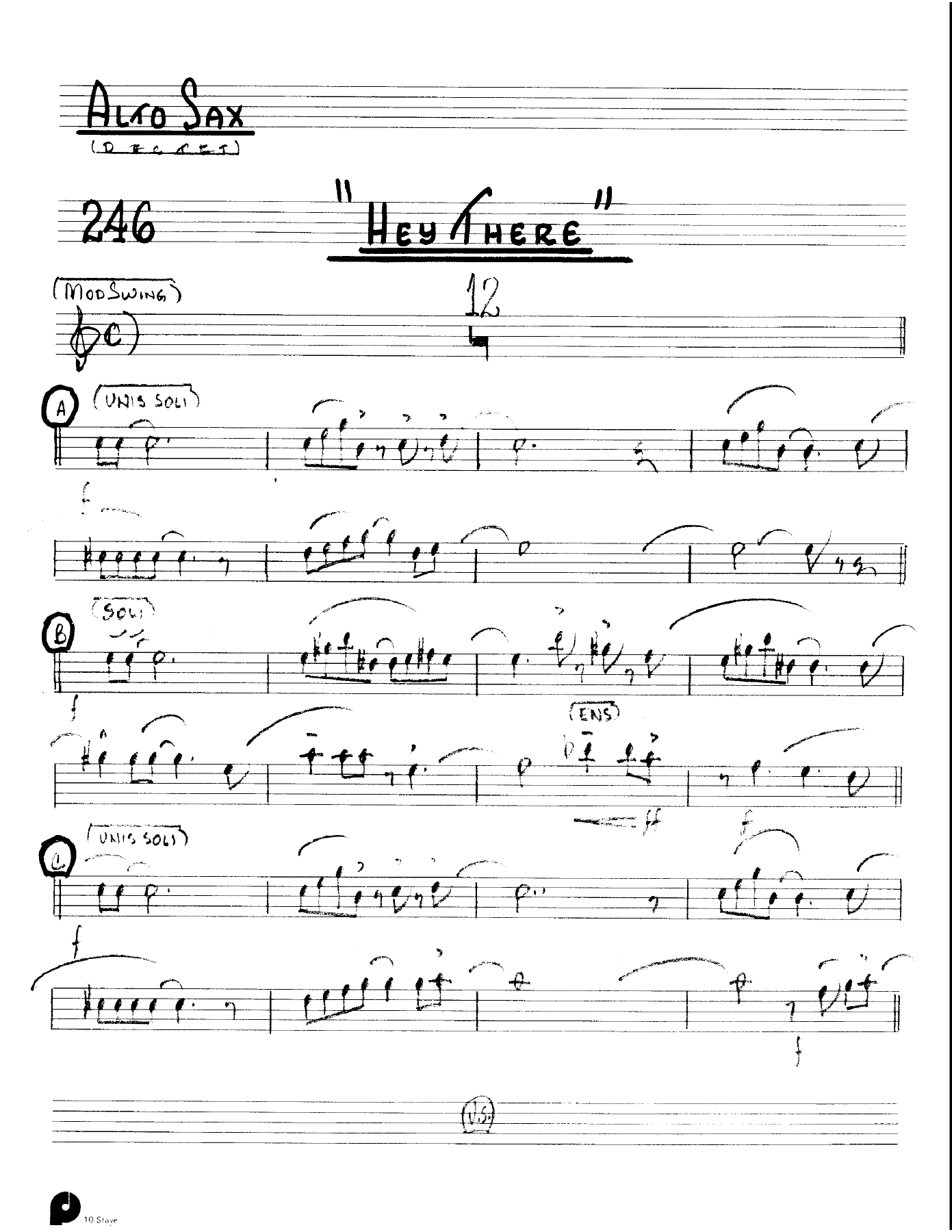
Hey There (Kenton Dectet #246) sheet music preview

Hey There (Kenton Dectet #246)

Composed by Richard Adler

Arranged by Kenton Dectet #246

  • Ensemble: Small Ensemble
  • Style: Musical Theatre
  • Pages: 26
  • Instruments (9): Alto Sax, Tenor Sax, Baritone Sax, Trumpet 1, Trumpet 2, Trombone, Piano, Bass, Drums
  • Difficulty: easy
  • Content: Individual Parts
  • Format: PDF Download (Instant)
  • Price: $12.99

"Hey There," a timeless ballad from the 1954 Broadway musical *The Pajama Game*, stands as a quintessential piece of mid-20th-century American musical theatre. Composed by Richard Adler and Jerry Ross, the song was originally introduced by John Raitt in his role as Sid Sorokin, an introspective moment where the character grapples with unspoken affection. Its melodic smoothness, sincere lyrics, and satisfying chord progressions are characteristic of the Rodgers and Hammerstein era, which emphasized character-driven songs and lush harmonies. Beyond the stage, "Hey There" quickly achieved widespread fame, most notably through Rosemary Clooney's chart-topping rendition in 1954, which solidified its status as a popular standard and earned it a place in the Grammy Hall of Fame. This enduring appeal has led to countless interpretations across various genres, cementing its place in the Great American Songbook. This arrangement by Kenton Dectet #246 reimagines the classic musical theatre ballad as a sophisticated, medium-swing jazz vehicle, set in a comfortable, accessible key. The mood is one of elegant introspection, evolving into a gently swinging, warm energy. The arrangement opens with a lyrical, harmonically rich statement of the melody, immediately establishing a sophisticated yet approachable sound. The Kenton Dectet #246 approach is characterized by its meticulous attention to voicing, creating a full and resonant sound despite the small ensemble format. Expect carefully crafted counter-melodies and inner-voice movement that add depth without obscuring the original melodic intent. The arranger's distinctive style shines through in the thoughtful interplay between the horns, avoiding dense textures in favor of clarity and melodic conversation. The melody is primarily carried by the lead horn, often supported by lush, close-voiced harmonies from the other ensemble members. While specific featured solos are indicated, the ensemble sections are designed to be rewarding for all players, with engaging lines and well-constructed soli passages that showcase the collective strength. Technical challenges are moderate, focusing on blend, balance, and maintaining a consistent, relaxed swing feel. The reward lies in achieving a cohesive, polished sound that honors the song's melodic beauty while infusing it with a tasteful jazz sensibility. This arrangement is ideally suited for college and advanced high school jazz ensembles, as well as community jazz groups seeking a polished, articulate small ensemble chart. The demands on individual players are reasonable, allowing for focus on musicality and ensemble cohesion rather than extreme technical virtuosity. Its detailed voicings and clear structure make it an excellent teaching tool for developing ensemble blend, intonation, and stylistic interpretation within a small group setting. The 26 pages of score and parts provide ample material for a comprehensive and rewarding performance experience. Conductors should emphasize a relaxed, medium-swing feel from the outset, ensuring the rhythm section establishes a solid, unhurried groove in 4/4. Pay close attention to dynamics, particularly in the opening melodic statements, to allow the rich harmonies to speak clearly. Intonation and blend are paramount in the horn voicings; encourage players to listen across the section and adjust accordingly. Technical challenges include achieving precise attacks and releases, especially in sustained chords, and navigating the subtle rhythmic nuances of the swing eighth notes. Rehearsal time should be dedicated to balancing the soli sections, ensuring each voice contributes without overpowering the lead. No special techniques like plunger mutes or falls are explicitly required, allowing the focus to remain on pure tone and ensemble precision. Q: What instruments are included in this arrangement? A: This small ensemble arrangement includes parts for a standard jazz dectet instrumentation, typically comprising a rhythm section (piano, bass, drums) and a horn section (e.g., trumpet, alto sax, tenor sax, trombone, baritone sax), with specific voicings for each. Q: What is the difficulty level of this arrangement? A: This arrangement is considered to be of an intermediate difficulty level, suitable for college and advanced high school jazz ensembles, as well as proficient community groups. Q: What musical style and historical context does "Hey There" represent in this arrangement? A: "Hey There" is a classic show tune from the 1954 musical *The Pajama Game*, and this arrangement presents it in a sophisticated, medium-swing jazz style, reflecting the era's transition of popular songs into the jazz repertoire. Q: What makes Kenton Dectet #246's arrangement of "Hey There" unique? A: Kenton Dectet #246's treatment is distinguished by its elegant, close-voiced horn harmonies, carefully crafted counter-melodies, and a focus on ensemble blend and musicality, offering a fresh yet respectful interpretation of the original. Q: What is the approximate performance duration or tempo of this piece? A: This arrangement is set at a medium-swing tempo, allowing for a comfortable and expressive performance, with an approximate duration that will vary slightly based on solo lengths and conductor interpretation.

Questions and answers

What is included in the Hey There (Kenton Dectet #246) PDF?
The verified current file contains individual parts across 26 pages.
How many instruments or parts are listed for Hey There (Kenton Dectet #246)?
The verified instrumentation list contains 9 entries for this Small Ensemble arrangement.
Who is credited for Hey There (Kenton Dectet #246)?
Composer: Richard Adler. Arranger: Kenton Dectet #246.
What difficulty is listed for Hey There (Kenton Dectet #246)?
The verified difficulty level is easy.
What style is listed for Hey There (Kenton Dectet #246)?
The catalog lists the style as Musical Theatre.
Can I preview Hey There (Kenton Dectet #246) before buying?
Yes. The product page provides a preview generated from the current PDF file.
How is Hey There (Kenton Dectet #246) delivered?
After successful payment, the digital PDF is made available for download. The displayed price is $12.99.

Musicians Also Search For

Hey There Kenton Dectet #246 PDFHey There Kenton Dectet #246 sheet musicHey There arranged by Kenton Dectet #246Kenton Dectet #246 small ensemble chartsKenton Dectet #246 jazz arrangements PDFHey There Richard Adler sheet musicHey There Richard Adler small ensemble arrangementsRichard Adler small ensemble chartsHey There small ensemble arrangementsHey There small ensemble PDF downloadHey There jazz sheet musicsmall ensemble sheet music downloadHey There individual parts downloadHey There sheet music PDFHey There Musical Theatre chartsMusical Theatre small ensemble arrangementsbuy Hey There sheet musicdownload Hey There PDFHey There jazz chartsbest Kenton Dectet #246 small ensemble arrangementsRichard Adler arranged by Kenton Dectet #246Hey There printable sheet musicsmall ensemble repertoire PDF

All arrangements by Kenton Dectet #246 All Richard Adler sheet music