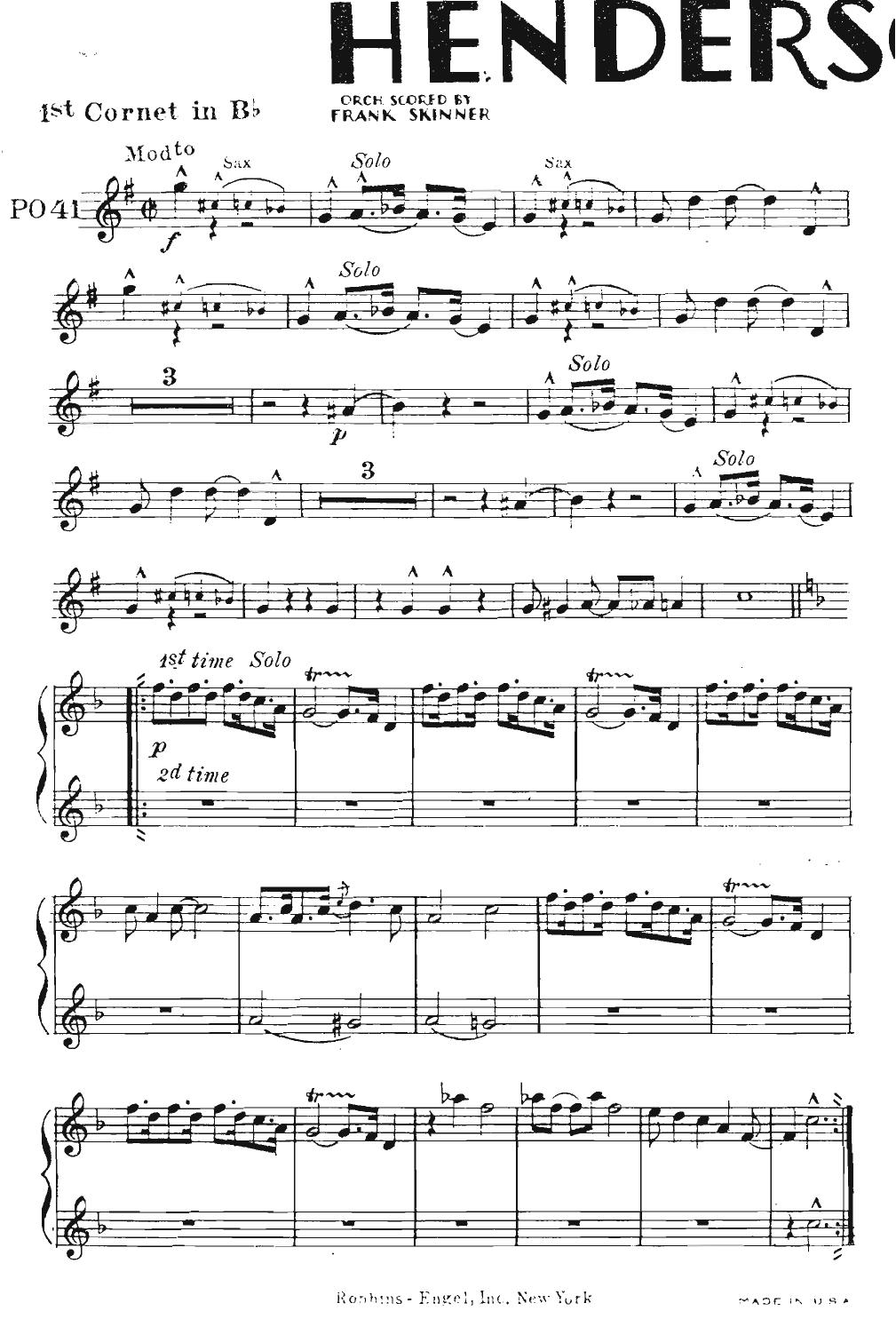
Henderson Stomp (F.Henderson)
Composed by Fletcher Henderson
Arranged by Fletcher Henderson
- Ensemble: Big Band
- Pages: 23
- Instruments (11): 1st Cornet in Bb, 2nd Cornet in Bb, Trombone, 1st Saxophone Eb Alto, 2nd Saxophone (Bb Tenor), 3rd Saxophone Eb Alto, Banjo, Bass, Drums, Piano, 1st Violin
- Difficulty: medium
- Content: Individual Parts
- Format: PDF Download (Instant)
- Price: $24.99
Fletcher Henderson’s pioneering work in the 1920s and 1930s laid the structural blueprint for the entire swing era, transforming jazz from a collective polyphonic folk expression into a sophisticated, section-oriented orchestral art. Recorded at the height of the Henderson Orchestra's creative peak—an era when luminaries like Louis Armstrong and later Coleman Hawkins defined the band's ferocious, swinging identity—"Henderson Stomp" stands as a masterclass in early big band architecture. This composition captures the transition from New Orleans collective improvisation to the tightly disciplined, sectional interplay that would soon be popularized nationwide by Benny Goodman (who famously bought many of Henderson's arrangements). It represents a vital historical link between hot jazz and the polished swing phenomenon of the 1930s. Driven by a relentless, infectious medium-up tempo swing feel, "Henderson Stomp" exudes a joyful, high-octane energy characteristic of Harlem’s dynamic dance halls. The musical character is defined by bright brass stabs, buoyant reed counterlines, and an irrepressible rhythmic bounce that demands precision and stamina. The mood shifts masterfully between driving tutti ensemble passages and relaxed, blues-infused transitional sections, evoking the sweat, glamour, and unbridled optimism of the late-1920s jazz age. The harmonic language relies heavily on early swing extensions, riff-based development, and call-and-response patterns that keep both the performers and listeners utterly engaged from the downbeat. True to Henderson’s signature arranging style—developed alongside his brilliant brother Horace and later star reedman Don Redman—this chart relies on sectional stratification rather than dense, modern block chords. The arrangement brilliantly deploys the 12-instrument ensemble by pitting the trumpets and trombones against a nimble reed section in sharp, conversational counterpoint. Soli sections feature prominently, requiring the saxophones and brass to blend with an intimate, chamber-like unity before expanding into a roaring, high-energy shout chorus. Henderson’s genius lies in how he paces the arrangement, alternating between transparent rhythm-section-backed interludes and thick, harmonized ensemble choruses that maximize the sonic weight of a relatively compact big band lineup. Performing this arrangement successfully requires crisp articulation, an authentic vintage swing phrasing concept, and agile execution across all sections. The melody is shared fluidly between the brass and reed sections, demanding equal proficiency in punchy brass accents and flowing, scalar saxophone runs. Featured solo spaces allow modern improvisers to stretch out over traditional changes, while the rhythm section must maintain an unwavering, driving four-to-the-bar pulse with a lightly feathered bass drum. Advanced high school, collegiate, and professional community big bands will find this chart deeply rewarding; it serves as an exceptional educational vehicle for teaching students how to swing with historical authenticity while offering enough subtle stylistic nuance to challenge seasoned professionals. Achieving an authentic reading of "Henderson Stomp" requires meticulous attention to articulation and stylistic historical context. The tempo should be brisk and buoyant—never rushed—allowing the eighth notes to sit comfortably with a relaxed, triplet-based swing feel rather than an even, modern bebop interpretation. The primary technical challenge lies in the execution of short, crisp brass accents (staccato tongues) contrasted against the flowing, legato lines of the reed section. Conductors should insist that the rhythm section keeps the quarter-note pulse light and driving, avoiding heavy downbeat accentuation that can bog down 1920s-style swing. Trumpets and trombones should utilize traditional cup or straight mutes where indicated to capture the authentic timbre of the original recordings, and players should incorporate stylistic devices such as subtle doits and falls naturally without over-exaggerating them. Rehearsal should begin by separating the ensemble into rhythm, reed, and brass subsections to lock in the intricate call-and-response figures before merging them at full tempo. Q: What instruments and parts are included in this arrangement? A: This 23-page big band chart is scored for a 12-instrument ensemble, specifically featuring three trumpet parts, two trombone parts, a comprehensive reed section, and a full rhythm section (piano, bass, and drums). Q: What is the difficulty level of this arrangement? A: It is graded as medium-advanced, making it ideal for high school jazz ensembles with strong section players, college bands, and professional community big bands looking for authentic swing repertoire. Q: What is the historical style and context of "Henderson Stomp"? A: Composed and recorded during the late 1920s by Fletcher Henderson, this piece represents the foundational transition era from early hot jazz to the structured, section-based swing arrangements that dominated the following decade. Q: What makes this specific arrangement unique? A: It showcases Fletcher Henderson's signature compositional style, utilizing clever call-and-response mechanics, sectional stratification, and transparent harmonic textures that highlight the interplay between brass and reeds. Q: What is the recommended performance duration and tempo feel? A: The arrangement is designed for a medium-up swing tempo (around 180-200 BPM) and typically runs between 3 to 4 minutes, depending on the number of improvised solo choruses taken.
Questions and answers
- What is included in the Henderson Stomp (F.Henderson) PDF?
- The verified current file contains individual parts across 23 pages.
- How many instruments or parts are listed for Henderson Stomp (F.Henderson)?
- The verified instrumentation list contains 11 entries for this Big Band arrangement.
- Who is credited for Henderson Stomp (F.Henderson)?
- Composer: Fletcher Henderson. Arranger: Fletcher Henderson.
- What difficulty is listed for Henderson Stomp (F.Henderson)?
- The verified difficulty level is medium.
- Can I preview Henderson Stomp (F.Henderson) before buying?
- Yes. The product page provides a preview generated from the current PDF file.
- How is Henderson Stomp (F.Henderson) delivered?
- After successful payment, the digital PDF is made available for download. The displayed price is $24.99.
Musicians Also Search For
Henderson Stomp Fletcher Henderson PDF • Henderson Stomp Fletcher Henderson sheet music • Henderson Stomp arranged by Fletcher Henderson • Fletcher Henderson big band charts • Fletcher Henderson jazz arrangements PDF • Henderson Stomp Fletcher Henderson big band arrangements • Henderson Stomp big band arrangements • Henderson Stomp big band PDF download • Henderson Stomp jazz sheet music • big band sheet music download • Henderson Stomp individual parts download • Henderson Stomp sheet music PDF • buy Henderson Stomp sheet music • download Henderson Stomp PDF • Henderson Stomp jazz charts • best Fletcher Henderson big band arrangements • Henderson Stomp printable sheet music • big band repertoire PDF