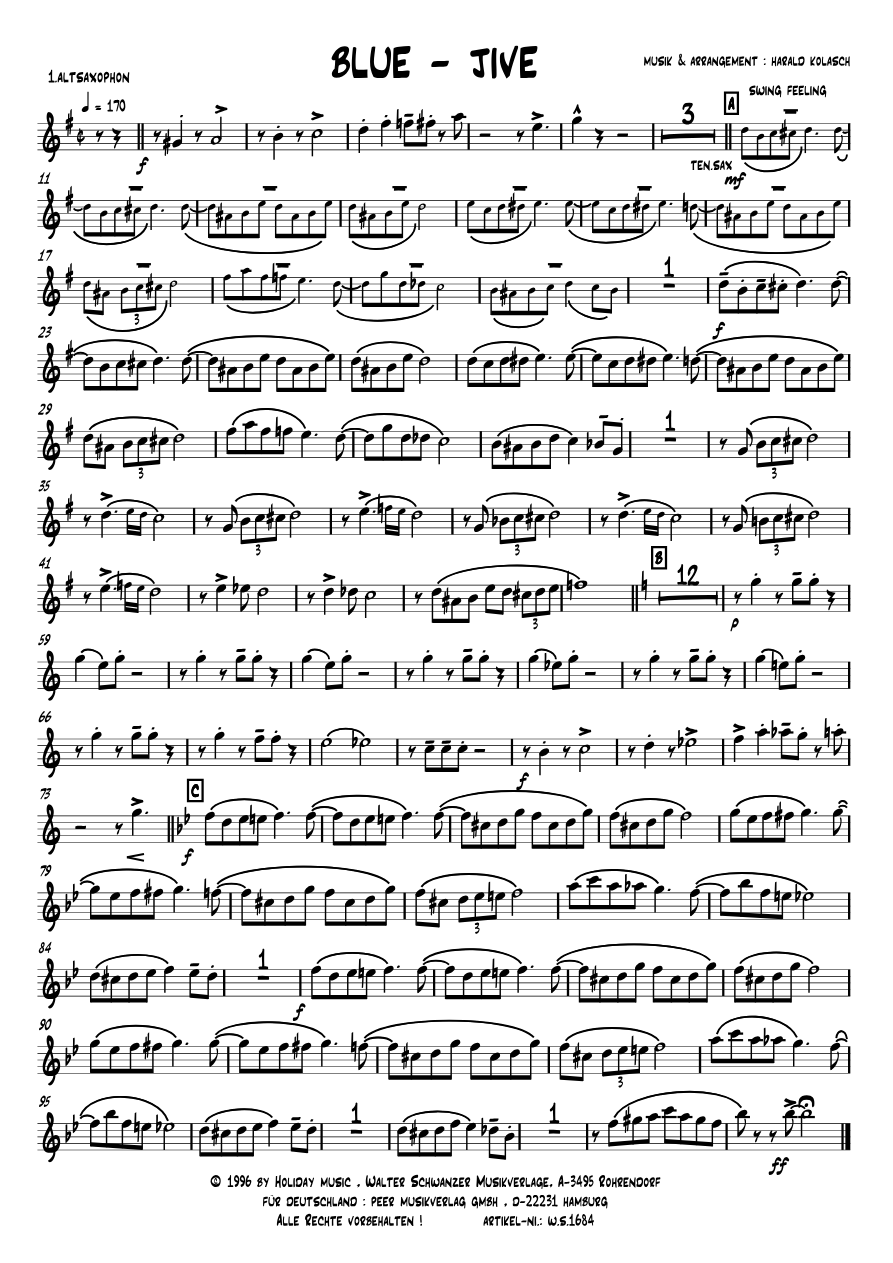
Blue Jive (H.Kolasch) sheet music preview

Blue Jive (H.Kolasch)

Composed by A. Borodin/H. Kolasch

Arranged by H. Kolasch

  • Ensemble: Big Band Dance
  • Style: Jive
  • Pages: 17
  • Instruments (14): Alto Saxophone 1, Alto Saxophone 2, Tenor Saxophone 1, Tenor Saxophone 2, Baritone Saxophone, Trumpet 1, Trumpet 2, Trumpet 3, Trombone 1, Trombone 2, Piano / Organ, Guitar, Bass, Drum Set
  • Difficulty: easy
  • Content: Individual Parts
  • Format: PDF Download (Instant)
  • Price: $24.99

"Blue Jive" by H. Kolasch is a vibrant big band arrangement that reimagines themes from Alexander Borodin's iconic Polovtsian Dances, injecting them with the irrepressible energy of 1940s jive. While Borodin's original work, composed in the late 19th century as part of his opera *Prince Igor*, is a cornerstone of classical romanticism, Kolasch's treatment catapults these familiar melodies into the swing era. The original Polovtsian Dances are renowned for their exoticism, driving rhythms, and soaring melodic lines, qualities that lend themselves remarkably well to a dance-oriented big band setting. This arrangement isn't merely a transcription; it's a creative transformation that honors Borodin's thematic material while firmly establishing it within the lexicon of jive and swing, a style popularized by bands like Louis Jordan's Tympany Five and countless jump blues ensembles of the post-war era. Musically, "Blue Jive" is an up-tempo, driving piece characterized by its infectious medium-fast jive feel in 4/4. The primary key is C minor, offering a rich, slightly melancholic yet undeniably propulsive harmonic landscape, though it frequently modulates to related keys for dynamic contrast. The mood is one of exuberant celebration, designed to evoke the dance halls and energetic performances of the jive era. Kolasch's distinctive arranging style shines through in his clever use of call-and-response figures between sections, particularly the brass and saxophones, and his ability to maintain a relentless forward momentum. Expect tight, punchy brass voicings, often featuring harmon-muted trumpets for a classic big band sound, contrasted with smooth, harmonized saxophone soli sections that carry much of the melodic development. H. Kolasch's approach to "Blue Jive" is marked by an intelligent blend of orchestral grandeur and swing-era grit. He masterfully fragments Borodin's sweeping melodies, reassembling them with syncopated rhythms and blues-inflected harmonies typical of jive. The arrangement features prominent melodic statements initially carried by the alto saxophone section, later expanding to full ensemble soli. There are ample opportunities for featured soloists, particularly in the trumpet and tenor saxophone chairs, with changes provided over a driving rhythm section accompaniment. A powerful shout chorus builds dynamically towards the piece's climax, showcasing the full power and precision of the big band. Technical challenges include maintaining the relentless up-tempo feel, precise articulation in the brass, and executing the intricate saxophone soli lines with clarity and blend. The reward lies in the sheer joy of performing such a high-energy, historically rich, and undeniably fun piece. This arrangement is ideally suited for college-level big bands, advanced community ensembles, and professional groups looking for a challenging yet highly engaging addition to their repertoire. Its blend of classical familiarity and jazz vitality makes it a crowd-pleaser and a rewarding performance experience. "Blue Jive" demands a precise and energetic approach to truly capture its jive spirit. The tempo should be a consistent medium-fast, around 180-200 BPM, with a strong emphasis on the "two" and "four" of the swing feel. Conductors should encourage a driving rhythm section, particularly the drummer, to lay down a solid, unflagging groove. Brass players must focus on crisp, unified articulation, especially in the punchy tutti sections and call-and-response figures. Trumpet players will need to be comfortable with harmon mutes, ensuring a consistent tone and projection. Saxophone sections should strive for a blended, unified sound during the soli passages, paying close attention to phrasing and dynamic shaping. Rehearsal time should be dedicated to locking in the ensemble's rhythmic precision and ensuring the dynamic contrasts are clearly defined, from the subtle build-ups to the full-throttle shout chorus. Soloists should be encouraged to embrace the bluesy, energetic aesthetic of jive, utilizing rhythmic propulsion and melodic invention. Q: What instruments and parts are included in the "Blue Jive" arrangement? A: This arrangement is scored for a standard 17-piece big band, including Alto Saxophone 1, Alto Saxophone 2, Tenor Saxophone 1, Tenor Saxophone 2, Baritone Saxophone, Trumpet 1, Trumpet 2, Trumpet 3, Trumpet 4, Trombone 1, Trombone 2, Trombone 3, Trombone 4, Piano, Bass, Drums, and Guitar. Q: What is the difficulty level of "Blue Jive" for a jazz ensemble? A: "Blue Jive" is considered an advanced-intermediate to advanced level arrangement, suitable for college-level big bands, advanced community ensembles, and professional groups due to its up-tempo demands, intricate soli passages, and precise articulation requirements. Q: What is the musical style and historical context of "Blue Jive"? A: "Blue Jive" is an energetic jive arrangement that reinterprets themes from Alexander Borodin's 19th-century classical work, the Polovtsian Dances, infusing them with the driving, dance-oriented swing feel popular in the 1940s. Q: What makes H. Kolasch's arrangement of "Blue Jive" unique? A: Kolasch's arrangement is unique for its clever transformation of classical themes into a vibrant jive setting, featuring tight brass voicings, intricate saxophone soli, prominent solo opportunities, and a powerful shout chorus that maintains the melodic integrity of Borodin while fully embracing swing-era aesthetics. Q: What is the typical performance duration and tempo for "Blue Jive"? A: The typical performance duration for "Blue Jive" is approximately 3-4 minutes, performed at a medium-fast jive tempo, generally in the range of 180-200 beats per minute.

Musicians Also Search For

Blue Jive H. Kolasch PDFBlue Jive H. Kolasch sheet musicBlue Jive arranged by H. KolaschH. Kolasch big band dance chartsH. Kolasch jazz arrangements PDFBlue Jive A. Borodin/H. Kolasch sheet musicBlue Jive A. Borodin/H. Kolasch big band dance arrangementA. Borodin/H. Kolasch big band dance chartsBlue Jive big band dance arrangementBlue Jive big band dance PDF downloadBlue Jive jazz ensemble sheet musicbig band dance sheet music instant downloadBlue Jive individual parts downloadBlue Jive sheet music with partsBlue Jive Jive chartJive big band dance arrangementsbuy Blue Jive sheet music onlinedownload Blue Jive PDFBlue Jive jazz chartbest H. Kolasch big band dance arrangementsA. Borodin/H. Kolasch songs arranged by H. KolaschBlue Jive printable sheet musicbig band dance repertoire PDF

All arrangements by H. Kolasch All A. Borodin/H. Kolasch sheet music