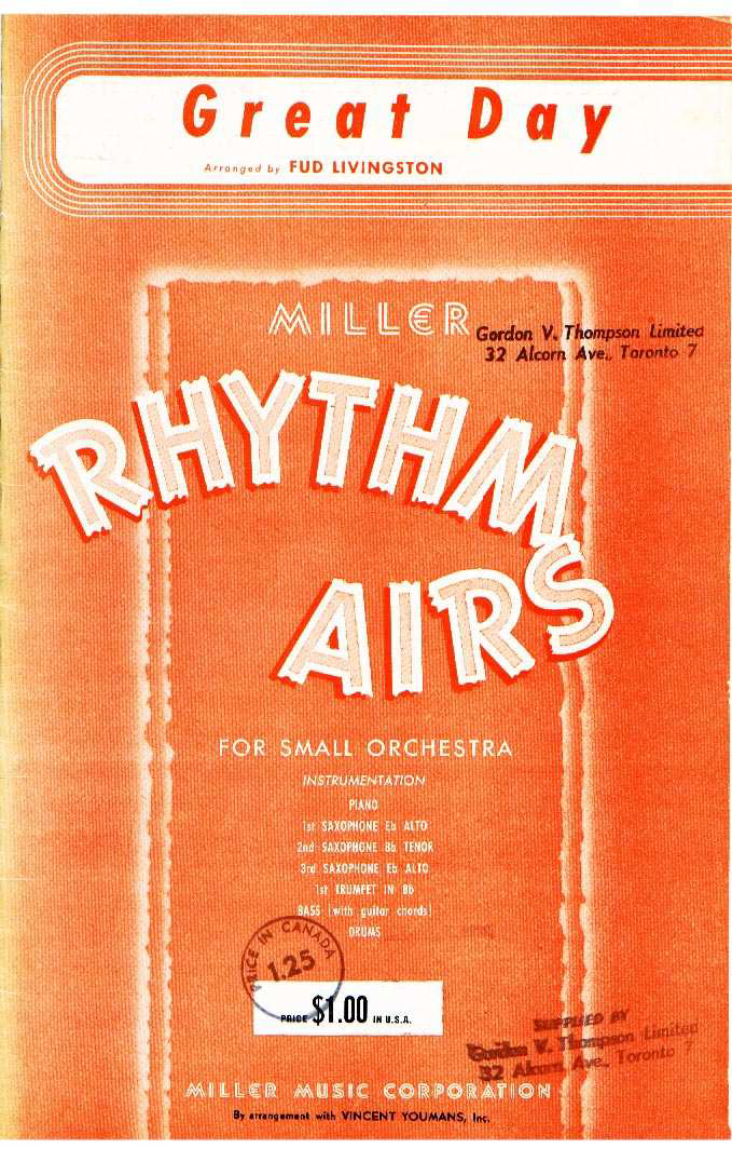
Great Day (F.Livingston) sheet music preview

Great Day (F.Livingston)

Composed by Vincent Youmans

Arranged by Fud Livingston

  • Ensemble: Small Ensemble
  • Style: Jazz Standard
  • Pages: 20
  • Difficulty: easy
  • Content: Sheet Music
  • Format: PDF Download (Instant)
  • Price: $12.99

"Great Day," composed by Vincent Youmans, emerged from the vibrant Broadway scene of 1929, a period marked by the efflorescence of American musical theater and the burgeoning jazz age. Originally featured in a Broadway musical of the same name, which premiered on October 17, 1929, the song quickly transcended the show's relatively short run to become a beloved jazz standard. Youmans, a prolific composer known for hits like "Tea for Two" and "More Than You Know," crafted a melody that perfectly captured the optimism and rhythmic sophistication of the era. While the original stage production itself was not a resounding success, the enduring quality of its songs, particularly "Great Day," cemented its place in the Great American Songbook, making it a favorite for countless vocalists and instrumentalists throughout jazz history. Its timeless appeal lies in its memorable melodic contours and its inherent adaptability to various jazz interpretations. This arrangement of "Great Day" by Fud Livingston presents the piece as a medium swing, firmly rooted in the classic small ensemble jazz style of the late 1920s and early 1930s. The musical character is bright and effervescent, evoking a sense of joyful anticipation and rhythmic buoyancy. The primary key is often C major or a closely related key, allowing for a comfortable and idiomatic feel for the ensemble. The mood is inherently uplifting and energetic, designed to get feet tapping and spirits soaring. Livingston's treatment emphasizes crisp articulation and a cohesive ensemble sound, characteristic of the "hot jazz" and early swing bands he was associated with. Fud Livingston, a highly respected clarinetist, saxophonist, and arranger from the Jazz Age, was renowned for his sophisticated yet swinging charts for small and large ensembles. In this arrangement, Livingston's distinctive approach is evident in his masterful use of counterpoint and his intelligent voicings, which provide a rich harmonic texture without sacrificing clarity. Expect tightly knit soli sections that showcase the ensemble's precision, often featuring interwoven lines between the reeds and brass. Livingston frequently employed sophisticated harmonic extensions and passing chords that add depth and color to the standard progression, a hallmark of his arranging style. While specific shout choruses might be more characteristic of larger big band arrangements, Livingston's small ensemble work often builds intensity through dynamic layering and rhythmic interplay, culminating in exciting, full-ensemble passages that feel like a miniature shout. His arrangements are known for their balance of written material and opportunities for improvisation, reflecting the era's emphasis on both ensemble precision and individual expression. The melody is typically carried by a lead alto saxophone or trumpet, often with harmonized backing from other horns. This arrangement provides ample space for featured improvised solos over the chord changes, offering a rewarding challenge for intermediate to advanced players. Technical challenges include navigating Livingston's often intricate melodic lines and rhythmic figures, as well as maintaining a consistent, driving swing feel throughout. The reward lies in performing a historically authentic and musically engaging piece that showcases both individual talent and collective synergy. This arrangement is ideally suited for college-level jazz combos, advanced high school jazz ensembles, or community jazz groups seeking to explore classic small ensemble jazz with a professional, authentic sound. Its 20 pages suggest a substantial and well-developed chart, offering significant musical content for performance and study. Approaching Fud Livingston's "Great Day" requires a keen attention to rhythmic precision and stylistic nuance. The medium swing tempo should be maintained with a light, driving feel, avoiding any heaviness. Emphasize a clear, articulate attack on eighth notes, leaning into the swing subdivision. Conductors should encourage a unified approach to phrasing, particularly in the soli sections, ensuring that melodic lines are shaped with a cohesive dynamic arc. Technical challenges include navigating the often-syncopated rhythms and the precise execution of Livingston's characteristic voicings. Rehearsal should focus on isolating these intricate passages, first slowly, then gradually increasing tempo, ensuring each part locks into place harmonically and rhythmically. While no specific special techniques like plunger mutes are explicitly required, encouraging a vibrant, period-appropriate tone from all instruments, particularly the brass with subtle growls or shakes where appropriate, will enhance the authenticity of the performance. Pay close attention to dynamic contrasts, using them to build excitement and shape the overall narrative of the piece. Q: What instruments/parts are included in this arrangement? A: This small ensemble arrangement typically includes parts for lead alto saxophone, tenor saxophone, trumpet, trombone, piano, bass, and drums. Specific instrumentation may vary slightly but adheres to a classic jazz combo format. Q: What is the difficulty level of this arrangement? A: This arrangement is rated as intermediate to advanced. It requires solid instrumental technique, a good understanding of jazz harmony, and experience with swing rhythm and improvisation. Q: What is the musical style and historical context of "Great Day (F. Livingston)"? A: "Great Day" is a jazz standard from the 1929 Broadway musical of the same name by Vincent Youmans. Fud Livingston's arrangement captures the medium swing, "hot jazz" style prevalent in the late 1920s and early 1930s. Q: What makes this arrangement unique compared to other versions of "Great Day"? A: Fud Livingston's arrangement is distinguished by his sophisticated counterpoint, intricate voicings, and the balance he strikes between written ensemble passages and opportunities for improvised solos, all characteristic of his influential Jazz Age style. Q: What is the typical performance duration or tempo for this piece? A: This arrangement is designed as a medium swing. While exact duration can vary with improvisation, a typical performance would likely range from 3 to 5 minutes, depending on the number and length of solos.

Musicians Also Search For

Great Day Fud Livingston PDFGreat Day Fud Livingston sheet musicGreat Day arranged by Fud LivingstonFud Livingston small ensemble chartsFud Livingston jazz arrangements PDFGreat Day Vincent Youmans sheet musicGreat Day Vincent Youmans small ensemble arrangementVincent Youmans small ensemble chartsGreat Day small ensemble arrangementGreat Day small ensemble PDF downloadGreat Day jazz ensemble sheet musicsmall ensemble sheet music instant downloadGreat Day sheet music with partsGreat Day Jazz Standard chartJazz Standard small ensemble arrangementsbuy Great Day sheet music onlinedownload Great Day PDFGreat Day jazz chartbest Fud Livingston small ensemble arrangementsVincent Youmans songs arranged by Fud LivingstonGreat Day printable sheet musicsmall ensemble repertoire PDF

All arrangements by Fud Livingston All Vincent Youmans sheet music