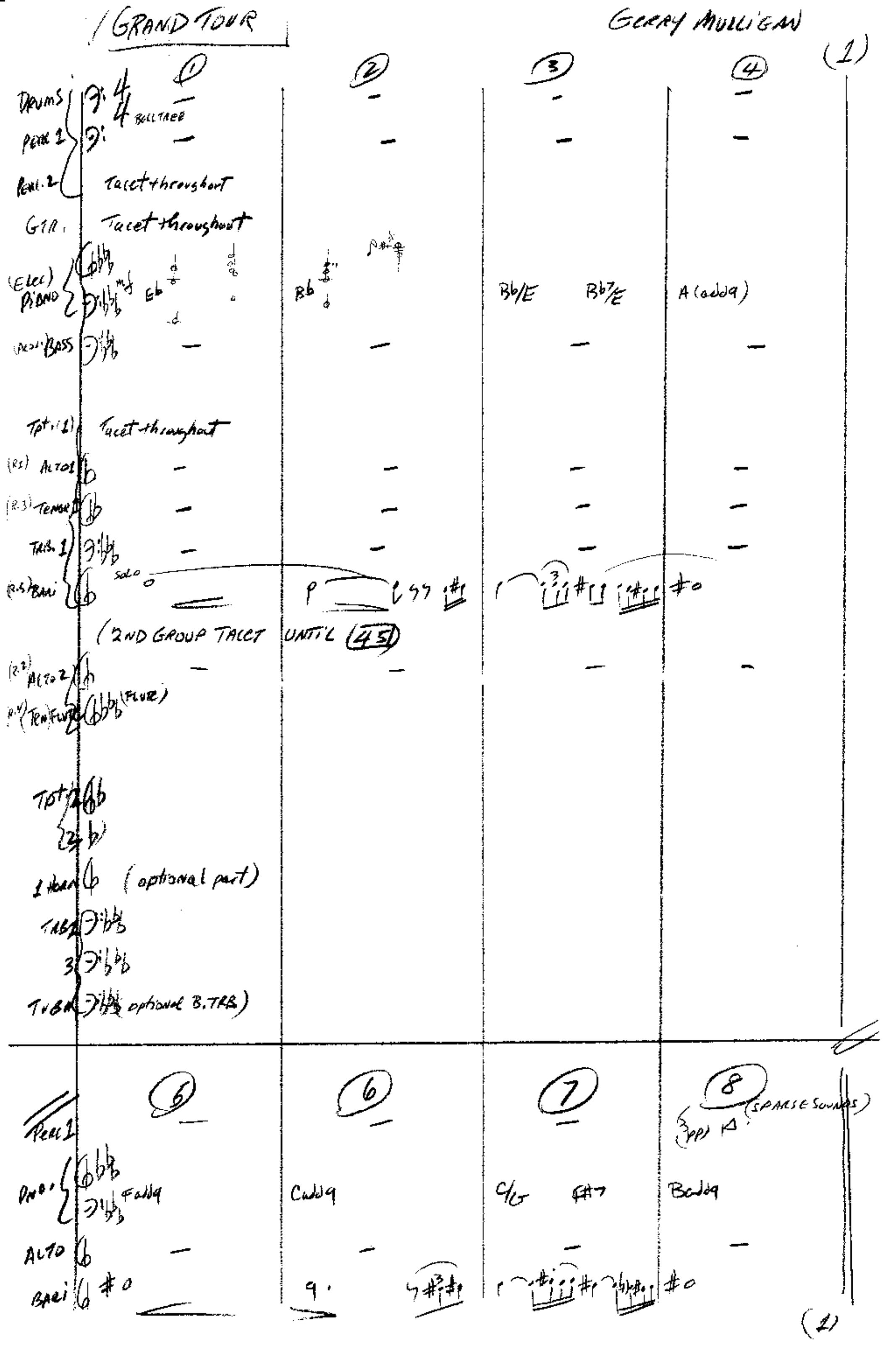
Grand Tour (J.Mulligan)
Composed by Gerry Mulligan
Arranged by Gerry Mulligan
- Ensemble: Big Band
- Pages: 27
- Instruments (19): Tenor 2 (Flute), Alto (Front Line), Alto 2, Tenor 1 (Front Line), Bari (Front Line), Horn, Trumpet 1, 2nd Trumpet (Front Line), Trumpet 3, Trombone 1 (Front Line), Trombone 2, Trombone 3, Tuba, Percussion 1, Percussion 2, Bass (Acoustic), Drums, (Elec.) Piano, Guitar
- Difficulty: medium
- Content: Individual Parts
- Format: PDF Download (Instant)
- Price: $24.99
Gerry Mulligan’s "Grand Tour" stands as a brilliant testament to the West Coast cool jazz movement of the 1950s and 1960s, capturing the sophisticated counterpoint and rich harmonic textures that defined the legendary baritone saxophonist's writing style. Originally conceived for Mulligan's innovative smaller ensembles and later adapted for larger developmental settings, this composition showcases the distinctive compositional voice that revolutionized modern jazz orchestration. Eschewing the hyper-aggressive, high-volume conventions of many East Coast big bands, Mulligan favored a transparent, highly integrated approach where individual horn lines weave together with intricate polyphonic clarity. The piece reflects an era of restless artistic exploration, translating the sophistication of modern jazz composition into an accessible yet intellectually stimulating framework that continues to captivate modern audiences. Driven by an infectious, forward-moving medium-up swing feel in 4/4 time, "Grand Tour" exudes an atmosphere of effortless sophistication, urbane elegance, and buoyant momentum. The mood shifts fluidly between breezy, relaxed optimism and moments of intense, tightly wound harmonic tension. Mulligan utilizes a clever interplay of conversational motifs across the ensemble, creating a sonic landscape that feels simultaneously spontaneous and meticulously engineered. The energy builds organically through clever rhythmic displacement and dynamic contrast, avoiding predictable climaxes in favor of surprising melodic detours and clever textural shifts that keep both performers and listeners thoroughly engaged from the opening measure to the final chord. As both composer and arranger, Mulligan brings his signature penchant for unconventional voicing to the chart, deliberately exploiting the unique timbral qualities of the horn section. The arrangement relies heavily on tight, interweaving counterpoint between the upper and lower voices, minimizing traditional block-chord writing in favor of independent linear motion. A standout feature of the chart is the ingenious use of the baritone saxophone as an anchor and equal melodic partner, driving the bottom end while frequently trading thematic material with the alto and tenor saxophones. The middle section features a meticulously crafted soli that highlights sectional blend and intonation, demanding precise articulation and a unified conception of time. Executing "Grand Tour" successfully requires an ensemble capable of maintaining a light, buoyant swing feel without dragging or over-blowing. The primary technical challenges lie in the independence of the individual horn parts and the requirement for absolute precision during rapid, conversational counter-melodies. The woodwind doublings and sax section integration demand mature intonation and light, articulate tongue technique. Advanced high school, collegiate, and professional jazz ensembles will find this 27-page arrangement immensely rewarding, as it offers a masterclass in counterpoint, balance, and stylistic restraint while providing ample space for inspired solo improvisations over sophisticated harmonic changes. Achieving the authentic Mulligan aesthetic requires absolute adherence to a relaxed, forward-leaning medium swing tempo, avoiding any tendency to rush or play with a heavy, plodding gate. Conductors should emphasize a lightweight, horizontal approach to phrasing rather than vertical, heavy-accented downbeats. The primary technical challenge involves the intricate interweaving of counter-melodies across the 8-instrument configuration; balance is critical, as no single voice should inadvertently mask the moving inner lines. Ensure the rhythm section maintains an unburdened, driving pulse, with the bass walking a clean, linear path that supports the horns' harmonic framework without cluttering the texture. Dynamics must be strictly observed, particularly the sudden subtones and unforced crescendos written into the transition sections. No special plunger or mute effects are required, allowing the natural acoustic brilliance of the open horns to define the ensemble's sophisticated West Coast sound profile. Q: What instruments and parts are included in this arrangement? A: The chart is scored for an 8-instrument ensemble comprising Alto Saxophone, Tenor Saxophone, Baritone Saxophone, Trumpet, Trombone, and a complete rhythm section framework spanning 27 comprehensive pages. Q: What is the difficulty level of this arrangement? A: This piece is best suited for advanced high school, collegiate, and professional jazz ensembles due to its demanding contrapuntal independence, intonation requirements, and stylistic subtlety. Q: What style and historical era does "Grand Tour" represent? A: Composed and arranged by Gerry Mulligan, the piece epitomizes the West Coast cool jazz movement of the 1950s and 1960s, prioritizing linear counterpoint and transparent voicings over aggressive big band volume. Q: What makes this specific arrangement unique? A: Unlike traditional block-chord big band charts, Mulligan’s writing emphasizes conversational counterpoint, tight linear interplay among the saxophones, and an elevated role for the baritone saxophone as a lead melodic voice. Q: What is the expected performance duration and tempo feel? A: The arrangement is designed around a buoyant, medium-up swing feel in 4/4 time, with a typical performance duration ranging between 4 to 5 minutes depending on solo extensions.
Questions and answers
- What is included in the Grand Tour (J.Mulligan) PDF?
- The verified current file contains a conductor score and individual parts across 27 pages.
- How many instruments or parts are listed for Grand Tour (J.Mulligan)?
- The verified instrumentation list contains 19 entries for this Big Band arrangement.
- Who is credited for Grand Tour (J.Mulligan)?
- Composer: Gerry Mulligan. Arranger: Gerry Mulligan.
- What difficulty is listed for Grand Tour (J.Mulligan)?
- The verified difficulty level is medium.
- Can I preview Grand Tour (J.Mulligan) before buying?
- Yes. The product page provides a preview generated from the current PDF file.
- How is Grand Tour (J.Mulligan) delivered?
- After successful payment, the digital PDF is made available for download. The displayed price is $24.99.
Musicians Also Search For
Grand Tour Gerry Mulligan PDF • Grand Tour Gerry Mulligan sheet music • Grand Tour arranged by Gerry Mulligan • Gerry Mulligan big band charts • Gerry Mulligan jazz arrangements PDF • Grand Tour Gerry Mulligan big band arrangements • Grand Tour big band arrangements • Grand Tour big band PDF download • Grand Tour jazz sheet music • big band sheet music download • Grand Tour conductor score PDF • Grand Tour individual parts download • Grand Tour sheet music PDF • buy Grand Tour sheet music • download Grand Tour PDF • Grand Tour jazz charts • best Gerry Mulligan big band arrangements • Grand Tour printable sheet music • big band repertoire PDF