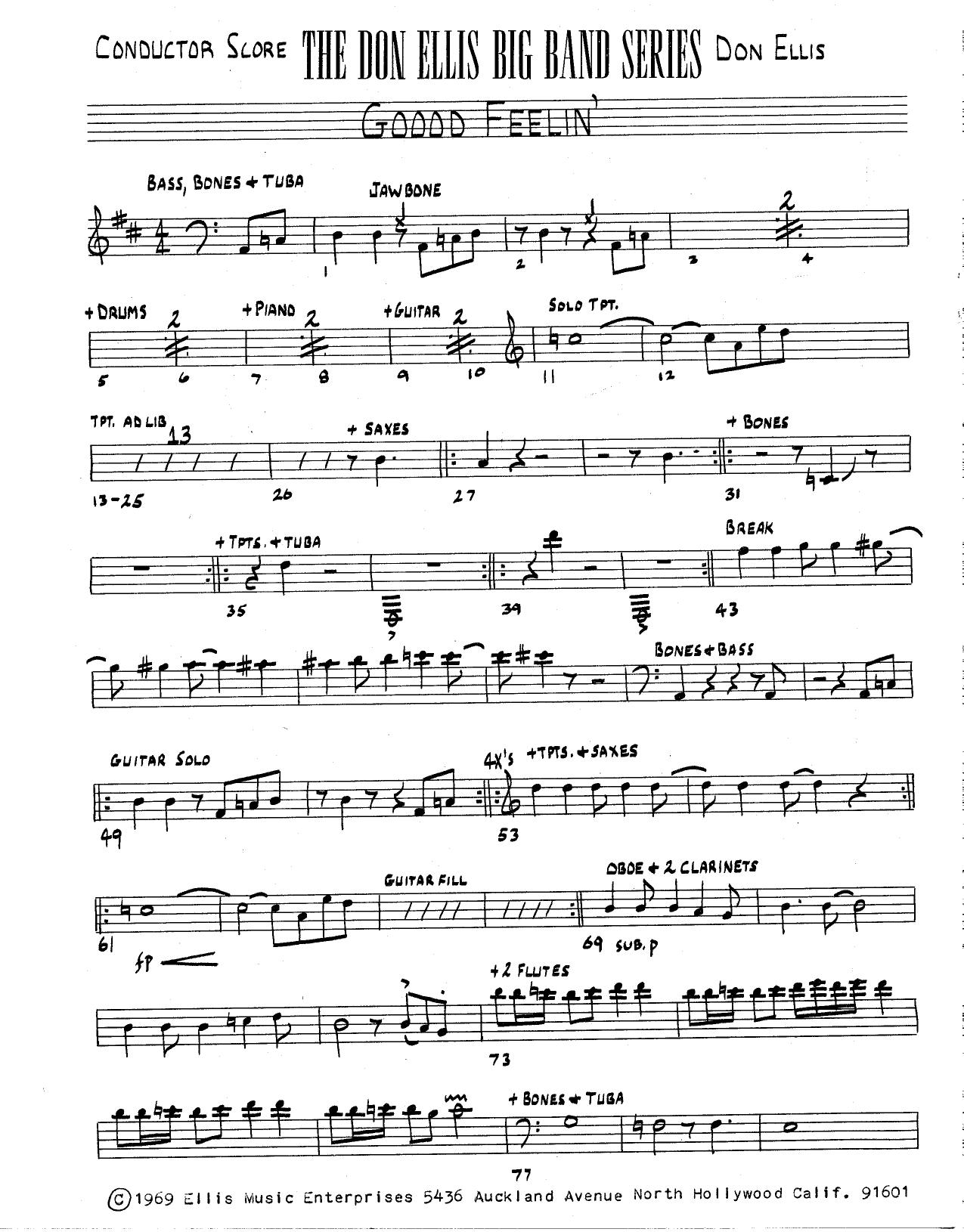
Goood Feelin' (D.Ellis) sheet music preview

Goood Feelin' (D.Ellis)

Composed by Don Ellis

Arranged by Don Ellis

  • Ensemble: Big Band
  • Pages: 40
  • Instruments (20): Conductor Score, Alto 1 (doubling Flute), Alto 2 (doubling Clarinet 2), Tenor 1 (doubling Clarinet 2), Tenor 2 (doubling Flute), Baritone Sax (doubling Oboe), Solo Trumpet, Trumpet 1, Trumpet 2, Trumpet 3, Trumpet 4, Trombone 1, Trombone 2, Trombone 3, Tuba (Bass Trombone 4), Guitar, Piano (Keys), Drums 1, Percussion (Drums II), Bass
  • Difficulty: medium
  • Content: Individual Parts
  • Format: PDF Download (Instant)
  • Price: $24.99

Pioneering a bold era of avant-garde big band jazz in the late 1960s, trumpeter, composer, and bandleader Don Ellis shattered conventional rhythmic boundaries by introducing odd meters, microtones, and electrifying amplification to the traditional jazz orchestra format. "Goood Feelin'" stands as a quintessential artifact of the Don Ellis Orchestra's high-octane library, capturing the spirit of West Coast progressive big band innovation. Originally brought to life on landmark Columbia Records releases, Ellis's compositions redefined what a large jazz ensemble could achieve, fusing the raw excitement of traditional swing with complex, interlocking asymmetrical meters and rock-inflected energy that captivated contemporary audiences and critics alike. Pulsing with an infectious, driving momentum, this arrangement merges a jubilant harmonic language with relentless rhythmic vitality. Built upon an unorthodox metric framework that feels both urgent and celebratory, the piece evokes a visceral sense of triumph and liberation. The mood is fiercely upbeat and relentlessly optimistic, propelled by punchy brass hits, intricate woodwind flourishes, and a grooving rhythm section foundation. The harmonic palette is rich with extended and altered dominants, yet it remains anchored by an unyielding blues-drenched accessibility that ensures the audience stays locked into the groove despite the mathematical complexity of the underlying time signatures. True to his distinctive compositional voice, Don Ellis utilizes the big band not merely as a vehicle for standard shout choruses, but as an orchestral canvas capable of shifting textures, microtonal inflections, and dense, multi-tiered counterpoint. The arrangement highlights explosive brass voicings—utilizing up to five trumpets with demanding upper-register requirements—balanced against fluid, cascading saxophone solis. Ellis treats the rhythm section as an interactive powerhouse rather than a simple timekeeping unit, demanding absolute precision in the execution of syncopated figures that cross standard bar lines. The dynamic architecture builds relentlessly from simmering, suspenseful vamp sections to thunderous, full-ensemble climaxes. Carrying the melodic weight are tightly integrated horn sections that trade thematic material in call-and-response fashion, punctuated by electrifying improvised solo spaces designed to test the mettle of advanced improvisers. Technical hurdles center primarily on the intricate odd-meter execution, rapid articulation demands across the brass and reed sections, and sustained endurance in the upper registers for trumpet and trombone players. Reaping the rewards of this chart requires absolute rhythmic unison; when locked in, the arrangement delivers an adrenaline-fueled performance experience that leaves both musicians and listeners exhilarated. Advanced collegiate ensembles, top-tier high school jazz bands with exceptional section leaders, and professional or premier community big bands will find this arrangement an ideal vehicle for stretching technical boundaries. Because of its demanding time feels, extensive range requirements, and the need for deep stylistic cohesion, it is best suited for experienced groups seeking to master progressive big band repertoire that pushes far beyond standard swing-era literature. Conquering "Goood Feelin'" requires absolute rhythmic synchronization and a fearless approach to asymmetrical meters. Conductors should spend significant rehearsal time having the entire ensemble internalize the subdivision of the beat before a single note is played; the rhythm section must serve as an unshakeable anchor for the erratic metric shifts. Trumpet 1 carries a demanding lead book with sustained high-register work, so players should pace themselves during dynamic builds. Articulation is paramount: ensure that all staccato figures are clipped and uniform across sections, while accented lines receive proper weight without sacrificing tone quality. Rehearsal strategies should isolate the complex inter-locking horn lines at a reduced tempo, gradually accelerating only when every section can execute their syncopated entrances with absolute precision. Pay close attention to balance during the dense contrapuntal passages so that inner voices remain audible beneath the dominant melodic statements. Q: What instruments and parts are included in this arrangement? A: This arrangement is scored for an 18-instrument big band lineup, featuring five trumpets (Trumpet 1 through 5), trombones, a full saxophone section, and a complete rhythm section including piano, guitar, bass, and drums. Q: What is the difficulty level of this Don Ellis chart? A: This piece is graded as advanced, specifically tailored for collegiate, professional, and elite high school big bands capable of navigating complex time signatures and extended upper-register brass demands. Q: What style and historical era does this composition represent? A: It represents the progressive, avant-garde big band jazz movement of the late 1960s, pioneered by Don Ellis on the West Coast by blending conventional jazz orchestra instrumentation with rock grooves and odd meters. Q: What makes this specific arrangement unique compared to standard swing charts? A: Unlike traditional charts written in standard 4/4 or 3/4 time, this arrangement utilizes asymmetrical meters, dense contrapuntal textures, and explosive brass writing that reflects Don Ellis's signature experimental approach to large ensemble jazz. Q: What is the general performance tempo and duration of the piece? A: The arrangement is performed at a brisk, driving tempo with an energetic groove, typically clocking in at around 4 to 5 minutes of continuous, high-intensity big band playing.

Questions and answers

What is included in the Goood Feelin' (D.Ellis) PDF?
The verified current file contains a conductor score and individual parts across 40 pages.
How many instruments or parts are listed for Goood Feelin' (D.Ellis)?
The verified instrumentation list contains 20 entries for this Big Band arrangement.
Who is credited for Goood Feelin' (D.Ellis)?
Composer: Don Ellis. Arranger: Don Ellis.
What difficulty is listed for Goood Feelin' (D.Ellis)?
The verified difficulty level is medium.
Can I preview Goood Feelin' (D.Ellis) before buying?
Yes. The product page provides a preview generated from the current PDF file.
How is Goood Feelin' (D.Ellis) delivered?
After successful payment, the digital PDF is made available for download. The displayed price is $24.99.

Musicians Also Search For

Goood Feelin' Don Ellis PDFGoood Feelin' Don Ellis sheet musicGoood Feelin' arranged by Don EllisDon Ellis big band chartsDon Ellis jazz arrangements PDFGoood Feelin' Don Ellis big band arrangementsGoood Feelin' big band arrangementsGoood Feelin' big band PDF downloadGoood Feelin' jazz sheet musicbig band sheet music downloadGoood Feelin' conductor score PDFGoood Feelin' individual parts downloadGoood Feelin' sheet music PDFbuy Goood Feelin' sheet musicdownload Goood Feelin' PDFGoood Feelin' jazz chartsbest Don Ellis big band arrangementsGoood Feelin' printable sheet musicbig band repertoire PDF

All arrangements by Don Ellis All Don Ellis sheet music