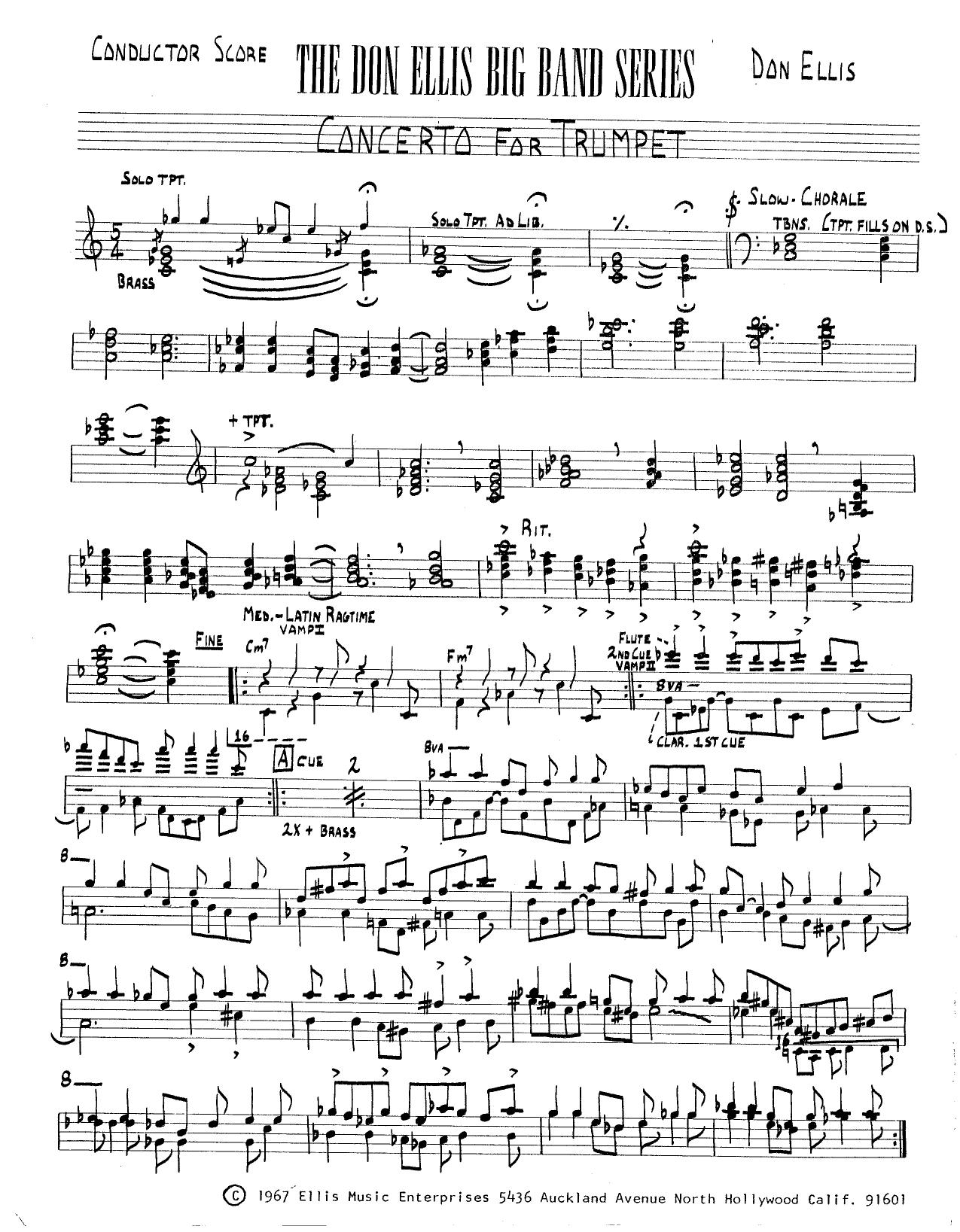
Concerto For Trumpet (D.Ellis)
Composed by Don Ellis
Arranged by Don Ellis
- Ensemble: Big Band
- Pages: 39
- Instruments (19): Conductor Score, Solo Trumpet, Woodwind 1 (Flute, Clarinet, Alto Sax), Woodwind 2 (Flute, Clarinet, Alto Sax), Woodwind 3 (Clarinet, Tenor Sax), Woodwind 4 (Clarinet, Tenor Sax), Woodwind 5 (Bari Sax), Trumpet 1, Trumpet 2, Trumpet 3, Trumpet 4, Trombone 1, Trombone 2, Trombone 3 (Bass), Tuba, Guitar (Spanish Style), Piano, Drums 1 (Timbales, Cow Bell, Conga), Bass
- Difficulty: medium
- Content: Individual Parts
- Format: PDF Download (Instant)
- Price: $24.99
Don Ellis pushed the absolute boundaries of avant-garde big band jazz during the late 1960s and early 1970s, pioneering the use of odd meters, microtones, and electrified orchestration that forever changed the genre. "Concerto For Trumpet," composed and arranged by Ellis himself, stands as a monumental showcase of his virtuosic command over unconventional time signatures and high-octane brass writing. Originally brought to international prominence through his legendary Columbia Records releases, this composition captures the exhilarating, high-risk spirit of the West Coast progressive jazz movement. It remains a watershed work for ensembles seeking to explore complex polyrhythms outside the traditional 4/4 swing framework, blending roaring orchestral power with intricate, modal harmonic language. Driving forward with an relentless, high-energy groove, the piece thrives on shifting metric pulses and an electric, brass-heavy atmosphere. The mood oscillates between tense, driving anticipation and explosive, triumphant releases of harmonic energy. Listeners are immediately struck by the sheer wall of sound generated by the expanded brass section, contrasted against delicate, shimmering cymbal textures and pulsing basslines. The emotional trajectory is one of relentless forward momentum, demanding absolute concentration and stamina from every player on the bandstand. The harmonic landscape is rich with extended alterations, pungent suspensions, and soaring trumpet lines that push performers to the edge of their capabilities. As both composer and arranger, Don Ellis constructs a dense, highly specialized sonic architecture tailored specifically to his groundbreaking orchestra. His signature approach utilizes thick, complex voicings across the four-part trumpet section and trombones, frequently employing specialized mutes, microtonal bending, and overlapping ostinatos that create a hypnotic wall of sound. Rather than relying on standard shout choruses, Ellis builds tension through cumulative rhythmic layering, where individual sections lock into contrasting odd-meter subdivisions before converging into massive, tutti climaxes. The arrangement demands absolute rhythmic precision, treating the entire 14-instrument ensemble as a unified, percussion-driven machine capable of turning on a dime. The lead trumpet chair carries the monumental burden of the title role, requiring staggering endurance, exceptional upper-register clarity, and absolute rhythmic command to navigate the blistering solo passages and complex thematic statements. Secondary melodic motifs are deftly tossed between the lower brass and woodwind doubles, creating dynamic counterpoint against the driving rhythm section. Technical challenges abound, particularly in maintaining a relaxed time feel while executing rapid metric modulations and asymmetrical subdivisions. The reward for mastering the score is immense, culminating in breathtaking ensemble unisons and soaring cadenzas that never fail to electrify an audience. Given the extraordinary technical demands, extreme upper-register requirements, and sophisticated rhythm section coordination needed to execute the odd meters, this arrangement is best suited for advanced collegiate jazz ensembles, premier military bands, and elite professional big bands. High school groups with exceptional lead players might tackle it only if they possess an advanced grasp of modern metric modulation. For sophisticated programs looking to expand their stylistic vocabulary far beyond standard swing charts, this 39-page masterwork offers a transcendent journey into the outer limits of progressive big band literature. Conductors approaching "Concerto For Trumpet" must first secure a rock-solid rhythm section capable of anchoring complex, asymmetric meters without dragging or rushing. Rehearsal should begin by isolating the rhythm tracks, having the ensemble internalize the subdivision pulses before adding pitched notes. The primary technical challenge lies in the extreme endurance required for the lead trumpet soloist and upper brass sections; pacing during rehearsal is vital to prevent lip fatigue. Pay meticulous attention to dynamic markings, as the arrangement relies heavily on sudden sub-ito pianos and explosive crescendos to create its characteristic tension. Ensemble members should utilize metronome clicks subdivided into odd groupings during early sectional rehearsals to lock in tight articulation across the 14-piece instrumentation. Ensure that stylistic accents remain crisp and pointed, avoiding a heavy or lumbering feel despite the dense orchestration. Q: What instruments and parts are included in this arrangement? A: Scored for a specialized 14-instrument big band instrumentation, the chart features parts for 4 trumpets, trombone, and accompanying rhythm and horn sections across 39 comprehensive pages. Q: What is the difficulty level of this arrangement? A: This chart is graded as advanced or professional-level, requiring elite technical proficiency, exceptional upper-register endurance for the lead trumpet, and fluency in complex odd-meter jazz styles. Q: What is the musical style and historical context of the piece? A: Written and recorded by innovative bandleader Don Ellis, this piece represents the pinnacle of late-1960s progressive avant-garde big band jazz, famous for its exploration of non-traditional time signatures and electrified orchestration. Q: What makes this Don Ellis arrangement unique? A: It features Ellis's signature dense harmonic voicings, microtonal tendencies, and asymmetric metric layering, treating the entire 14-piece ensemble as a high-velocity, rhythmically intricate percussion machine. Q: What is the performance duration and tempo approach? A: While performance duration varies based on the breathing room given to improvised solo sections, the piece requires a relentlessly driving, high-tempo metric foundation that demands absolute rhythmic stability from the entire ensemble.
Questions and answers
- What is included in the Concerto For Trumpet (D.Ellis) PDF?
- The verified current file contains a conductor score and individual parts across 39 pages.
- How many instruments or parts are listed for Concerto For Trumpet (D.Ellis)?
- The verified instrumentation list contains 19 entries for this Big Band arrangement.
- Who is credited for Concerto For Trumpet (D.Ellis)?
- Composer: Don Ellis. Arranger: Don Ellis.
- What difficulty is listed for Concerto For Trumpet (D.Ellis)?
- The verified difficulty level is medium.
- Can I preview Concerto For Trumpet (D.Ellis) before buying?
- Yes. The product page provides a preview generated from the current PDF file.
- How is Concerto For Trumpet (D.Ellis) delivered?
- After successful payment, the digital PDF is made available for download. The displayed price is $24.99.
Musicians Also Search For
Concerto For Trumpet Don Ellis PDF • Concerto For Trumpet Don Ellis sheet music • Concerto For Trumpet arranged by Don Ellis • Don Ellis big band charts • Don Ellis jazz arrangements PDF • Concerto For Trumpet Don Ellis big band arrangements • Concerto For Trumpet big band arrangements • Concerto For Trumpet big band PDF download • Concerto For Trumpet jazz sheet music • big band sheet music download • Concerto For Trumpet conductor score PDF • Concerto For Trumpet individual parts download • Concerto For Trumpet sheet music PDF • buy Concerto For Trumpet sheet music • download Concerto For Trumpet PDF • Concerto For Trumpet jazz charts • best Don Ellis big band arrangements • Concerto For Trumpet printable sheet music • big band repertoire PDF