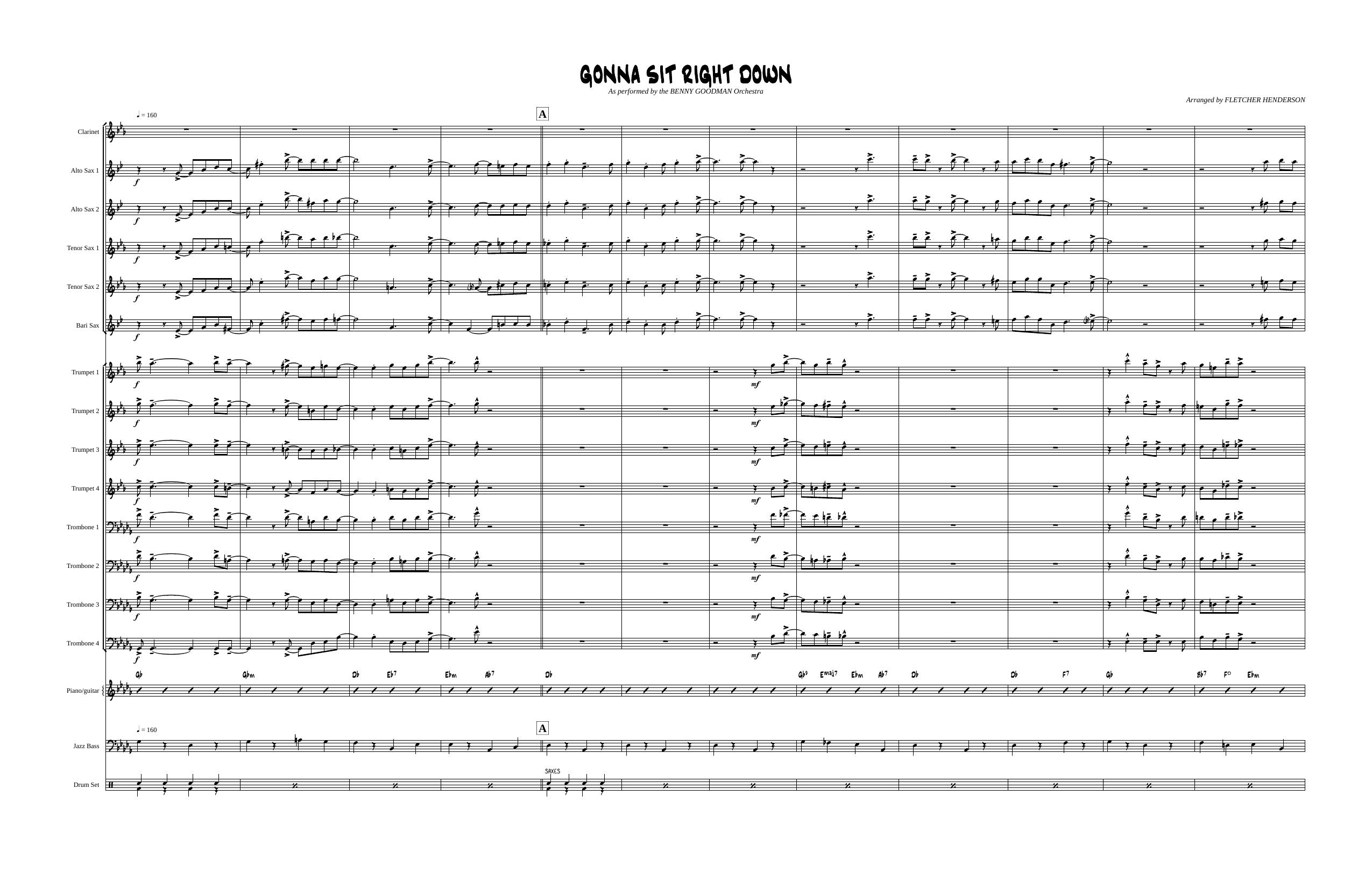
Gonna Sit Right Down (B.Goodman - (F.Henderson)
Composed by Fletcher Henderson
Arranged by Fletcher Henderson
- Ensemble: Big Band
- Pages: 51
- Instruments (17): Clarinet, Alto Sax 1, Alto Sax 2, Tenor Sax 1, Tenor Sax 2, Bari Sax, Trumpet 1, Trumpet 2, Trumpet 3, Trumpet 4, Trombone 1, Trombone 2, Trombone 3, Trombone 4, Piano/Guitar, Jazz Bass, Drum Set
- Difficulty: advanced
- Content: Individual Parts
- Format: PDF Download (Instant)
- Price: $24.99
The swing era of the mid-1930s reached its zenith largely through the groundbreaking collaborative synergy between clarinetist Benny Goodman and master arranger Fletcher Henderson. Recorded during the height of the swing craze, "Gonna Sit Right Down and Write Myself a Letter" represents the quintessential Goodman small-group-to-big-band translation, adapted directly from Henderson's brilliant studio library. Henderson, widely regarded as the architect of modern big band arranging, defined the template for pitting the brass section against the reed section in sharp, call-and-response dialogues that propelled dance halls nationwide. This timeless tune captures the infectious optimism and driving rhythmic pulse characteristic of Goodman’s landmark 1935–1937 Victor recordings, blending accessible pop-song lyricism with sophisticated, swinging counterpoint. Propelled by an exuberant medium-bright swing tempo in 4/4 time, the chart exudes a joyful, effervescent mood driven by a relentless walking bass line and crisp hi-hat pulse. The harmonic language is firmly rooted in classic swing-era diatonicism spiced with clever secondary dominants and passing chords that keep the momentum fresh. Henderson constructs the arrangement with masterly economy, opening with a playful thematic statement before introducing swinging saxophone solis that showcase tight, homogeneous ensemble blend. The energy steadily escalates through punchy brass background figures, culminating in a textbook Henderson shout chorus that dynamically releases accumulated tension just before the final triumphant cadence. Henderson’s signature arranging methodology relies on sectional independence and transparent voicings, avoiding thick, muddy clusters in favor of crystal-clear counterpoint between the reeds and brass. The woodwinds—featuring crisp alto and tenor saxophones—frequently handle cascading arpeggios and harmonized lead lines, while the trumpet and trombone provide punchy, staccato punctuations that mimic a breathless conversational flow. The rhythm section, anchored by an integral piano part that outlines the stride-inflected foundation of the era, must maintain an unyielding, buoyant bounce. Featured solo spaces allow individual players to stretch out within the traditional swing vocabulary, demanding an authentic sense of phrasing, rhythmic placement, and tone quality true to the 1930s aesthetic. Advanced high school ensembles, collegiate jazz orchestras, and professional repertory big bands will find this 51-page manuscript an exceptional vehicle for developing traditional swing articulation and ensemble listening skills. While the 8-instrument core instrumentation is streamlined compared to a massive 17-piece modern stage band, it demands absolute precision in balance and intonation because every voice is exposed. Performers must navigate stylistic nuances such as sustained quarter-note weighting, controlled vibrato, and sharply articulated accents. Bringing this Henderson chart to life offers a deeply rewarding masterclass in historical jazz articulation, connecting contemporary students directly to the foundational roots of big band history. Success with this Fletcher Henderson arrangement hinges on capturing an authentic 1930s swing feel, which relies heavily on light, buoyant quarter notes and precise, unforced articulation. The conductor should establish a lively medium-swing tempo, ensuring the rhythm section—particularly the piano and drums—locks into a driving, danceable groove without rushing. Horn players must pay meticulous attention to section balance, ensuring that staccato background punches never overpower the primary melody carried by the saxophones or brass leads. Technical challenges include maintaining consistent stylistic uniformity across the 8-part texture, where individual player accountability is remarkably high. Reeds should focus on smooth, linear voice-leading during the harmonized soli sections, utilizing a warm, controlled vibrato typical of the pre-bop era. Brass players ought to employ clean, plunger-free attacks, favoring natural tongue-stops and subtle drop-offs over exaggerated modern effects. During rehearsals, isolate the rhythm section first to secure the foundational bounce, then layer the horns section-by-section to balance the intricate call-and-response dynamics inherent in Henderson’s masterful writing. Q: What instruments and parts are included in this arrangement? A: This chart is scored for an 8-instrument core ensemble, featuring parts for Alto Saxophone, Tenor Saxophone, Trumpet, Trombone, Piano, and accompanying rhythm section elements spanning a comprehensive 51-page master score and part set. Q: What is the designated difficulty level of this piece? A: It is suited for advanced high school, collegiate, and professional jazz ensembles that possess a solid grasp of traditional swing style, strong sectional intonation, and disciplined rhythmic precision. Q: What is the historical style and background of the music? A: Written during the mid-1930s swing era, this arrangement reflects Fletcher Henderson's legendary style of writing for the Benny Goodman organization, balancing catchy popular song melodies with sophisticated big band counterpoint. Q: What makes this specific Fletcher Henderson arrangement unique? A: It exemplifies Henderson's signature technique of transparent sectional writing, utilizing dynamic call-and-response interplay between reeds and brass rather than dense, contemporary harmonic clusters. Q: What is the typical performance duration and tempo feel? A: The arrangement is designed for a medium-bright swing tempo in 4/4 time, typically resulting in a performance duration of approximately 3 to 4 minutes depending on solo rotations.
Questions and answers
- What is included in the Gonna Sit Right Down (B.Goodman - (F.Henderson) PDF?
- The verified current file contains a conductor score and individual parts across 51 pages.
- How many instruments or parts are listed for Gonna Sit Right Down (B.Goodman - (F.Henderson)?
- The verified instrumentation list contains 17 entries for this Big Band arrangement.
- Who is credited for Gonna Sit Right Down (B.Goodman - (F.Henderson)?
- Composer: Fletcher Henderson. Arranger: Fletcher Henderson.
- What difficulty is listed for Gonna Sit Right Down (B.Goodman - (F.Henderson)?
- The verified difficulty level is advanced.
- Can I preview Gonna Sit Right Down (B.Goodman - (F.Henderson) before buying?
- Yes. The product page provides a preview generated from the current PDF file.
- How is Gonna Sit Right Down (B.Goodman - (F.Henderson) delivered?
- After successful payment, the digital PDF is made available for download. The displayed price is $24.99.
Musicians Also Search For
Gonna Sit Right Down Fletcher Henderson PDF • Gonna Sit Right Down Fletcher Henderson sheet music • Gonna Sit Right Down arranged by Fletcher Henderson • Fletcher Henderson big band charts • Fletcher Henderson jazz arrangements PDF • Gonna Sit Right Down Fletcher Henderson big band arrangements • Gonna Sit Right Down big band arrangements • Gonna Sit Right Down big band PDF download • Gonna Sit Right Down jazz sheet music • big band sheet music download • Gonna Sit Right Down conductor score PDF • Gonna Sit Right Down individual parts download • Gonna Sit Right Down sheet music PDF • buy Gonna Sit Right Down sheet music • download Gonna Sit Right Down PDF • Gonna Sit Right Down jazz charts • best Fletcher Henderson big band arrangements • Gonna Sit Right Down printable sheet music • big band repertoire PDF