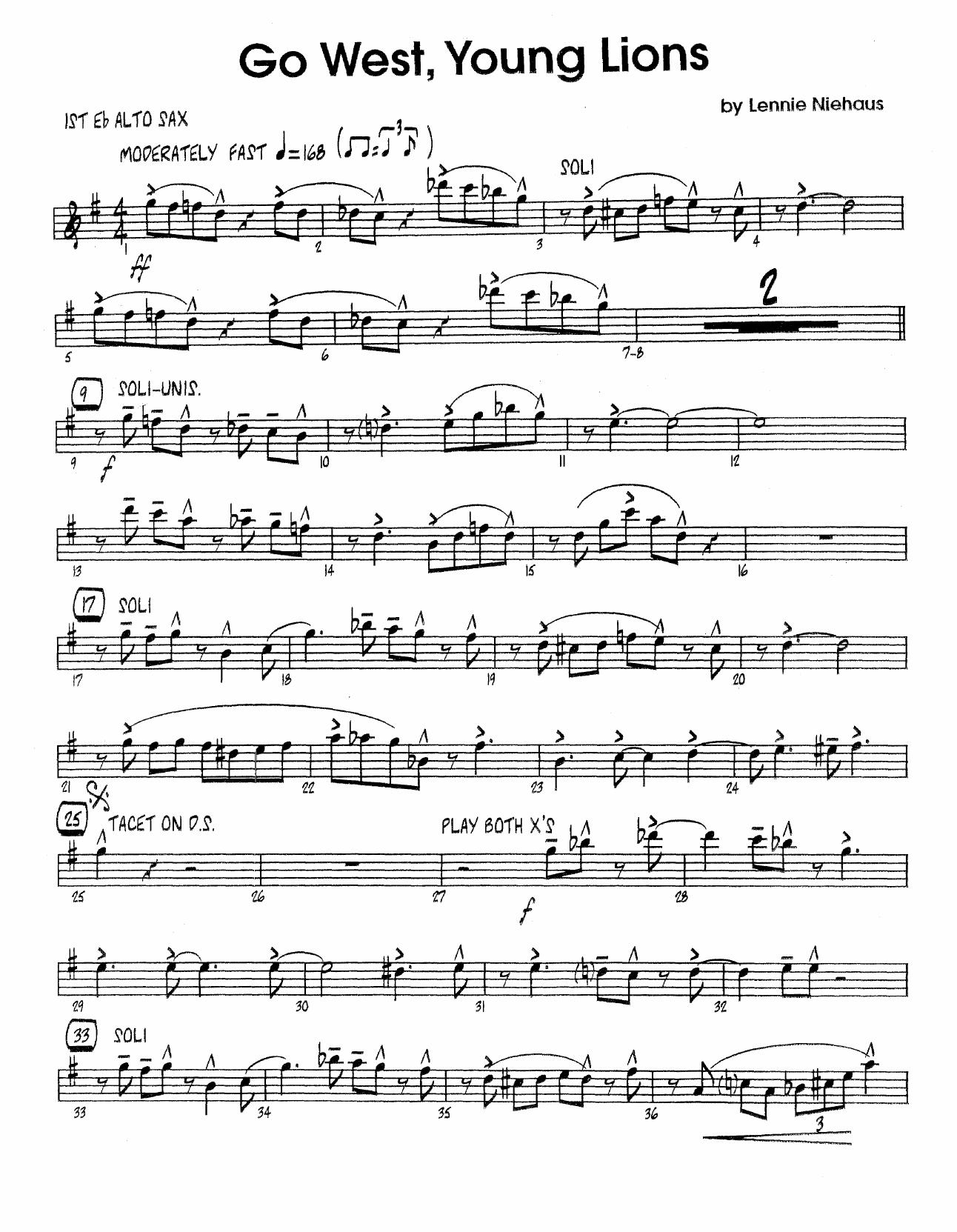
Go West, Young Lions (L.Niehaus) sheet music preview

Go West, Young Lions (L.Niehaus)

Composed by Lennie Niehaus

Arranged by Lennie Niehaus

  • Ensemble: Big Band
  • Pages: 62
  • Instruments (17): 1st Eb Alto Sax, 2nd Eb Alto Sax, 1st Bb Tenor Sax, 2nd Bb Tenor Sax, Eb Baritone Sax, 1st Bb Trumpet, 2nd Bb Trumpet, 3rd Bb Trumpet, 4th Bb Trumpet, 1st Trombone, 2nd Trombone, 3rd Trombone, 4th Trombone, Piano, Guitar, Bass, Drums
  • Difficulty: advanced
  • Content: Individual Parts
  • Format: PDF Download (Instant)
  • Price: $24.99

Bebop and West Coast cool jazz intertwine seamlessly in Lennie Niehaus’s "Go West, Young Lions," an energetic big band showcase that captures the sophisticated, counterpoint-driven aesthetic of 1950s California jazz. Emerging from the fertile ground of the Stan Kenton orchestra—where Niehaus served as a foundational alto saxophonist, staff arranger, and composer—this composition reflects the intellectual rigor and buoyant optimism of the era's modern jazz movement. Niehaus, a disciple of classical theory who studied under Lennie Tristano and Max Roach, built a legendary catalog defined by pristine horn voicings, linear driving forces, and an effortless West Coast polish that set a new standard for modern big band writing. Driven by an infectious, medium-up swing groove in 4/4 time, "Go West, Young Lions" balances breezy sophistication with fierce rhythmic drive. The mood is confident, bright, and forward-looking, evoking the sun-drenched dynamism of the post-war American West while maintaining the harmonic complexity of bebop. Niehaus crafts a textural landscape defined by crisp articulation, nimble scalar runs, and rich, tertian-extended harmonies. The brass and reed sections engage in witty, conversational counterpoint, creating an airy yet substantial sonic footprint that avoids heavy-handed, brass-heavy bombast in favor of linear clarity and horizontal momentum. True to Niehaus’s signature style, the arrangement relies heavily on tightly knit saxophone solis and clever cross-section dialogue. The 17-instrument orchestration (featuring the standard 5-4-4-4 big band setup of two altos, two tenors, baritone, four trumpets, four trombones, and a four-piece rhythm section) utilizes close-position horn voicings that give the ensemble a sleek, chamber-jazz transparency. The melody is introduced by the saxophone section before being brilliantly tossed across the brass. Solos are strategically opened over standard blues or rhythm changes-derived harmonic frameworks, allowing improvisers to stretch out over crisp, transparent backgrounds. The shout chorus builds tension organically through linear acceleration and dynamic contrast rather than sheer volume, culminating in a triumphant, high-energy restatement of the main theme. Advanced high school ensembles, collegiate jazz orchestras, and professional big bands will find this chart an exceptional vehicle for developing stylistic versatility, section blend, and articulation precision. Because Niehaus writes with a classical sensibility regarding voice-leading, players must possess strong sight-reading skills and clean execution of complex, bebop-rooted figures. The chart rewards bands that excel at light, articulate swing playing and collective breathing. --- Conductors approaching "Go West, Young Lions" must prioritize immaculate section blend and light, buoyant articulation. The tempo should be set at a comfortable, driving medium-up swing (around quarter note = 192–200 BPM)—fast enough to maintain momentum, but relaxed enough to let the intricate bebop lines breathe. Avoid heavy accents on beats two and four; instead, encourage the rhythm section to push a lean, driving ride-cymbal pulse with a steady, unforced walking bassline. The primary technical challenge lies in the fast, linear unison and harmony passages within the saxophone and trumpet sections. Ensure that the players use consistent articulation (utilizing a light "doodle-tongue" approach where applicable) to keep eighth-note lines sounding horizontal rather than choppy. Dynamics should be carefully managed; the background figures must remain strictly subservient to the featured soloists, maintaining a transparent texture that lets the improvised lines shine through. No specialized mutes or extreme extended techniques are required, allowing the ensemble to focus entirely on stylistic purity, intonation, and swing feel. --- Q: What instruments and parts are included in this arrangement? A: This 62-page publication includes a full conductor score and complete instrumental parts for a standard 17-piece big band: 2 alto saxophones, 2 tenor saxophones, 1 baritone saxophone, 4 trumpets, 4 trombones, guitar, piano, bass, and drums. Q: What is the difficulty level of "Go West, Young Lions"? A: This arrangement is graded as advanced, making it ideal for skilled high school jazz bands, collegiate ensembles, and professional big bands that are comfortable with bebop-era harmonic structures and fast linear phrasing. Q: What is the musical style and historical context of this piece? A: Written by arranger and Kenton alumnus Lennie Niehaus, the piece is rooted in the 1950s West Coast cool jazz movement, blending sophisticated bebop lines with bright, optimistic West Coast swing aesthetics. Q: What makes this specific Lennie Niehaus arrangement unique? A: It features Niehaus's signature transparent, close-position horn voicings, intricate counterpoint, and clever cross-section dialogue that favors linear clarity and chamber-jazz precision over heavy, bombastic brass writing. Q: What is the performance duration and tempo of the chart? A: The arrangement is designed as a medium-up swing chart, typically clocking in at around 3.5 to 4.5 minutes depending on the length of the open improvised solos and the chosen tempo (recommended around quarter note = 192–200 BPM).

Questions and answers

What is included in the Go West, Young Lions (L.Niehaus) PDF?
The verified current file contains a conductor score and individual parts across 62 pages.
How many instruments or parts are listed for Go West, Young Lions (L.Niehaus)?
The verified instrumentation list contains 17 entries for this Big Band arrangement.
Who is credited for Go West, Young Lions (L.Niehaus)?
Composer: Lennie Niehaus. Arranger: Lennie Niehaus.
What difficulty is listed for Go West, Young Lions (L.Niehaus)?
The verified difficulty level is advanced.
Can I preview Go West, Young Lions (L.Niehaus) before buying?
Yes. The product page provides a preview generated from the current PDF file.
How is Go West, Young Lions (L.Niehaus) delivered?
After successful payment, the digital PDF is made available for download. The displayed price is $24.99.

Musicians Also Search For

Go West, Young Lions Lennie Niehaus PDFGo West, Young Lions Lennie Niehaus sheet musicGo West, Young Lions arranged by Lennie NiehausLennie Niehaus big band chartsLennie Niehaus jazz arrangements PDFGo West, Young Lions Lennie Niehaus big band arrangementsGo West, Young Lions big band arrangementsGo West, Young Lions big band PDF downloadGo West, Young Lions jazz sheet musicbig band sheet music downloadGo West, Young Lions conductor score PDFGo West, Young Lions individual parts downloadGo West, Young Lions sheet music PDFbuy Go West, Young Lions sheet musicdownload Go West, Young Lions PDFGo West, Young Lions jazz chartsbest Lennie Niehaus big band arrangementsGo West, Young Lions printable sheet musicbig band repertoire PDF

All arrangements by Lennie Niehaus All Lennie Niehaus sheet music