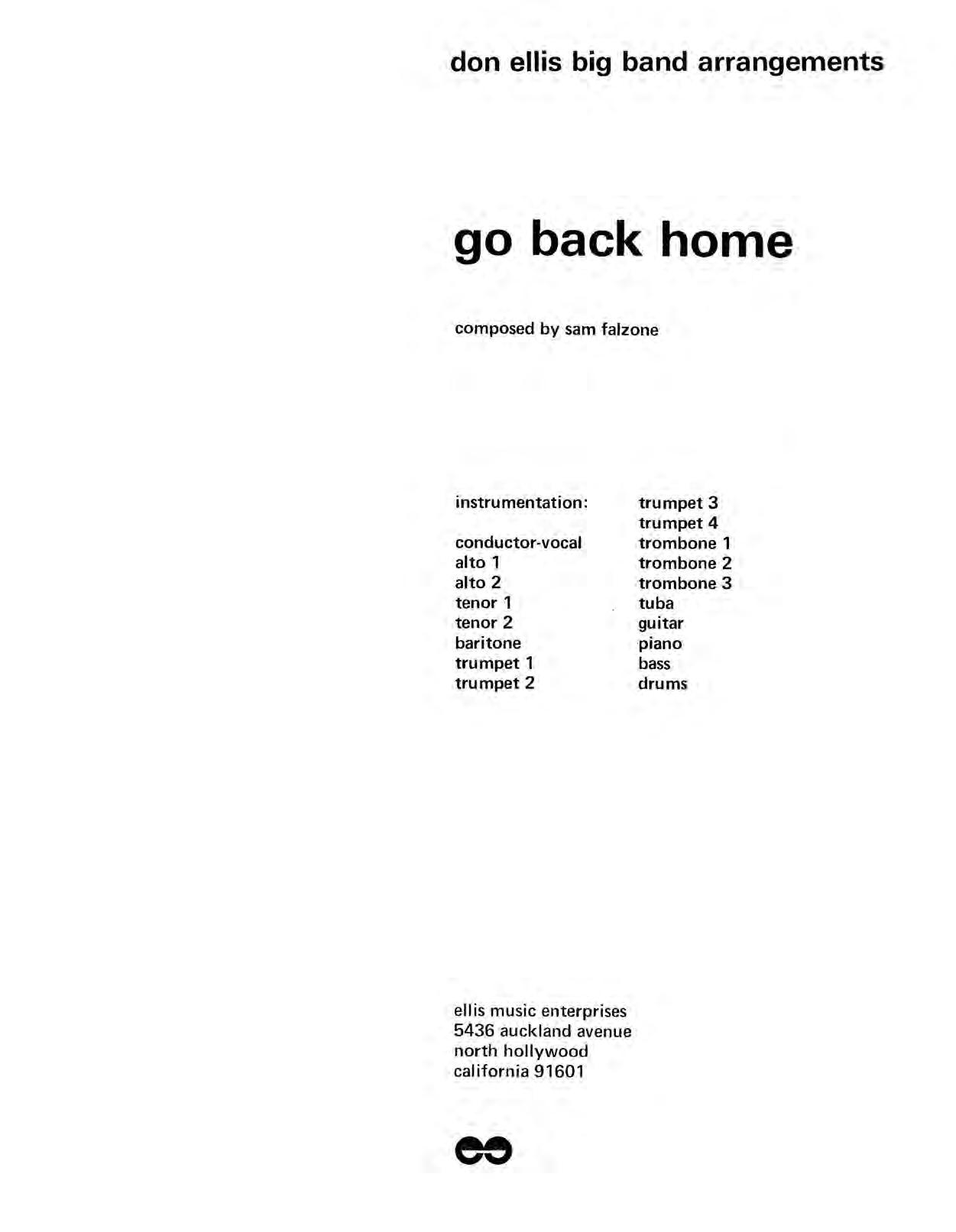
Go Back Home (D.Ellis) sheet music preview

Go Back Home (D.Ellis)

Composed by Don Ellis

Arranged by Don Ellis

  • Ensemble: Big Band
  • Pages: 40
  • Instruments (18): Conductor-Vocal, Alto I, Alto II, Tenor I, Tenor II, Bari, Trumpet I, Trumpet II, Trumpet III, Trumpet IV, Trombone I, Trombone II, Trombone III, Tuba, Piano, Guitar, Bass, Drums
  • Difficulty: medium
  • Content: Individual Parts
  • Format: PDF Download (Instant)
  • Price: $24.99

Pioneering trumpeter, composer, and bandleader Don Ellis redefined the boundaries of modern big band jazz during the late 1960s and 1970s, famously infusing traditional jazz orchestration with complex, asymmetrical meters, microtones, and rock-infused energy. "Go Back Home" stands as a captivating representation of Ellis’s visionary approach, capturing the innovative spirit of his groundbreaking Los Angeles-based orchestra. Emerging from an era where big bands were desperately seeking relevance amidst the rock revolution, Ellis bridged the gap between avant-garde experimentation and hard-swinging orchestral power, creating a distinct sonic signature that relied as much on hypnotic groove as it did on harmonic sophistication. Driven by a relentless, infectious rhythmic pulse and an expansive modal harmonic palette, the mood of "Go Back Home" shifts seamlessly between introspective tension and explosive, high-octane liberation. The arrangement opens with a haunting, atmospheric vamp that builds anticipation before locking into an insistent, driving groove. Ellis’s orchestration avoids conventional big band clichés, instead utilizing dense, modern voicings that stretch across the ensemble to create a wide, cinematic soundscape. The energy is palpable, evoking a sense of urgent forward motion, triumphant homecoming, and psychological release, underlined by sharp dynamic contrasts and shifting textural layers. In crafting this chart, Don Ellis applies his trademark genius for reinterpreting time and texture within an 8-instrument configuration (Alto Sax, Tenor Sax, Baritone Sax, Trumpet, Trombone, and rhythm section support). Rather than relying on standard 4/4 swing patterns, the arrangement weaves intricate counterpoint and interlocking horn lines that challenge the traditional division of melody and accompaniment. The woodwinds frequently double and harmonize in tight, contemporary intervals, while the brass punctuates the arrangement with biting accents and soaring harmonic extensions. A striking feature of Ellis's writing here is the organic integration of space; modal vamps provide soloists with an open, modal canvas for exploration, avoiding predictable bebop changes in favor of exploratory, modal freedom. Navigating this 40-page manuscript requires precision, exceptional rhythmic security, and a deep sense of collective ensemble listening. The melody is shared fluidly across the horn section, demanding absolute blend and intonation, particularly when executing the jagged, angular lines typical of Ellis’s repertoire. Featured solo spaces allow advanced improvisers to stretch beyond standard changes, while the rhythm section must maintain an unyielding, hypnotic groove underneath shifting meters or complex accents. Because of its demanding harmonic language, unconventional phrasing, and rhythmic intricacies, this arrangement is best suited for advanced collegiate, professional, or elite contemporary jazz ensembles looking to push their technical and stylistic boundaries. Executing "Go Back Home" successfully demands meticulous attention to rhythmic precision and stylistic commitment from every member of the ensemble. The conductor must establish a rock-solid, internal pulse before the downbeat, as the hypnotic groove forms the foundation upon which the entire chart rests. Key technical challenges involve navigating asymmetrical rhythmic groupings and executing tight unison horn lines at brisk tempos. Horn players should prioritize clean articulation, ensuring that staccato accents are crisp and sustained notes maintain a rich, centered tone without sagging pitch. Incorporate sectional rehearsals prior to full ensemble run-throughs, specifically isolating the interlocking woodwind and brass counterlines to lock in the articulation and balance. Soloists should familiarize themselves with the modal framework of the piece, leaning into exploratory, textural improvisation rather than defaulting to standard ii-V-I licks. Emphasize dynamic contrast—let the arranged crescendos peak naturally without forcing the tone, preserving the sophisticated, modern orchestral palette envisioned by Don Ellis. Q: What instruments and parts are included in this arrangement? A: This 40-page arrangement is scored for an 8-instrument contemporary ensemble, specifically featuring Alto Saxophone, Tenor Saxophone, Baritone Saxophone, Trumpet, Trombone, and a complete rhythm section. Q: What is the difficulty level of this arrangement? A: This piece is graded as advanced, making it exceptionally well-suited for collegiate, professional, or elite contemporary jazz ensembles with strong readers and improvisers. Q: What is the musical style and historical context of "Go Back Home"? A: Composed and recorded by visionary bandleader Don Ellis, the piece embodies the avant-garde, rhythmically complex, and groove-heavy big band jazz movement of the late 1960s and 1970s. Q: What makes this specific Don Ellis arrangement unique? A: It features Ellis's signature modal harmonies, angular unisons, and an innovative approach to an 8-instrument configuration that trades traditional swing clichés for cinematic tension and open solo spaces. Q: What is the expected performance tempo and duration? A: The piece is driven by a brisk, high-energy tempo with an infectious pulse, and runs approximately 5 to 7 minutes depending on the length of the open improvised solos.

Questions and answers

What is included in the Go Back Home (D.Ellis) PDF?
The verified current file contains individual parts across 40 pages.
How many instruments or parts are listed for Go Back Home (D.Ellis)?
The verified instrumentation list contains 18 entries for this Big Band arrangement.
Who is credited for Go Back Home (D.Ellis)?
Composer: Don Ellis. Arranger: Don Ellis.
What difficulty is listed for Go Back Home (D.Ellis)?
The verified difficulty level is medium.
Can I preview Go Back Home (D.Ellis) before buying?
Yes. The product page provides a preview generated from the current PDF file.
How is Go Back Home (D.Ellis) delivered?
After successful payment, the digital PDF is made available for download. The displayed price is $24.99.

Musicians Also Search For

Go Back Home Don Ellis PDFGo Back Home Don Ellis sheet musicGo Back Home arranged by Don EllisDon Ellis big band chartsDon Ellis jazz arrangements PDFGo Back Home Don Ellis big band arrangementsGo Back Home big band arrangementsGo Back Home big band PDF downloadGo Back Home jazz sheet musicbig band sheet music downloadGo Back Home individual parts downloadGo Back Home sheet music PDFbuy Go Back Home sheet musicdownload Go Back Home PDFGo Back Home jazz chartsbest Don Ellis big band arrangementsGo Back Home printable sheet musicbig band repertoire PDF

All arrangements by Don Ellis All Don Ellis sheet music