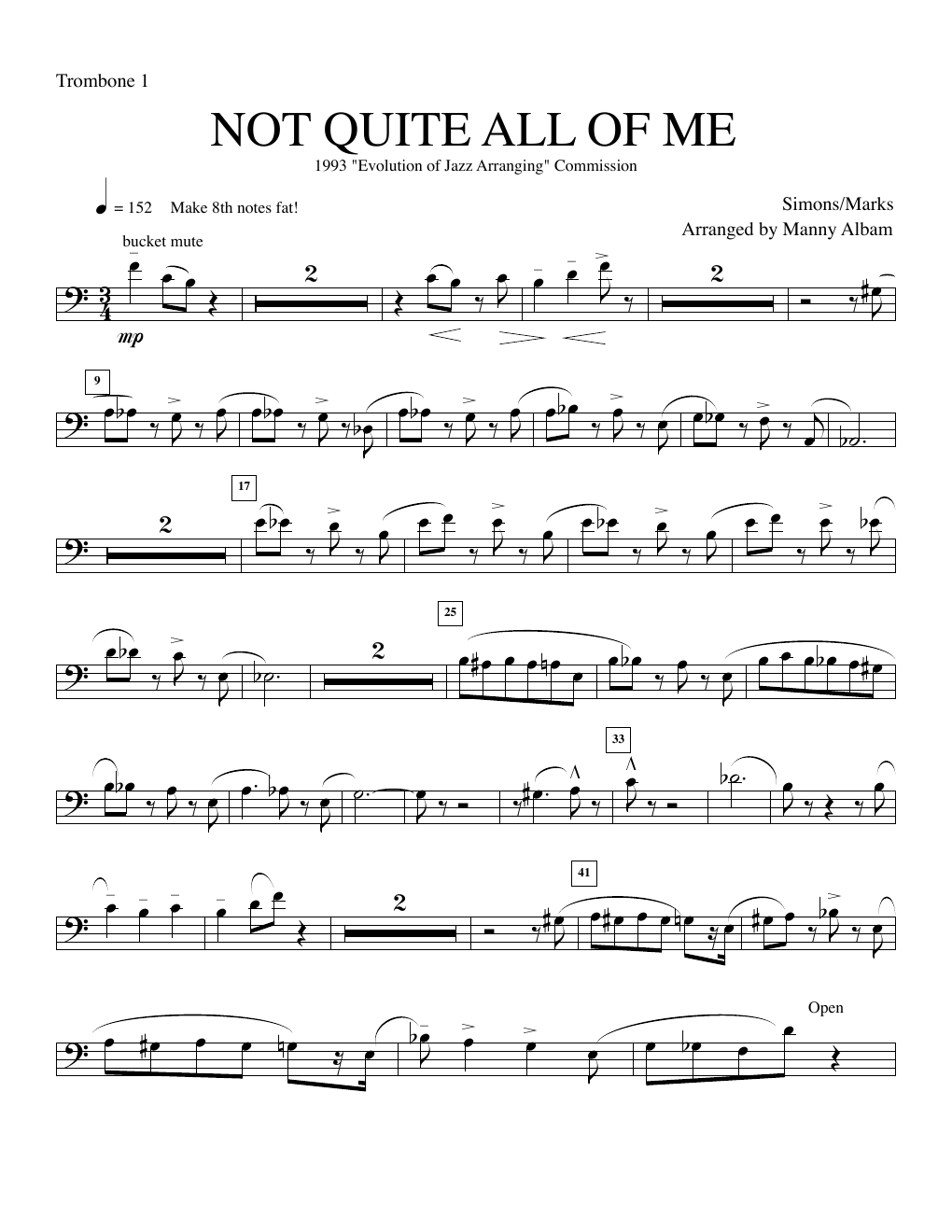
gavotte_trombone (Garth Balint) sheet music preview

gavotte_trombone (Garth Balint)

Composed by Traditional

Arranged by Manny Albam

  • Ensemble: Small Ensemble
  • Style: Traditional
  • Pages: 4
  • Instruments (1): Trombone 1
  • Difficulty: easy
  • Content: Individual Parts
  • Format: PDF Download (Instant)
  • Price: $12.99

The Gavotte, a dance form originating in 17th-century France, holds a distinguished place in classical music, characterized by its moderate tempo, duple meter, and often upbeat, stately character. While traditionally associated with Baroque suites and opera, its melodic and rhythmic charm has transcended eras, occasionally inspiring interpretations across diverse genres. This particular arrangement, "gavotte_trombone (Garth Balint)," reimagines the traditional Gavotte through a unique lens, specifically tailored for a small jazz ensemble. Rather than a direct jazz standard, this piece explores the Gavotte's inherent elegance and structure, presenting it as a foundation for creative jazz improvisation and ensemble interplay, reminiscent of how classical themes were sometimes reinterpreted in early jazz or third-stream compositions. This rendition of the Gavotte establishes a sophisticated yet accessible musical character. It is conceived with a medium swing feel, maintaining the original's graceful pulse but infusing it with a subtle rhythmic lilt. The piece is set in a bright, accessible key, likely C or G major, which contributes to its generally uplifting and clear mood. The energy is one of refined buoyancy, allowing for both precise ensemble work and individual expression. It evokes a feeling of playful elegance, a polite conversation between classical form and jazz sensibility, making it an engaging listen and a rewarding performance experience. The Unknown Arranger's approach to this traditional material is distinctive and insightful, especially given its focus on the trombone. The arrangement likely features the trombone prominently, carrying the primary melodic statements with a blend of lyrical phrasing and jazz articulation. Expect carefully crafted voicings that support the trombone's lead, possibly employing close harmony in the accompanying instruments to create a rich, warm texture. While specific details like shout choruses or extended harmonies might be adapted to the small ensemble format, the arranger's signature will likely be found in how they blend the Gavotte's classical structure with jazz vocabulary – perhaps through reharmonization, rhythmic displacement, or clever counter-melodies. The "Garth Balint" designation suggests a potential dedication or a specific stylistic influence, hinting at a thoughtful and personalized treatment. Performance of this Gavotte arrangement offers both technical and interpretive rewards. The trombone undoubtedly carries the main melody, presenting opportunities for expressive legato playing and nuanced phrasing. There are likely featured solo sections, providing space for improvisation over the Gavotte's chord changes, which will be an engaging challenge for intermediate to advanced soloists. Technical challenges might include maintaining precise ensemble articulation in the swing feel, navigating potentially intricate inner voices, and executing dynamic contrasts effectively. The piece is particularly rewarding for its blend of historical reverence and jazz innovation, allowing musicians to explore a unique stylistic fusion. This arrangement is ideally suited for college-level jazz ensembles, advanced high school groups, or community bands seeking to expand their repertoire with something both familiar and fresh. Its small ensemble format fosters tight musicianship and individual responsibility, making it an excellent vehicle for developing ensemble cohesion and improvisational skills. This arrangement of "gavotte_trombone (Garth Balint)" thrives on a consistent medium swing feel, approximately 120-132 BPM. Emphasize a light, buoyant quarter-note pulse, avoiding a heavy or plodding rhythm. The primary technical challenge lies in maintaining precise articulation and blend, particularly in the melodic lines carried by the trombone and supporting voices. Encourage the trombone soloist to approach the melody with a lyrical, vocal quality, utilizing subtle jazz inflections without losing the inherent grace of the Gavotte. Rehearsal should focus on rhythmic accuracy in the swing eighths and ensuring clarity in any contrapuntal sections. Dynamics are crucial; aim for expressive contrasts, from delicate piano passages to warm, full-bodied forte sections. Pay attention to the balance between the lead trombone and the accompanying instruments to ensure the melody always sings clearly. Q: What instruments are included in this "gavotte_trombone (Garth Balint)" arrangement? A: This arrangement is for a small ensemble, specifically featuring a lead trombone. While exact instrumentation isn't specified, typical small jazz ensemble configurations would include piano, bass, and drums, possibly with one or two additional horn parts to support the lead trombone. Q: What is the difficulty level of this arrangement? A: This arrangement is considered suitable for intermediate to advanced musicians. It requires solid instrumental technique, a good understanding of jazz articulation and swing feel, and improvisational skills for any featured solo sections. Q: What is the musical style and historical context of this piece? A: This arrangement reimagines a traditional Gavotte, a 17th-century French dance form. While the original is classical, this arrangement presents it in a jazz-influenced style, likely with a medium swing feel, blending historical elegance with modern jazz sensibilities. Q: What makes this specific arrangement unique? A: Its uniqueness stems from its focus on the trombone as the primary melodic voice within a small jazz ensemble context, applying jazz interpretation to a classical Gavotte. The "Garth Balint" designation suggests a particular stylistic or dedicatory nuance, making it a distinctive fusion piece. Q: What is the typical performance duration or tempo for this arrangement? A: Given its medium swing feel, the tempo is likely around 120-132 BPM. The performance duration would typically be 3-5 minutes, depending on the number and length of improvised solos.

Questions and answers

What is included in the gavotte_trombone (Garth Balint) PDF?
The verified current file contains individual parts across 4 pages.
How many instruments or parts are listed for gavotte_trombone (Garth Balint)?
The verified instrumentation list contains 1 entries for this Small Ensemble arrangement.
Who is credited for gavotte_trombone (Garth Balint)?
Composer: Traditional. Arranger: Manny Albam.
What difficulty is listed for gavotte_trombone (Garth Balint)?
The verified difficulty level is easy.
What style is listed for gavotte_trombone (Garth Balint)?
The catalog lists the style as Traditional.
Can I preview gavotte_trombone (Garth Balint) before buying?
Yes. The product page provides a preview generated from the current PDF file.
How is gavotte_trombone (Garth Balint) delivered?
After successful payment, the digital PDF is made available for download. The displayed price is $12.99.

Musicians Also Search For

gavotte_trombone Manny Albam PDFgavotte_trombone Manny Albam sheet musicgavotte_trombone arranged by Manny AlbamManny Albam small ensemble chartsManny Albam jazz arrangements PDFgavotte_trombone Traditional sheet musicgavotte_trombone Traditional small ensemble arrangementsTraditional small ensemble chartsgavotte_trombone small ensemble arrangementsgavotte_trombone small ensemble PDF downloadgavotte_trombone jazz sheet musicsmall ensemble sheet music downloadgavotte_trombone individual parts downloadgavotte_trombone sheet music PDFgavotte_trombone Traditional chartsTraditional small ensemble arrangementsbuy gavotte_trombone sheet musicdownload gavotte_trombone PDFgavotte_trombone jazz chartsbest Manny Albam small ensemble arrangementsTraditional arranged by Manny Albamgavotte_trombone printable sheet musicsmall ensemble repertoire PDF

All arrangements by Manny Albam All Traditional sheet music