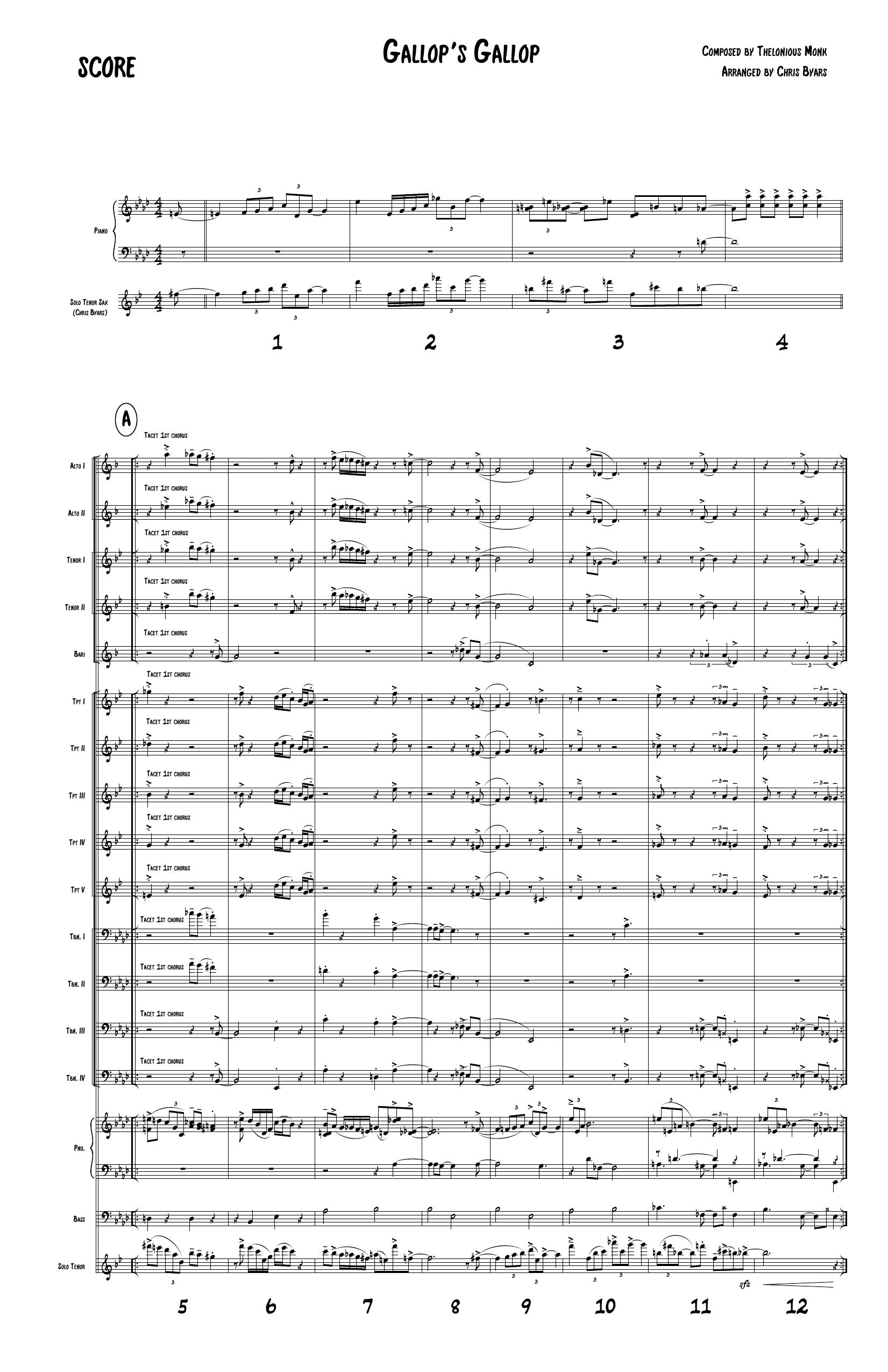
Gallop's Gallop (C.Byars)
Composed by Thelonious Monk
Arranged by Thelonious Monk (arr.C.Byars)
- Ensemble: Big Band
- Pages: 13
- Instruments (19): Piano, Solo Tenor Saxophone, Alto Saxophone I, Alto Saxophone II, Tenor Saxophone I, Tenor Saxophone II, Baritone Saxophone, Trumpet I, Trumpet II, Trumpet III, Trumpet IV, Trumpet V, Trombone I, Trombone II, Trombone III, Trombone IV, Bass, Drums, Guitar
- Difficulty: easy
- Content: Individual Parts
- Format: PDF Download (Instant)
- Price: $24.99
Thelonious Monk’s idiosyncratic compositional genius finds a roaring, dynamic vehicle in "Gallop's Gallop," a piece that encapsulates the unpredictable harmonic landscape and rhythmic displacement of mid-century modern jazz. Originally associated with Monk’s adventurous small-group writing and later reimagined for larger ensembles, this composition stands out for its jagged, asymmetrical melodic contours and driving momentum. It represents the pinnacle of bebop-infused modernism, where angular intervals and playful dissonance collide with an irresistible, infectious forward propulsion. The music evokes a sense of whimsical urgency, balancing intellectual rigor with the sheer, unbridled joy of bebop experimentation. Driven by an invigorating up-tempo swing feel, this big band interpretation crackles with high-octane energy and sharp, percussive accents. The arrangement embraces Monk's signature cluster voicings and sparse, probing piano accompaniment, translating them into massive brass stabs and tightly interwoven saxophone solis. The harmonic language avoids predictable resolutions, favoring chromatic twists and unexpected modal shifts that keep both performers and listeners on the edge of their seats. The mood shifts fluidly between playful cheekiness and fierce, driving intensity, demanding absolute rhythmic precision from the entire ensemble. C. Byars’ meticulous arranging approach honors Monk's legacy by maintaining the composer's structural eccentricities while fully exploiting the textural palette of a 19-piece jazz orchestra. The arrangement features brilliant counterpoint, utilizing section interleaving where the brass and reeds toss fragmented motifs back and forth before locking into thunderous, full-ensemble shout choruses. The voicings avoid traditional, lush block-chord padding, opting instead for open-interval structures that preserve the distinct bite of Monk's original piano harmonies. A prominent solo tenor saxophone takes center stage, cutting through the dense ensemble textures with space for uninhibited, exploratory phrasing. Advanced collegiate, community, and professional big bands will find this chart an exhilarating centerpiece for a concert program. The technical challenges lie primarily in executing the angular unison lines at a brisk tempo, requiring exceptional articulation, dynamic control, and internal clock stability from the rhythm section. Horn players must navigate tricky chromatic passages with clean separation, while the drummer must master the art of trading metric tension and release in the classic Monk tradition. Exceptionally rewarding for ensembles looking to push beyond standard swing-era repertoire, this chart offers a masterclass in modern big band interaction and historic jazz interpretation. Executing "Gallop's Gallop" successfully requires a disciplined approach to tempo stability and articulation. The rhythm section serves as the anchor; the drummer should channel the sparse, comping-heavy style of Art Blakey or Frankie Dunlop, avoiding heavy rides in favor of crisp, interactive snare and bass drum accents that mirror the horns' erratic phrasing. The piano part demands a delicate balance of percussive attack and harmonic space—do not over-pedal. Horn players must treat all staccato markings with a dry, focused tongue, ensuring that the angular leaps in the melody sound intentional rather than frantic. Pay close attention to dynamic contrast; the sudden drops from forte to piano are essential for highlighting Monk's signature comedic timing and structural surprises. Rehearsals should begin under-tempo, focusing on section blend and intonation within the dense, altered chord voicings before pushing toward the performance metronome marking. Q: What instruments and parts are included in this 19-instrument big band arrangement? A: The instrumentation comprises a full standard big band setup: Solo Tenor Saxophone, Alto Saxophone 1, Alto Saxophone 2, Tenor Saxophone 1, plus additional saxophone, trumpet, and trombone parts totaling 19 instruments, alongside a comprehensive conductor score and rhythm section parts. Q: What is the difficulty level of this arrangement? A: This arrangement is rated as advanced, making it best suited for collegiate, professional, and top-tier community jazz orchestras that are comfortable with complex modern harmonies and brisk tempos. Q: What is the historical context and musical style of "Gallop's Gallop"? A: Composed by Thelonious Monk, this piece is rooted in the bebop and hard-bop idioms, showcasing the iconic composer's penchant for angular melodies, dissonant harmony, and playful rhythmic displacement. Q: What makes C. Byars' arrangement of this Monk composition unique? A: Byars brilliantly translates Monk's sparse, eccentric piano voicings into massive, open-interval big band textures, utilizing sharp sectional counterpoint and a dedicated tenor saxophone feature while preserving the original's harmonic edge. Q: What is the approximate performance duration and tempo feel of the piece? A: The arrangement is set at an energetic, driving up-tempo swing feel designed to showcase the band's technical virtuosity and rhythmic cohesion over a brisk multi-minute duration.
Questions and answers
- What is included in the Gallop's Gallop (C.Byars) PDF?
- The verified current file contains a conductor score across 13 pages.
- How many instruments or parts are listed for Gallop's Gallop (C.Byars)?
- The verified instrumentation list contains 19 entries for this Big Band arrangement.
- Who is credited for Gallop's Gallop (C.Byars)?
- Composer: Thelonious Monk. Arranger: Thelonious Monk (arr.C.Byars).
- What difficulty is listed for Gallop's Gallop (C.Byars)?
- The verified difficulty level is easy.
- Can I preview Gallop's Gallop (C.Byars) before buying?
- Yes. The product page provides a preview generated from the current PDF file.
- How is Gallop's Gallop (C.Byars) delivered?
- After successful payment, the digital PDF is made available for download. The displayed price is $24.99.
Musicians Also Search For
Gallop's Gallop Thelonious Monk (arr.C.Byars) PDF • Gallop's Gallop Thelonious Monk (arr.C.Byars) sheet music • Gallop's Gallop arranged by Thelonious Monk (arr.C.Byars) • Thelonious Monk (arr.C.Byars) big band charts • Thelonious Monk (arr.C.Byars) jazz arrangements PDF • Gallop's Gallop Thelonious Monk sheet music • Gallop's Gallop Thelonious Monk big band arrangements • Thelonious Monk big band charts • Gallop's Gallop big band arrangements • Gallop's Gallop big band PDF download • Gallop's Gallop jazz sheet music • big band sheet music download • Gallop's Gallop conductor score PDF • Gallop's Gallop sheet music PDF • buy Gallop's Gallop sheet music • download Gallop's Gallop PDF • Gallop's Gallop jazz charts • best Thelonious Monk (arr.C.Byars) big band arrangements • Thelonious Monk arranged by Thelonious Monk (arr.C.Byars) • Gallop's Gallop printable sheet music • big band repertoire PDF