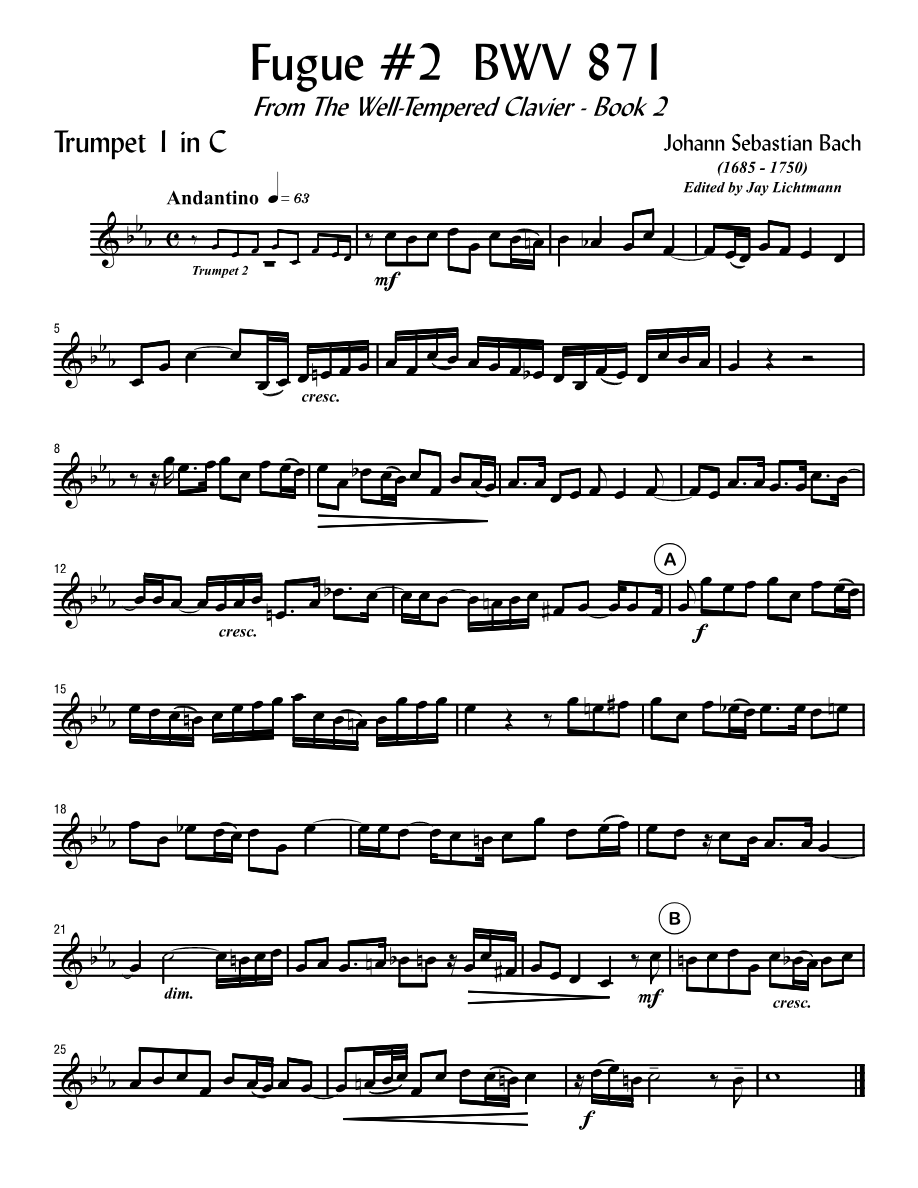
Fugue #2 BWV 871 (J.Lichtmann)
Composed by Johann Sebastian Bach
Arranged by Jay Lichtmann
- Ensemble: Small Ensemble
- Style: Jazz Standard
- Pages: 5
- Instruments (5): Trumpet 1 in C, Trumpet 2 in C, Trombone 1, Trombone 2, Horn in F (Substitute for Trombone 1)
- Difficulty: easy
- Content: Individual Parts
- Format: PDF Download (Instant)
- Price: $12.99
Johann Sebastian Bach's Fugue No. 2 in C minor, BWV 871, is a cornerstone of the Baroque keyboard repertoire, originally composed in 1738 as part of the second book of "The Well-Tempered Clavier". This collection of preludes and fugues was revolutionary for its time, showcasing the possibilities of playing in all 24 major and minor keys with a "well-tempered" tuning system. While not a jazz standard in its original form, Bach's fugues, with their intricate counterpoint and rigorous structure, have long fascinated jazz musicians and composers, inspiring numerous adaptations that bridge the gap between classical formality and jazz improvisation. The piece itself, in C minor and 4/4 time, is characterized by its driving, continuous sixteenth-note figures and a subject that builds in complexity and presence throughout its 28 measures. Jay Lichtmann's arrangement transforms this Baroque masterpiece into a vibrant jazz standard for small ensemble, infusing it with a medium swing feel that recontextualizes Bach's meticulous counterpoint within a contemporary jazz idiom. The arrangement maintains the original C minor key, preserving the fugue's inherently serious and contemplative mood, yet elevates it with the dynamic energy and harmonic richness characteristic of modern jazz. The interplay between voices, a hallmark of Bach's writing, is reimagined through jazz voicings, creating a sophisticated texture that is both intellectually stimulating and rhythmically engaging. The arrangement evokes a sense of respectful innovation, honoring the original's gravitas while inviting listeners into a fresh, swinging interpretation. Lichtmann's distinctive approach to this arrangement is evident in his masterful orchestration for a small jazz ensemble. Rather than merely transcribing, he reharmonizes sections with extended jazz chords, introducing color and tension while preserving the integrity of Bach's melodic lines. Expect to find meticulously crafted soli sections where the ensemble voices weave together, reminiscent of the original fugal entries but now imbued with a jazz sensibility. While the core fugal exposition carries the melody through various instruments, Lichtmann introduces opportunities for featured solos, allowing individual musicians to improvise over the rich harmonic framework he has established. The arrangement's technical challenges lie in maintaining the precise articulation and rhythmic drive of the swing feel, particularly in the rapid sixteenth-note passages, while navigating complex jazz harmonies. The reward is a performance that showcases both individual virtuosity and tight ensemble cohesion, culminating in a powerful and satisfying musical statement. This arrangement is ideally suited for advanced high school, college, community, and professional jazz ensembles. Its demands on musicianship, including strong sight-reading skills, an understanding of jazz harmony, and the ability to articulate a consistent swing feel, make it an excellent vehicle for developing sophisticated ensemble playing. The blend of classical structure and jazz improvisation offers a unique educational opportunity, fostering an appreciation for both genres. It stands out as a challenging yet incredibly rewarding piece, offering moments of intricate beauty and exhilarating swing that will captivate both performers and audiences. Conductors should emphasize a consistent medium swing feel throughout, ensuring that the sixteenth-note lines maintain clarity and propulsion without becoming rushed. The primary technical challenge lies in the precise articulation of Bach's original melodic contours within a jazz rhythmic framework. Encourage musicians to practice the fugal entries slowly, focusing on clean attacks and releases, and to understand their role within the overall counterpoint. Special attention should be given to blend and balance in the soli sections, allowing each voice to be heard without overpowering the others. While no specific special techniques like plunger mutes or falls are explicitly notated, musicians should be encouraged to employ standard jazz phrasing and articulation appropriate to a swinging small ensemble, including subtle scoops and vibrato where musically appropriate. Rehearsal time should be dedicated to isolating and perfecting the handoffs of the fugal subject between instruments, ensuring seamless transitions and a unified ensemble sound. Q: What instruments/parts are included in this arrangement? A: This arrangement is for a small jazz ensemble. The specific instrumentation typically includes a rhythm section (piano, bass, drums) and melodic instruments such as trumpet, saxophone (alto/tenor), and trombone, allowing for flexible voicings of Bach's original four-voice fugue. Q: What is the difficulty level of "Fugue #2 BWV 871 (J.Lichtmann)"? A: This arrangement is considered advanced, suitable for college, community, and professional jazz ensembles. It requires strong technical proficiency, advanced sight-reading, and a solid understanding of jazz harmony and articulation. Q: What is the musical style and historical context of this arrangement? A: This arrangement reinterprets J.S. Bach's Baroque Fugue No. 2 in C minor, BWV 871, composed in 1738, as a jazz standard. It blends the intricate counterpoint of the Baroque era with modern jazz harmonies and a medium swing feel. Q: What makes Jay Lichtmann's arrangement unique? A: Lichtmann's arrangement is unique for its sophisticated reharmonization of Bach's original work with extended jazz chords, meticulously crafted soli sections, and integrated opportunities for jazz improvisation, all while maintaining the structural integrity of the fugue. Q: What is the typical performance duration and tempo for this piece? A: The performance duration will vary slightly based on improvisation, but typically ranges from 3:00 to 4:00 minutes. The tempo is a medium swing, allowing for both rhythmic drive and clarity of the intricate melodic lines.
Questions and answers
- What is included in the Fugue #2 BWV 871 (J.Lichtmann) PDF?
- The verified current file contains individual parts across 5 pages.
- How many instruments or parts are listed for Fugue #2 BWV 871 (J.Lichtmann)?
- The verified instrumentation list contains 5 entries for this Small Ensemble arrangement.
- Who is credited for Fugue #2 BWV 871 (J.Lichtmann)?
- Composer: Johann Sebastian Bach. Arranger: Jay Lichtmann.
- What difficulty is listed for Fugue #2 BWV 871 (J.Lichtmann)?
- The verified difficulty level is easy.
- What style is listed for Fugue #2 BWV 871 (J.Lichtmann)?
- The catalog lists the style as Jazz Standard.
- Can I preview Fugue #2 BWV 871 (J.Lichtmann) before buying?
- Yes. The product page provides a preview generated from the current PDF file.
- How is Fugue #2 BWV 871 (J.Lichtmann) delivered?
- After successful payment, the digital PDF is made available for download. The displayed price is $12.99.
Musicians Also Search For
Fugue #2 BWV 871 Jay Lichtmann PDF • Fugue #2 BWV 871 Jay Lichtmann sheet music • Fugue #2 BWV 871 arranged by Jay Lichtmann • Jay Lichtmann small ensemble charts • Jay Lichtmann jazz arrangements PDF • Fugue #2 BWV 871 Johann Sebastian Bach sheet music • Fugue #2 BWV 871 Johann Sebastian Bach small ensemble arrangements • Johann Sebastian Bach small ensemble charts • Fugue #2 BWV 871 small ensemble arrangements • Fugue #2 BWV 871 small ensemble PDF download • Fugue #2 BWV 871 jazz sheet music • small ensemble sheet music download • Fugue #2 BWV 871 individual parts download • Fugue #2 BWV 871 sheet music PDF • Fugue #2 BWV 871 Jazz Standard charts • Jazz Standard small ensemble arrangements • buy Fugue #2 BWV 871 sheet music • download Fugue #2 BWV 871 PDF • Fugue #2 BWV 871 jazz charts • best Jay Lichtmann small ensemble arrangements • Johann Sebastian Bach arranged by Jay Lichtmann • Fugue #2 BWV 871 printable sheet music • small ensemble repertoire PDF