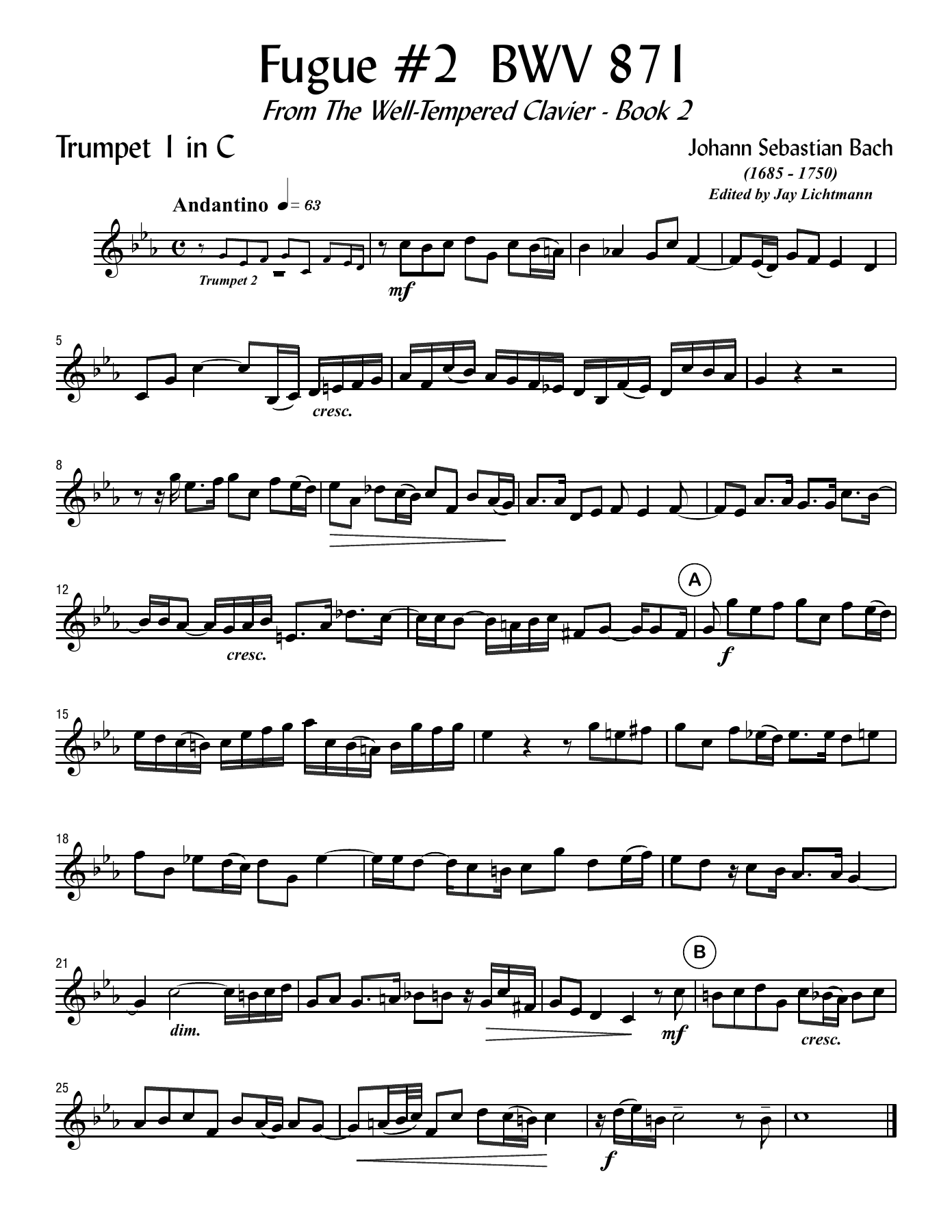
Fugue #2 BWV (comp. Johann Sebastian Bach) sheet music preview

Fugue #2 BWV (comp. Johann Sebastian Bach)

Composed by Johann Sebastian Bach

Arranged by Jay Lichtmann

  • Ensemble: Small Ensemble
  • Style: Traditional
  • Pages: 5
  • Instruments (5): Trumpet 1 in C, Trumpet 2 in C, Trombone 1, Trombone 2, Horn in F
  • Difficulty: easy
  • Content: Individual Parts
  • Format: PDF Download (Instant)
  • Price: $12.99

Johann Sebastian Bach's "Fugue #2 in C minor, BWV 847" from Book I of *The Well-Tempered Clavier* stands as a cornerstone of Western classical music, a testament to intricate counterpoint and harmonic ingenuity. Composed around 1722, this Baroque masterpiece, originally for keyboard, has captivated musicians and audiences for centuries with its tightly woven thematic development and emotional depth. While not a traditional jazz standard, its inherent musicality and structural brilliance have long made it a compelling subject for reinterpretation across various genres. This particular arrangement by an Unknown Arranger reimagines Bach's iconic work through a traditional jazz lens, transforming its classical precision into a vibrant, swinging exploration while retaining the integrity of the original fugal form. The musical character of this arrangement is a sophisticated medium swing, set in its original key of C minor. The mood oscillates between contemplative introspection and buoyant, driving energy, reflecting both Bach's original gravitas and the inherent optimism of swing. The arrangement opens with the fugal subject presented clearly, often in unison or octaves, before blossoming into rich, four-part jazz voicings. The energy builds steadily, culminating in sections that feature a full ensemble sound, evoking a classic big band feel despite its small ensemble instrumentation. The piece demands a precise yet relaxed swing eighth-note feel, ensuring that the intricate contrapuntal lines retain their clarity while grooving authentically. The Unknown Arranger's approach to this Bach fugue is particularly distinctive, demonstrating a deep respect for the source material while infusing it with authentic jazz idioms. Rather than merely harmonizing the original lines, the arranger skillfully re-orchestrates the fugal voices, assigning them to different instruments within the small ensemble. There are moments of tightly voiced soli sections that highlight the ensemble's blend, often reinterpreting Bach's counterpoint with modern jazz harmony. While not featuring extended improvised solos in the traditional sense, the arrangement often presents the fugal subject and countersubject in a way that allows for individual instrumental character to shine through. The technical challenges lie in maintaining the clarity of the independent lines, executing precise articulations, and sustaining a consistent swing feel throughout the piece's dynamic and textural shifts. The reward of performing it lies in the unique blend of intellectual satisfaction from Bach's genius and the visceral joy of swinging jazz. This arrangement is ideally suited for advanced high school, college, community, or professional small jazz ensembles. Its demands for precise ensemble playing, sophisticated harmonic understanding, and a nuanced grasp of swing articulation make it an excellent educational tool for developing musicians. However, its inherent musicality and clever blend of classical and jazz elements also make it a highly engaging and rewarding piece for seasoned groups looking to expand their repertoire with something truly unique and challenging. This arrangement of Bach's Fugue #2 BWV requires meticulous attention to detail to achieve its intended blend of classical precision and jazz vitality. The primary technical challenge lies in articulating the independent fugal lines with clarity while maintaining a relaxed, medium swing feel. Conductors should emphasize a light, precise attack on eighth notes, avoiding a heavy or rushed feel. Rehearsal should focus on isolating individual voices to ensure each musician understands their melodic and rhythmic role within the counterpoint. Pay close attention to dynamic contrasts, particularly in sections where the fugal subject is passed between instruments; these shifts should be deliberate and contribute to the overall narrative. There are no special techniques like mutes or falls indicated, so focus should remain on blend, balance, and rhythmic accuracy. The piece is in C minor and should be approached with a consistent medium swing tempo, allowing the intricate lines to breathe without dragging. Encourage musicians to listen across the ensemble, ensuring that the polyphonic texture remains transparent and engaging. Q: What instruments/parts are included in this arrangement? A: This arrangement is for a small jazz ensemble, typically including trumpet, alto saxophone, tenor saxophone, trombone, piano, bass, and drums. Specific instrumentation may vary slightly depending on the arranger's intent for the "Unknown Arranger" designation. Q: What is the difficulty level of "Fugue #2 BWV" (arranged)? A: This arrangement is considered advanced, suitable for advanced high school, college, community, and professional small jazz ensembles due to its intricate counterpoint, demanding ensemble precision, and sophisticated harmonic language. Q: What is the musical style and historical context of this arrangement? A: This arrangement reinterprets Johann Sebastian Bach's Baroque "Fugue #2 in C minor, BWV 847" through a traditional jazz lens, blending classical counterpoint with a medium swing feel. The original piece was composed around 1722. Q: What makes this particular arrangement unique compared to other jazz interpretations of classical works? A: This arrangement stands out for its faithful yet inventive re-orchestration of Bach's fugal voices into a swinging small ensemble setting, utilizing modern jazz voicings and articulation while preserving the original work's structural integrity and emotional depth. Q: What is the approximate performance duration or tempo for this piece? A: The piece is intended to be performed at a medium swing tempo. While exact duration can vary with interpretation, a typical performance would be approximately 3-4 minutes, allowing for the full development of the fugal material.

Questions and answers

What is included in the Fugue #2 BWV (comp. Johann Sebastian Bach) PDF?
The verified current file contains individual parts across 5 pages.
How many instruments or parts are listed for Fugue #2 BWV (comp. Johann Sebastian Bach)?
The verified instrumentation list contains 5 entries for this Small Ensemble arrangement.
Who is credited for Fugue #2 BWV (comp. Johann Sebastian Bach)?
Composer: Johann Sebastian Bach. Arranger: Jay Lichtmann.
What difficulty is listed for Fugue #2 BWV (comp. Johann Sebastian Bach)?
The verified difficulty level is easy.
What style is listed for Fugue #2 BWV (comp. Johann Sebastian Bach)?
The catalog lists the style as Traditional.
Can I preview Fugue #2 BWV (comp. Johann Sebastian Bach) before buying?
Yes. The product page provides a preview generated from the current PDF file.
How is Fugue #2 BWV (comp. Johann Sebastian Bach) delivered?
After successful payment, the digital PDF is made available for download. The displayed price is $12.99.

Musicians Also Search For

Fugue #2 BWV Jay Lichtmann PDFFugue #2 BWV Jay Lichtmann sheet musicFugue #2 BWV arranged by Jay LichtmannJay Lichtmann small ensemble chartsJay Lichtmann jazz arrangements PDFFugue #2 BWV Johann Sebastian Bach sheet musicFugue #2 BWV Johann Sebastian Bach small ensemble arrangementsJohann Sebastian Bach small ensemble chartsFugue #2 BWV small ensemble arrangementsFugue #2 BWV small ensemble PDF downloadFugue #2 BWV jazz sheet musicsmall ensemble sheet music downloadFugue #2 BWV individual parts downloadFugue #2 BWV sheet music PDFFugue #2 BWV Traditional chartsTraditional small ensemble arrangementsbuy Fugue #2 BWV sheet musicdownload Fugue #2 BWV PDFFugue #2 BWV jazz chartsbest Jay Lichtmann small ensemble arrangementsJohann Sebastian Bach arranged by Jay LichtmannFugue #2 BWV printable sheet musicsmall ensemble repertoire PDF

All arrangements by Jay Lichtmann All Johann Sebastian Bach sheet music