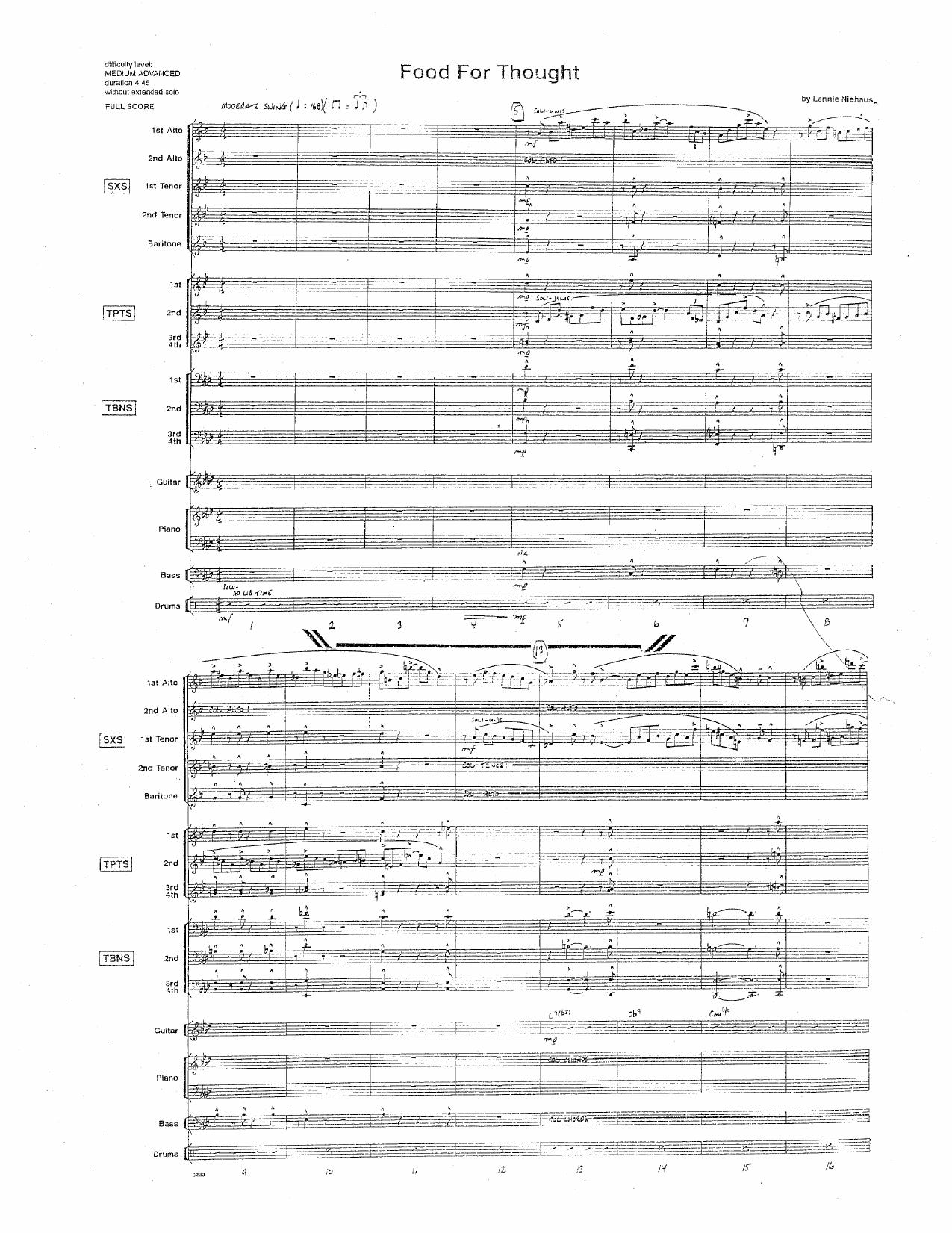
Food For Thought (L.Niehaus) sheet music preview

Food For Thought (L.Niehaus)

Composed by Lennie Niehaus

Arranged by Lennie Niehaus

  • Ensemble: Big Band
  • Pages: 46
  • Instruments (17): 1st Eb Alto Saxophone, 2nd Eb Alto Saxophone, 1st Bb Tenor Saxophone, 2nd Bb Tenor Saxophone, Eb Baritone Saxophone, 1st Bb Trumpet, 2nd Bb Trumpet, 3rd Bb Trumpet, 4th Bb Trumpet, 1st Trombone, 2nd Trombone, 3rd Trombone, 4th Trombone, Guitar, Piano, Bass, Drums
  • Difficulty: medium
  • Content: Individual Parts
  • Format: PDF Download (Instant)
  • Price: $24.99

West Coast jazz history is indelibly linked to the prolific writing and alto saxophone artistry of Lennie Niehaus, whose charts for Stan Kenton and his own small groups defined a sophisticated, cool-toned counter-statement to East Coast bebop. "Food For Thought" encapsulates the brilliant compositional mind of an arranger who balanced intricate contrapuntal lines with an undeniable, swinging momentum. Emerging from the vibrant post-war California modern jazz scene, Niehaus crafted charts that demanded precision, light articulation, and a deep understanding of harmonic extensions without ever sacrificing warmth or groove. This timeless contribution to the big band repertoire serves as a masterclass in West Coast counterpoint, linear writing, and economic yet striking orchestration. Driving with a bright, infectious medium-up swing feel in 4/4 time, "Food For Thought" radiates an energetic yet intellectually engaging mood. The piece opens with a crisp, punchy thematic statement that immediately establishes a sophisticated atmosphere, balancing buoyant rhythmic syncopations with cool, harmonically rich voicings. The emotional landscape shifts seamlessly between driving, high-energy tutti sections and relaxed, linear interludes that evoke the quintessential sun-drenched, cerebral aesthetic of 1950s modernist jazz. The harmony relies heavily on clean extensions, clever chromatic passing tones, and tight brass-and-reed interlockings that create a transparent, highly textured sonic signature. Niehaus’s arranging approach is immediately recognizable through his brilliant handling of saxophone solis and interlocking horn counterlines. Rather than relying on heavy, thick block chords characteristic of some East Coast powerhouse charts, Niehaus treats the big band like a chamber ensemble, utilizing transparent textures, linear voice-leading, and ingenious cross-section scoring. The saxophones—led by two altos, two tenors, and baritone—often act as a cohesive, nimble unit executing intricate bebop-inflected lines, while the brass respond with sharp, angular stabs. A meticulously crafted shout chorus builds organically, layering dynamic intensity and harmonic tension before resolving into a triumphant restatement of the main theme. Performance-wise, the chart places primary melodic responsibilities on the saxophone section and lead trumpet, demanding clean articulation, nimble fingerwork, and impeccable section blend. Solo opportunities are provided for key improvisers, allowing soloists to stretch out over standard, well-structured chord changes that sit comfortably on the fingerboard. Technical challenges center around maintaining a light, articulate swing eighth-note feel at a brisk tempo, ensuring that fast linear passages do not rush or bog down. Advanced high school, collegiate, and professional jazz ensembles will find this arrangement profoundly rewarding, as it forces players to develop better internal time, dynamic control, and horizontal ear-training. Conductors tackling "Food For Thought" should prioritize a light, buoyant swing feel with a distinct articulation style—think detached and breathless eighth notes rather than heavy, legato bebop lines. The tempo must remain steady and driving; avoid dragging during the transitions between full ensemble tutti passages and sparse developmental sections. Saxophone and brass sections must rehearse their interlocking lines with a metronome to lock in the rapid, scalar unison passages characteristic of Niehaus’s writing. Pay close attention to dynamic markings: Niehaus often builds tension through careful crescendos rather than sheer volume, so balancing the accompanying horns beneath featured soloists is critical. Ensure that trumpets and trombones use clean, controlled attacks without excessive edge, preserving the cool, polished West Coast aesthetic inherent in the score. Q: What instruments and parts are included in this big band arrangement? A: The instrumentation is scored for a standard 17-piece big band, consisting of Alto Saxophone 1, Alto Saxophone 2, Tenor Saxophone 1, Tenor Saxophone 2, Baritone Saxophone, 4 Trumpets, 4 Trombones, Piano, Guitar, Bass, and Drums, along with a comprehensive conductor score. Q: What is the difficulty level of this arrangement? A: This chart is graded as advanced, making it ideal for collegiate jazz ensembles, advanced high school bands, and professional or community big bands looking for sophisticated material. Q: What musical style and historical context does "Food For Thought" represent? A: Composed by Lennie Niehaus, it represents the West Coast "cool" jazz movement of the 1950s, blending intricate bebop-influenced linear writing with clear, transparent orchestrations. Q: What makes this specific Lennie Niehaus arrangement unique? A: Its uniqueness lies in Niehaus's masterful chamber-like counterpoint, highly intricate saxophone soli sections, and sophisticated harmonic voicings that avoid heavy block chords in favor of nimble, horizontal voice-leading. Q: What is the recommended tempo feel and duration for this piece? A: The arrangement is set in a bright, driving medium-up swing feel at 4/4 time, typically clocking in at around 3 to 4 minutes depending on the length of the improvised solos.

Questions and answers

What is included in the Food For Thought (L.Niehaus) PDF?
The verified current file contains a conductor score and individual parts across 46 pages.
How many instruments or parts are listed for Food For Thought (L.Niehaus)?
The verified instrumentation list contains 17 entries for this Big Band arrangement.
Who is credited for Food For Thought (L.Niehaus)?
Composer: Lennie Niehaus. Arranger: Lennie Niehaus.
What difficulty is listed for Food For Thought (L.Niehaus)?
The verified difficulty level is medium.
Can I preview Food For Thought (L.Niehaus) before buying?
Yes. The product page provides a preview generated from the current PDF file.
How is Food For Thought (L.Niehaus) delivered?
After successful payment, the digital PDF is made available for download. The displayed price is $24.99.

Musicians Also Search For

Food For Thought Lennie Niehaus PDFFood For Thought Lennie Niehaus sheet musicFood For Thought arranged by Lennie NiehausLennie Niehaus big band chartsLennie Niehaus jazz arrangements PDFFood For Thought Lennie Niehaus big band arrangementsFood For Thought big band arrangementsFood For Thought big band PDF downloadFood For Thought jazz sheet musicbig band sheet music downloadFood For Thought conductor score PDFFood For Thought individual parts downloadFood For Thought sheet music PDFbuy Food For Thought sheet musicdownload Food For Thought PDFFood For Thought jazz chartsbest Lennie Niehaus big band arrangementsFood For Thought printable sheet musicbig band repertoire PDF

All arrangements by Lennie Niehaus All Lennie Niehaus sheet music