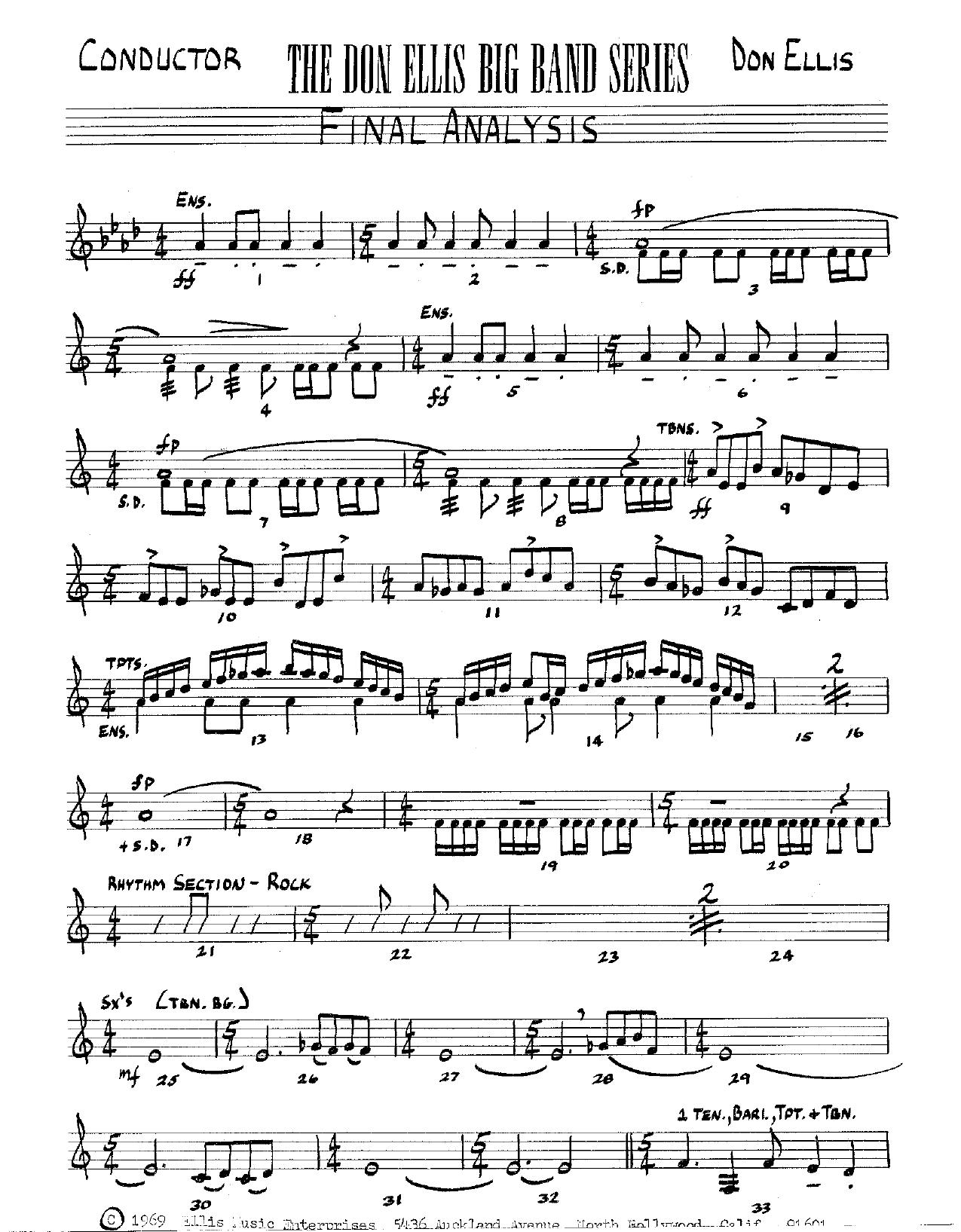
Final Analysis (D.Ellis)
Composed by Don Ellis
Arranged by Don Ellis
- Ensemble: Big Band
- Pages: 98
- Instruments (22): Conductor, Reed 1 (Alto Saxophone, Soprano Saxophone), Reed 2 (Alto Saxophone, Piccolo), Reed 3 (Tenor Saxophone, Clarinet), Reed 4 (Tenor Saxophone, Clarinet, Flute), Reed 5 (Baritone Saxophone, Clarinet, Piccolo), Solo Trumpet, Trumpet 1, Trumpet 2, Trumpet 3, Trumpet 4, Guitar, Piano (Organ), Bass, Drums 1, Drums 2, Conga, Timbales, Trombone 1, Trombone 2, Trombone 3 (Bass Trombone), Tuba
- Difficulty: advanced
- Content: Individual Parts
- Format: PDF Download (Instant)
- Price: $24.99
Don Ellis pushed the boundaries of avant-garde big band jazz during the late 1960s and early 1970s, infusing traditional jazz orchestration with odd meters, microtones, and electrifying rock energy. "Final Analysis" stands as a quintessential artifact of this innovative era, capturing the fiery intensity and intellectual rigor that defined the Don Ellis Orchestra's legendary live performances and Columbia Records releases. Written during a period when the ensemble was redefining the sonic parameters of the traditional big band, this composition showcases Ellis's mastery of complex rhythmic subdivisions and driving momentum, transporting listeners into a high-octane sonic landscape that bridges post-bop exploration with progressive big band fusion. Driven by a relentless, high-energy groove, "Final Analysis" operates at an exhilarating tempo that demands absolute precision from every section. The musical character is urgent, cerebral, and relentlessly dynamic, moving seamlessly between explosive ensemble hits and intricate, interlocking rhythmic ostinatos. The mood is tense yet triumphant, evoking a sense of kinetic urgency through shifting accents and asymmetrical meters that challenge both the performers' internal clocks and their technical agility. The harmonic language is rich with extended alterations, sharp dissonance, and modal colorations, creating a dense, modern texture that feels both chaotic and meticulously calculated. In his own arrangement, Don Ellis utilizes a compact yet potent 8-instrument big band instrumentation (featuring Alto Saxophone, Tenor Saxophone, Baritone Saxophone, Trumpet, Trombone, and rhythm section support within its comprehensive 98-page score) to achieve the maximalist impact of a full 20-piece orchestra. Ellis’s arranging approach relies heavily on transparent, exposed voicing where every part functions as an essential melodic or counter-rhythmic pillar. Horns are frequently deployed in tight, angular solis and blistering unison passages that cut through the rhythm section with surgical precision. Rather than leaning on conventional swing-era shout choruses, Ellis constructs developmental climaxes through cumulative rhythmic layering, where independent lines collide to form massive, harmonically complex vertical structures. Performing "Final Analysis" requires an advanced professional or elite collegiate ensemble capable of navigating sophisticated odd-meter subdivisions, rapid articulation shifts, and demanding endurance. The melody is shared dynamically across the horn section, requiring seamless blending between the saxophone and brass voices during lightning-fast unison lines. Featured solo sections provide ample space for advanced improvisers to stretch over modern modal changes. The primary technical challenges lie in the execution of complex metric modulations and maintaining impeccable intonation through tight, altered chord voicings. For ensembles looking to test their technical limits while exploring a vital chapter of progressive jazz history, this 98-page masterwork offers an intensely rewarding and unforgettable performance experience. Conductors tackling "Final Analysis" must first establish a rock-solid internal pulse for the ensemble, as the primary challenge lies in mastering the piece's complex, asymmetrical rhythmic subdivisions without dragging or rushing. Rehearsal should begin away from the horns; have the rhythm section loop the foundational groove until the underlying pocket feels entirely natural. Pay meticulous attention to articulation markings—staccatos must be clipped and uniform across both saxophones and brass to preserve the driving, percussive nature of Ellis's writing. Trumpet and trombone players should approach high-register passages with relaxed air support, avoiding forced tone quality during aggressive ensemble unisons. Dynamic contrast is crucial; balance the heavy, fortissimo stabs against sudden, delicate sub-tone textures to maintain narrative tension throughout the 98-page score. Section leaders should run internal sectional rehearsals to lock in intonation on the altered chord clusters before integrating the full band. Q: What instruments and parts are included in this arrangement? A: This 98-page arrangement is scored for an 8-instrument ensemble featuring Alto Saxophone, Tenor Saxophone, Baritone Saxophone, Trumpet, Trombone, and a complete rhythm section, meticulously condensed to retain the full impact of the original Don Ellis orchestrations. Q: What is the difficulty level of "Final Analysis"? A: This arrangement is designated for advanced college, community, and professional big bands due to its demanding tempo, complex odd-meter subdivisions, and advanced harmonic vocabulary. Q: What musical style and historical context does this piece represent? A: Composed by Don Ellis, "Final Analysis" represents the progressive, avant-garde big band jazz movement of the late 1960s and early 1970s, merging post-bop complexity with high-energy fusion and non-traditional meters. Q: What makes this specific Don Ellis arrangement unique? A: The arrangement is uniquely defined by Ellis's transparent, exposed voicings, angular unison horn lines, and cumulative rhythmic layering that creates massive vertical textures from a compact 8-instrument ensemble. Q: What is the performance duration and tempo feel of this arrangement? A: The piece is built around an exhilarating, high-tempo groove designed to test ensemble endurance, typically running for several minutes of non-stop, high-intensity performance depending on the length of the improvised solos.
Questions and answers
- What is included in the Final Analysis (D.Ellis) PDF?
- The verified current file contains a conductor score and individual parts across 98 pages.
- How many instruments or parts are listed for Final Analysis (D.Ellis)?
- The verified instrumentation list contains 22 entries for this Big Band arrangement.
- Who is credited for Final Analysis (D.Ellis)?
- Composer: Don Ellis. Arranger: Don Ellis.
- What difficulty is listed for Final Analysis (D.Ellis)?
- The verified difficulty level is advanced.
- Can I preview Final Analysis (D.Ellis) before buying?
- Yes. The product page provides a preview generated from the current PDF file.
- How is Final Analysis (D.Ellis) delivered?
- After successful payment, the digital PDF is made available for download. The displayed price is $24.99.
Musicians Also Search For
Final Analysis Don Ellis PDF • Final Analysis Don Ellis sheet music • Final Analysis arranged by Don Ellis • Don Ellis big band charts • Don Ellis jazz arrangements PDF • Final Analysis Don Ellis big band arrangements • Final Analysis big band arrangements • Final Analysis big band PDF download • Final Analysis jazz sheet music • big band sheet music download • Final Analysis conductor score PDF • Final Analysis individual parts download • Final Analysis sheet music PDF • buy Final Analysis sheet music • download Final Analysis PDF • Final Analysis jazz charts • best Don Ellis big band arrangements • Final Analysis printable sheet music • big band repertoire PDF