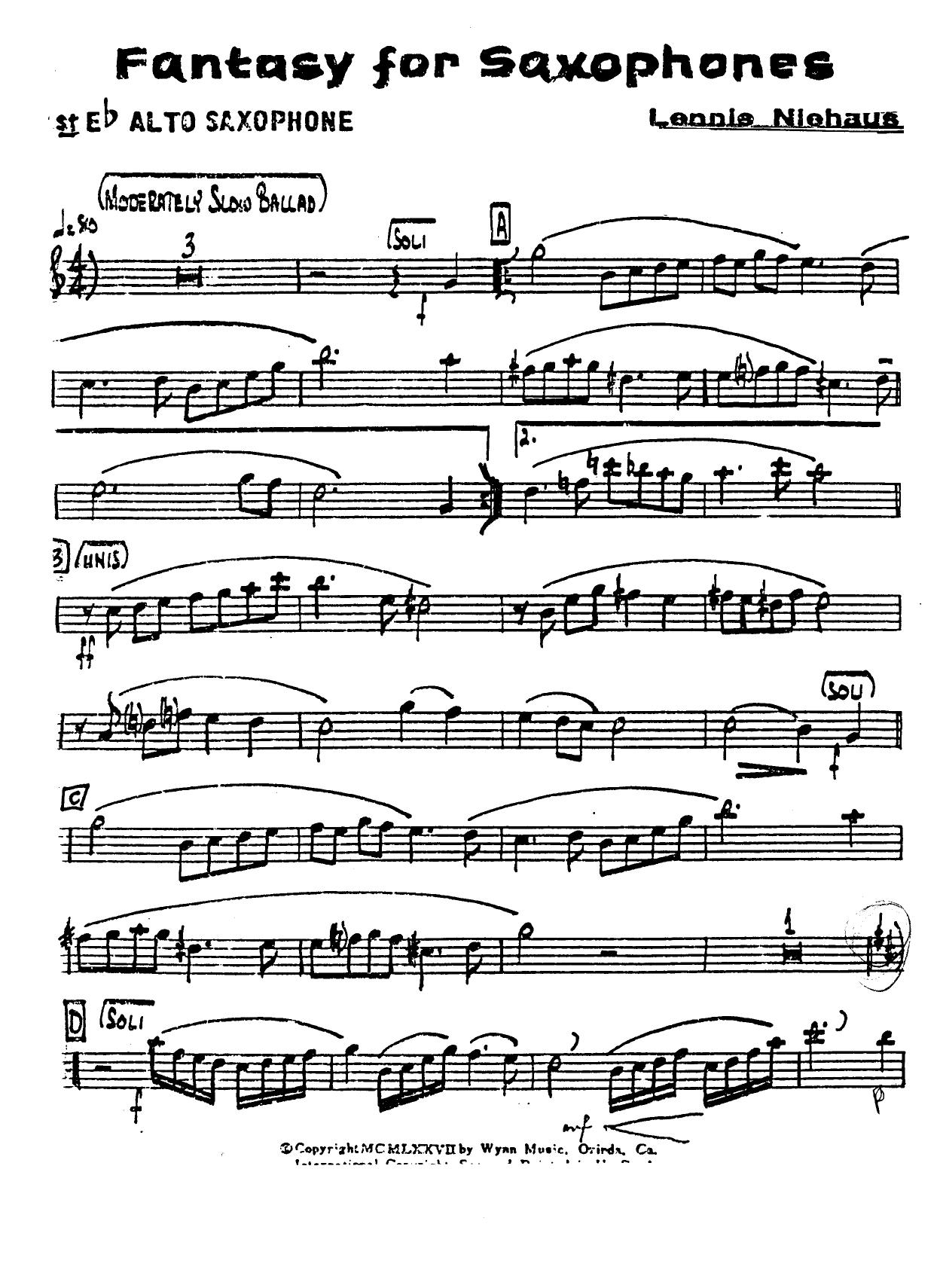
Fantasy For Saxophones (L.Niehaus) sheet music preview

Fantasy For Saxophones (L.Niehaus)

Composed by Lennie Niehaus

Arranged by Lennie Niehaus

  • Ensemble: Big Band
  • Pages: 36
  • Instruments (16): 1st Eb Alto Saxophone, 2nd Eb Alto Saxophone, 1st Bb Tenor Saxophone, 2nd Bb Tenor Saxophone, Eb Baritone Saxophone, 1st Bb Trumpet, 2nd Bb Trumpet, 3rd Bb Trumpet, 4th Bb Trumpet, 1st Trombone, 2nd Trombone, 3rd Trombone, 4th Trombone, Piano, Bass, Drums
  • Difficulty: medium
  • Content: Individual Parts
  • Format: PDF Download (Instant)
  • Price: $24.99

Lennie Niehaus’s "Fantasy For Saxophones" stands as a brilliant testament to West Coast cool jazz composition, capturing the sophisticated, counterpoint-driven aesthetic that defined the California jazz scene of the 1950s and 60s. Niehaus, renowned for his extensive work with the Stan Kenton Orchestra as both lead alto saxophonist and staff arranger, brought an intimate understanding of saxophone timbre and articulation to his writing. This chart reflects the sleek, harmonically advanced, yet swinging style that bypassed East Coast aggression in favor of pristine intonation, linear clarity, and intricate harmonic textures. It represents a golden era of jazz arranging where modernist composition techniques met classic swinging momentum. Driven by a crisp, buoyant medium-up swing feel in 4/4 time, "Fantasy For Saxophones" opens with an inviting, conversational energy that immediately showcases the agility of the horn section. The harmonic language is rich with extended extensions—major sevenths, ninths, and altered dominants—typifying Niehaus's signature West Coast vocabulary, yet it remains remarkably accessible due to its transparent voice-leading. The mood shifts fluidly between playful, intricate bebop-inflected lines and lush, cinematic harmonic plateaus. The overall sonic landscape evokes the sophisticated atmosphere of a West Coast jazz club, balancing intellectual rigour with an undeniable toe-tapping pulse that keeps both performers and audiences thoroughly engaged. True to its title, the arrangement serves as an extended feature vehicle for the reed section, though it is orchestrated for a dynamic 8-instrument big band ensemble (featuring Alto Sax, Tenor Sax, Baritone Sax, Trumpet, Trombone, and rhythm section support). Niehaus constructs brilliant, multi-voiced sax solid sections that demand absolute precision, tight blend, and light, articulated tonguing. The brass instruments act primarily as a punctuating, responsive foil to the dominant woodwind lines, offering rich chordal stabs and counter-melodies that never obscure the saxophones. Technical challenges center around navigating rapid, interlocking diatonic lines, maintaining consistent stylistic articulation at higher tempos, and balancing the inner voices within the saxophone choir. Solo opportunities allow featured players to stretch out over changes reminiscent of classic modal and bop frameworks, making every measure a masterclass in linear phrasing. Advanced high school ensembles, collegiate jazz bands, and professional community big bands will find "Fantasy For Saxophones" an ideal vehicle for developing sectional blend, stylistic versatility, and endurance. While the technical demands require proficient players—particularly within the saxophone section who must execute nimble scalar passages and complex rhythms—the payoff is immense. Performing this piece elevates an ensemble's listening skills, requiring players to lock in with sectional intonation and dynamic nuance. It serves as a stellar festival piece or a sophisticated concert program centerpiece that bridges the gap between traditional swing and modern jazz composition. Conductors approaching "Fantasy For Saxophones" must prioritize sectional unity and lightness of touch above sheer volume. The primary technical challenge lies in the execution of Niehaus’s intricate, linear counterpoint; the saxophone section must rehearse passages slowly with a metronome to ensure uniform articulation and pristine tuplets before pushing toward the performance tempo. Aim for a bright, forward-moving medium swing feel around quarter note = 180–192, ensuring the rhythm section maintains a driving, unhurried pulse without rushing the lighter eighth-note passages. Brass players should treat their stabs and background figures with restraint, keeping dynamic levels subservient to the unfolding woodwind melodies. Directors should encourage players to swing eighth notes naturally, avoiding heavy downbeat accents in favor of a smooth, horizontal legato-tonguing approach. Pay close attention to balance during the dense harmonic shifts; inner voices must project clearly to let Niehaus's sophisticated chord voicings resonate fully across the ensemble. Q: What instruments and parts are included in this arrangement? A: This arrangement is scored for an 8-instrument ensemble featuring Alto Saxophone, Tenor Saxophone, Baritone Saxophone, Trumpet, Trombone, and a complete rhythm section. Q: What is the difficulty level of this chart? A: It is suited for advanced high school, collegiate, and professional jazz ensembles due to its intricate saxophone soli lines, fast tempos, and sophisticated harmonic reading requirements. Q: What is the style and historical context of "Fantasy For Saxophones"? A: Written by Lennie Niehaus, this piece represents the sophisticated West Coast cool jazz movement of the 1950s and 60s, blending bebop harmonic sophistication with pristine, linear counterpoint. Q: What makes this specific arrangement unique? A: It functions as a brilliant showcase piece that treats the saxophone section as a unified soloist, highlighting Niehaus's signature dense, gorgeous voicings and intricate dialogue between reeds and brass. Q: What is the performance duration and tempo framework? A: The piece is set in a driving 4/4 meter with a bright medium-up swing feel, typically clocking in around 3 to 4 minutes depending on the length of improvised solo spaces.

Questions and answers

What is included in the Fantasy For Saxophones (L.Niehaus) PDF?
The verified current file contains individual parts across 36 pages.
How many instruments or parts are listed for Fantasy For Saxophones (L.Niehaus)?
The verified instrumentation list contains 16 entries for this Big Band arrangement.
Who is credited for Fantasy For Saxophones (L.Niehaus)?
Composer: Lennie Niehaus. Arranger: Lennie Niehaus.
What difficulty is listed for Fantasy For Saxophones (L.Niehaus)?
The verified difficulty level is medium.
Can I preview Fantasy For Saxophones (L.Niehaus) before buying?
Yes. The product page provides a preview generated from the current PDF file.
How is Fantasy For Saxophones (L.Niehaus) delivered?
After successful payment, the digital PDF is made available for download. The displayed price is $24.99.

Musicians Also Search For

Fantasy For Saxophones Lennie Niehaus PDFFantasy For Saxophones Lennie Niehaus sheet musicFantasy For Saxophones arranged by Lennie NiehausLennie Niehaus big band chartsLennie Niehaus jazz arrangements PDFFantasy For Saxophones Lennie Niehaus big band arrangementsFantasy For Saxophones big band arrangementsFantasy For Saxophones big band PDF downloadFantasy For Saxophones jazz sheet musicbig band sheet music downloadFantasy For Saxophones individual parts downloadFantasy For Saxophones sheet music PDFbuy Fantasy For Saxophones sheet musicdownload Fantasy For Saxophones PDFFantasy For Saxophones jazz chartsbest Lennie Niehaus big band arrangementsFantasy For Saxophones printable sheet musicbig band repertoire PDF

All arrangements by Lennie Niehaus All Lennie Niehaus sheet music