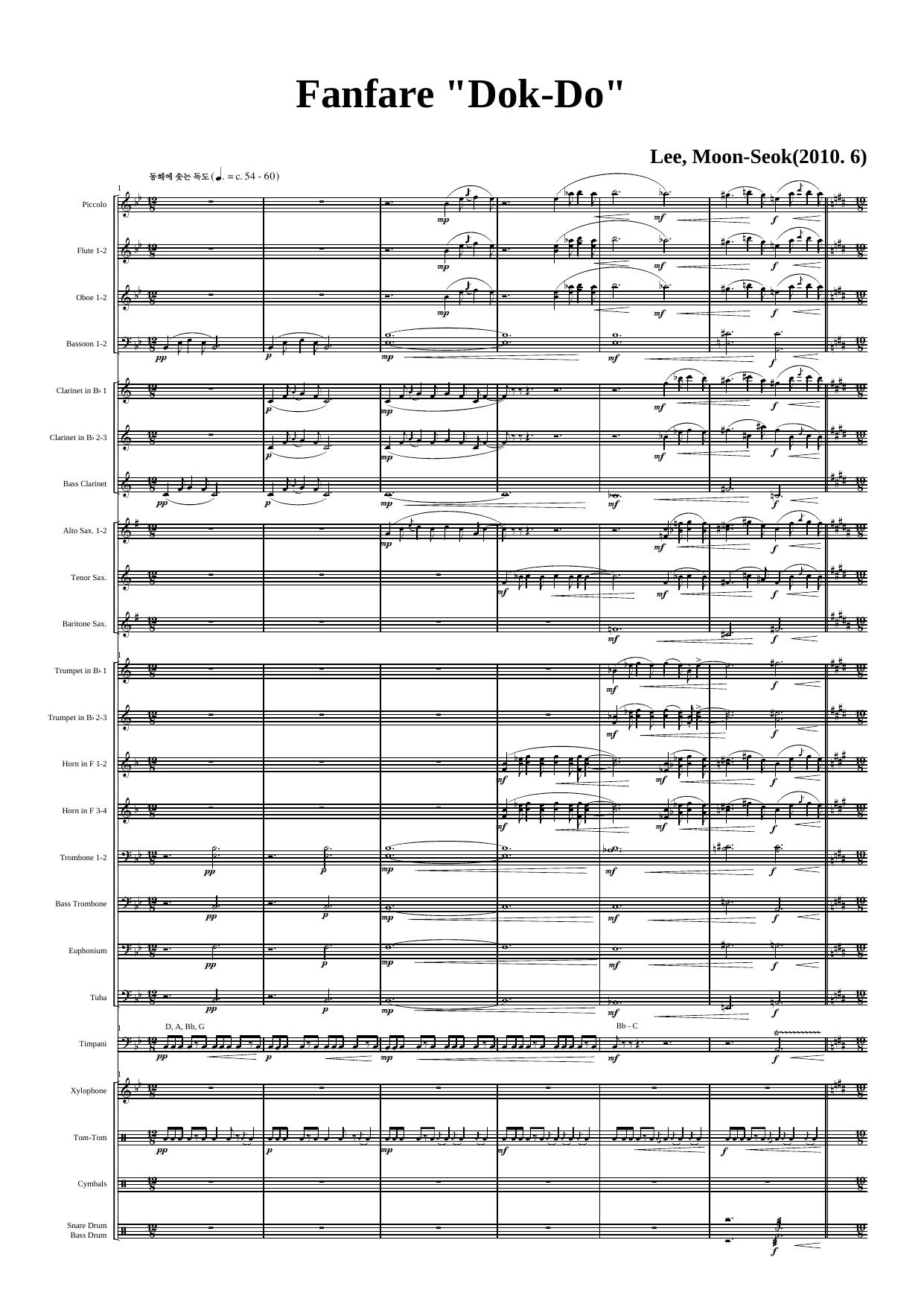
Fanfare Dok -Do (comp. Lee)
Composed by Lee, Moon-Seok
Arranged by null
- Ensemble: Big Band
- Style: Jazz Standard
- Pages: 64
- Instruments (24): Piccolo, Flute 1-2, Oboe 1-2, Bassoon 1-2, Clarinet in Bb 1, Clarinet in Bb 2-3, Bass Clarinet, Alto Sax. 1-2, Tenor Sax., Baritone Sax., Trumpet in Bb 1, Trumpet in Bb 2-3, Horn in F 1-2, Horn in F 3-4, Trombone 1-2, Bass Trombone, Euphonium, Tuba, Timpani, Xylophone, Tom-Tom, Cymbals, Snare Drum, Bass Drum
- Difficulty: advanced
- Content: Individual Parts
- Format: PDF Download (Instant)
- Price: $24.99
Composed by Moon-Seok Lee, "Fanfare Dok-Do" bridges vibrant contemporary jazz composition and traditional celebratory motifs, reflecting the dynamic evolution of modern Korean jazz writing. Rooted in the rich cultural resonance of the Dok-Do islets, the original work serves as a triumphant musical landmark, reinterpreted here for full big band with an emphasis on majestic open-air energy and intricate rhythmic interplay. The piece occupies a unique space within the modern jazz standard repertoire, blending celebratory fanfare structures with sophisticated harmonic extensions that challenge both ensemble cohesion and individual expression. Driven by an infectious medium-up Latin-swing hybrid groove in 4/4 time, the arrangement opens with brilliant brass declarations that immediately establish an atmosphere of pageantry and resolve. The harmonic landscape is lush, frequently utilizing modal shifts, sus chords, and soaring upper-structure triads that evoke vast oceanic horizons and unyielding strength. The emotional trajectory moves dynamically from thunderous, celebratory tutti declarations to introspective, lyrical minor-mode interludes, creating a powerful narrative arc that commands the audience's attention from the downbeat to the final sustained chord. The scoring utilizes an expansive 21-instrument lineup—including a versatile woodwind auxiliary section of Piccolo, Flute, Oboe, Bassoon, and Bb Clarinet alongside standard big band forces—allowing for unprecedented textural variety. Woodwinds frequently double or weave around the primary lines, providing orchestral color reminiscent of contemporary third-stream writing. The melody is initially introduced by the trumpet section supported by crisp sax voicings, before handing off to extended solo sections that feature changes demanding fluent modal and extended bebop vocabulary. Interlocking shout choruses feature dense, vertical chord stacking in the brass, set against aggressive syncopated rhythms in the rhythm section that test the ensemble's precision. Advanced high school, collegiate, and professional big bands will find this 64-page conductor score and parts package exceptionally rewarding. The intricate metric modulations and overlapping counterpoint require mature section leadership and attentive balance, particularly when woodwinds are integrated into the primary sonic fabric. Conductor and players alike will appreciate the meticulous care given to dynamic markings and articulation guides, ensuring that every stylistic nuance—from whispered textural pads to explosive, stadium-filling brass climaxes—translates clearly from the page to the bandstand. Achieving the correct stylistic balance requires strict adherence to the underlying groove, which alternates between crisp swing subdivision and driving Latin ostinatos. The conductor should ensure that the rhythm section maintains an unhurried, authoritative pulse, particularly during the transition from the majestic intro into the primary head statement. Key technical challenges involve the intricate woodwind passages and high-register trumpet writing. Players navigating the Piccolo, Oboe, and Bassoon parts must carefully balance their intonation against the dominant brass section, using vibrato sparingly to maintain a clear, modern acoustic profile. Brass players should approach high-register fanfare motifs with controlled breath support rather than sheer force, ensuring that upper-register accents do not pinch the overall ensemble blend. Rehearsal should begin section-by-section, isolating the complex metric shifts and syncopated counter-melodies in the saxophones and trombones before integrating the rhythm section. Pay close attention to dynamic contrast: ensure that background figures remain dynamic under soloists without muddying the harmonic center. Standard jazz articulations apply throughout, with marked roof-accent styles on primary fanfare hits and sustained, connected phrasing on the lyrical bridge statements. Q: What instruments and parts are included in this publication? A: This 21-instrument arrangement features a comprehensive 64-page package containing a full conductor score and individual parts for Piccolo, Flute, Oboe, Bassoon, Bb Clarinet, standard 5-saxophone section, trumpet and trombone sections, and a complete rhythm section. Q: What is the designated difficulty level for this chart? A: It is targeted at advanced high school, collegiate, and professional big bands due to its complex modal harmonies, dense 21-instrument scoring, and technical demands across woodwind and brass auxiliary parts. Q: What musical style and historical background define this piece? A: Composed by Moon-Seok Lee, the piece functions as a contemporary jazz standard that merges ceremonial fanfare traditions with sophisticated modern jazz-ensemble writing inspired by the cultural significance of the Dok-Do region. Q: What makes this specific arrangement unique within big band literature? A: Its integration of traditional symphonic woodwinds—such as Oboe, Bassoon, and Piccolo—alongside a standard jazz big band creates a uniquely rich, orchestral texture rarely found in traditional jazz arrangements. Q: What is the tempo feel and performance duration of the arrangement? A: The piece is set to a driving medium-up groove that blends swing and Latin feel, yielding a substantial performance duration well-suited for festival adjudication or featured concert programming.
Questions and answers
- What is included in the Fanfare Dok -Do (comp. Lee) PDF?
- The verified current file contains a conductor score and individual parts across 64 pages.
- How many instruments or parts are listed for Fanfare Dok -Do (comp. Lee)?
- The verified instrumentation list contains 24 entries for this Big Band arrangement.
- Who is credited for Fanfare Dok -Do (comp. Lee)?
- Composer: Lee, Moon-Seok. Arranger: null.
- What difficulty is listed for Fanfare Dok -Do (comp. Lee)?
- The verified difficulty level is advanced.
- What style is listed for Fanfare Dok -Do (comp. Lee)?
- The catalog lists the style as Jazz Standard.
- Can I preview Fanfare Dok -Do (comp. Lee) before buying?
- Yes. The product page provides a preview generated from the current PDF file.
- How is Fanfare Dok -Do (comp. Lee) delivered?
- After successful payment, the digital PDF is made available for download. The displayed price is $24.99.
Musicians Also Search For
Fanfare Dok -Do null PDF • Fanfare Dok -Do null sheet music • Fanfare Dok -Do arranged by null • null big band charts • null jazz arrangements PDF • Fanfare Dok -Do Lee, Moon-Seok sheet music • Fanfare Dok -Do Lee, Moon-Seok big band arrangements • Lee, Moon-Seok big band charts • Fanfare Dok -Do big band arrangements • Fanfare Dok -Do big band PDF download • Fanfare Dok -Do jazz sheet music • big band sheet music download • Fanfare Dok -Do conductor score PDF • Fanfare Dok -Do individual parts download • Fanfare Dok -Do sheet music PDF • Fanfare Dok -Do Jazz Standard charts • Jazz Standard big band arrangements • buy Fanfare Dok -Do sheet music • download Fanfare Dok -Do PDF • Fanfare Dok -Do jazz charts • best null big band arrangements • Lee, Moon-Seok arranged by null • Fanfare Dok -Do printable sheet music • big band repertoire PDF