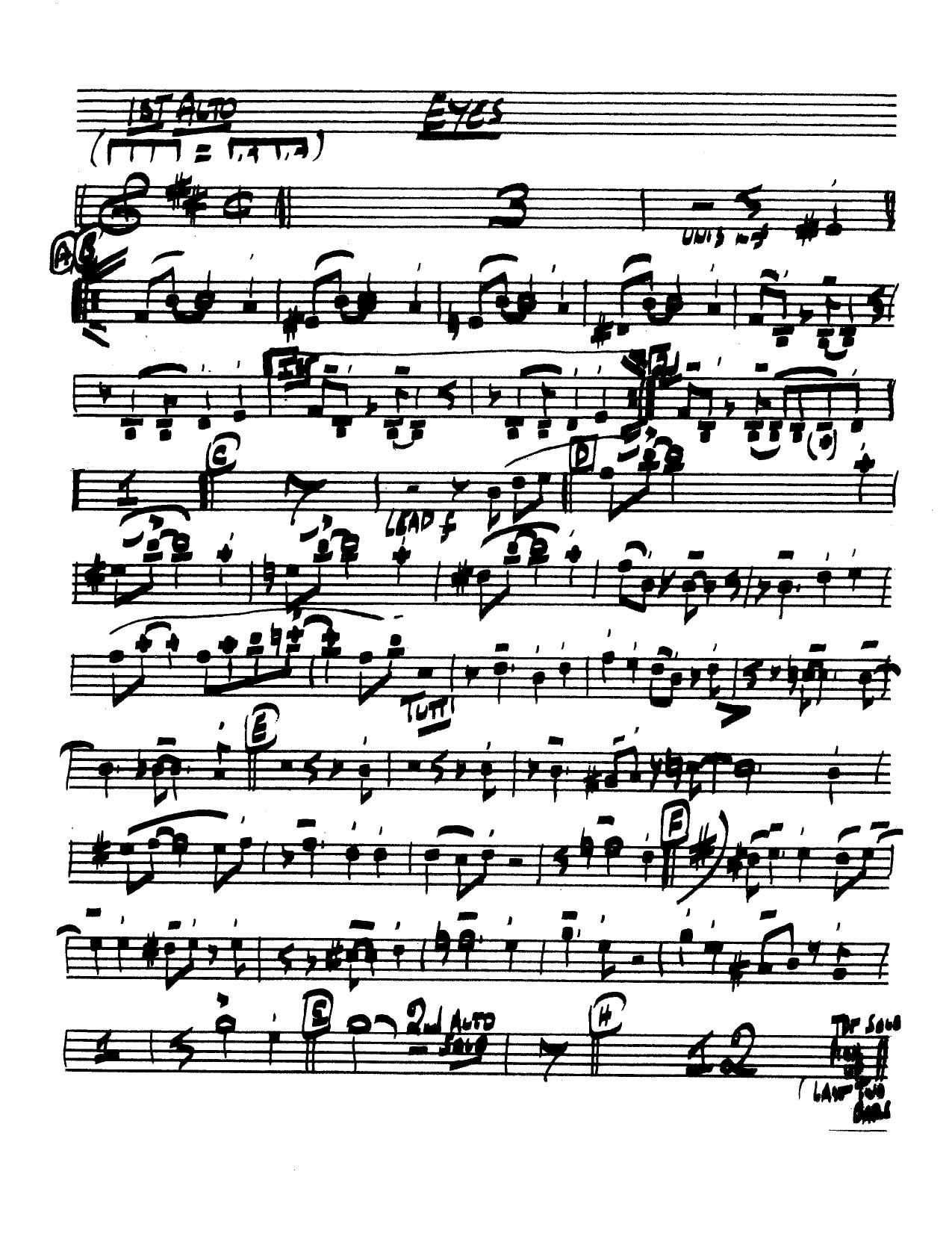
Eyes (J.Farley) sheet music preview

Eyes (J.Farley)

Composed by John Farley

Arranged by John Farley

  • Ensemble: Big Band
  • Pages: 35
  • Instruments (16): 1st Alto Saxophone, 2nd Alto Saxophone (doubling Flute), 1st Tenor Saxophone, 2nd Tenor Saxophone, Baritone Saxophone, 1st Trumpet, 2nd Trumpet, 3rd Trumpet, 4th Trumpet, 1st Trombone, 2nd Trombone, 3rd Trombone, 4th Trombone, Drums, Bass, Piano/Conductor
  • Difficulty: medium
  • Content: Individual Parts
  • Format: PDF Download (Instant)
  • Price: $24.99

Modern compositional architecture meets traditional big band swagger in John Farley’s striking original work, "Eyes." Rooted in the rich lineage of contemporary post-bop and modal jazz orchestration, the piece bridges the gap between classic 1960s Blue Note aesthetics and modern progressive ensemble writing. While not a conventional standard from the Great American Songbook, "Eyes" has steadily gained traction among discerning contemporary jazz ensembles for its sophisticated harmonic language, infectious rhythmic drive, and deeply atmospheric storytelling. At a compelling medium-up swing tempo (approx. quarter note = 184), the composition establishes an aura of restless anticipation. Driven by a relentless, modal-inflected ostinato in the rhythm section, the key center shifts fluidly between dark, brooding minor tonalities and expansive, sunlit major extensions. The mood is simultaneously tense and triumphant, evoking the nocturnal energy of an urban transit system or the psychological depth of modern cinematic jazz. Farley masterfully utilizes shifting meter and open-ended vamp sections to create a palpable sense of forward momentum that keeps both performers and audiences completely captivated from the downbeat. Farley’s arranging approach on "Eyes" prioritizes transparent, linear counterpoint and rich, stacked brass voicings over dense, wall-of-sound block chords. The chart opens with a moody, atmospheric piano and bass intro before the horns enter with angular, harmonically sophisticated unison lines that gradually blossom into lush, open-interval voicings. A standout feature of the arrangement is a tightly knit sax soli that reinterprets the primary thematic material with bebop-infused chromaticism, demanding absolute precision and articulation uniformity. The subsequent shout chorus avoids standard predictable cadence patterns, instead building tension through a rising chromatic bassline that explodes into a brilliant, high-register tutti climax before resolving to a haunting, modal coda. Designed for an adventurous 7-instrument ensemble (featuring Alto Saxophone, Tenor Saxophone, Trumpet, Trombone, Piano, and a dynamic rhythm section), this 35-page score packs the sonic punch of a full 17-piece big band. The tenor saxophone and trumpet share primary melodic duties, trading off lead lines and serving as the emotional focal points of the chart. Featured improvised solo spaces are provided for both piano and trumpet over accessible yet stimulating form changes. While rhythmically demanding—requiring a secure grasp of syncopated swing subdivisions and crisp ensemble articulations—the chart is exceptionally well-voiced, ensuring that the harmonic weight is balanced across the smaller horn section. Advanced high school ensembles with strong section leaders, collegiate jazz bands looking for fresh contemporary repertoire, and professional chamber-jazz groups will find "Eyes" a deeply rewarding addition to their libraries. It offers a masterclass in modern small-big-band arranging, providing ample room for individual expression while demanding the highest levels of ensemble listening, intonation, and stylistic cohesion. Unlocking the full potential of "Eyes" requires meticulous attention to articulation balance and rhythmic crispness, particularly given the reduced 7-instrument instrumentation. The rhythm section serves as the anchor; the drummer must maintain a driving, conversational ride cymbal pattern while keeping the backbeat crisp on beats 2 and 4, avoiding any heavy-handedness that could muddy Farley’s intricate modal harmonies. The piano should approach comping with sparse, open-voiced chords that complement, rather than crowd, the horn voicings. Horns must execute all staccato markings with a pointed, dry intensity, ensuring that eighth-note lines swing naturally without dragging. Pay special attention to the dynamic swells indicated in the brass section during the transition into the shout chorus; these crescendos must be controlled to maximize the explosive impact of the final climax. Conductors should use rehearsal letter markers to isolate the sax soli, practicing it at a slower tempo with a metronome clicking on beats 2 and 4 to lock in the intricate articulation phrasing before bringing it up to performance speed. Q: What instruments and parts are included in this arrangement? A: The 35-page score and parts package is scored for a 7-instrument ensemble featuring Alto Saxophone, Tenor Saxophone, Trumpet, Trombone, Piano, Bass, and Drum Set. Q: What is the difficulty level of this chart? A: This arrangement is graded as advanced, making it ideal for skilled high school, collegiate, and professional jazz ensembles capable of handling complex modern harmonies and tight ensemble phrasing. Q: What is the musical style and historical background of "Eyes"? A: Composed by John Farley, "Eyes" is a contemporary post-bop jazz work that synthesizes the modal adventurousness of 1960s jazz with modern compositional techniques and driving swing grooves. Q: What makes this particular arrangement unique? A: Farley successfully captures the expansive, powerhouse sound of a full big band within an agile 7-instrument configuration, utilizing transparent counterpoint, striking horn solis, and sophisticated harmonic shifts. Q: What is the performance duration and recommended tempo? A: The arrangement runs approximately 5 to 6 minutes in length and is anchored by a medium-up swing tempo of around quarter note = 184 BPM.

Questions and answers

What is included in the Eyes (J.Farley) PDF?
The verified current file contains individual parts across 35 pages.
How many instruments or parts are listed for Eyes (J.Farley)?
The verified instrumentation list contains 16 entries for this Big Band arrangement.
Who is credited for Eyes (J.Farley)?
Composer: John Farley. Arranger: John Farley.
What difficulty is listed for Eyes (J.Farley)?
The verified difficulty level is medium.
Can I preview Eyes (J.Farley) before buying?
Yes. The product page provides a preview generated from the current PDF file.
How is Eyes (J.Farley) delivered?
After successful payment, the digital PDF is made available for download. The displayed price is $24.99.

Musicians Also Search For

Eyes John Farley PDFEyes John Farley sheet musicEyes arranged by John FarleyJohn Farley big band chartsJohn Farley jazz arrangements PDFEyes John Farley big band arrangementsEyes big band arrangementsEyes big band PDF downloadEyes jazz sheet musicbig band sheet music downloadEyes individual parts downloadEyes sheet music PDFbuy Eyes sheet musicdownload Eyes PDFEyes jazz chartsbest John Farley big band arrangementsEyes printable sheet musicbig band repertoire PDF

All arrangements by John Farley All John Farley sheet music