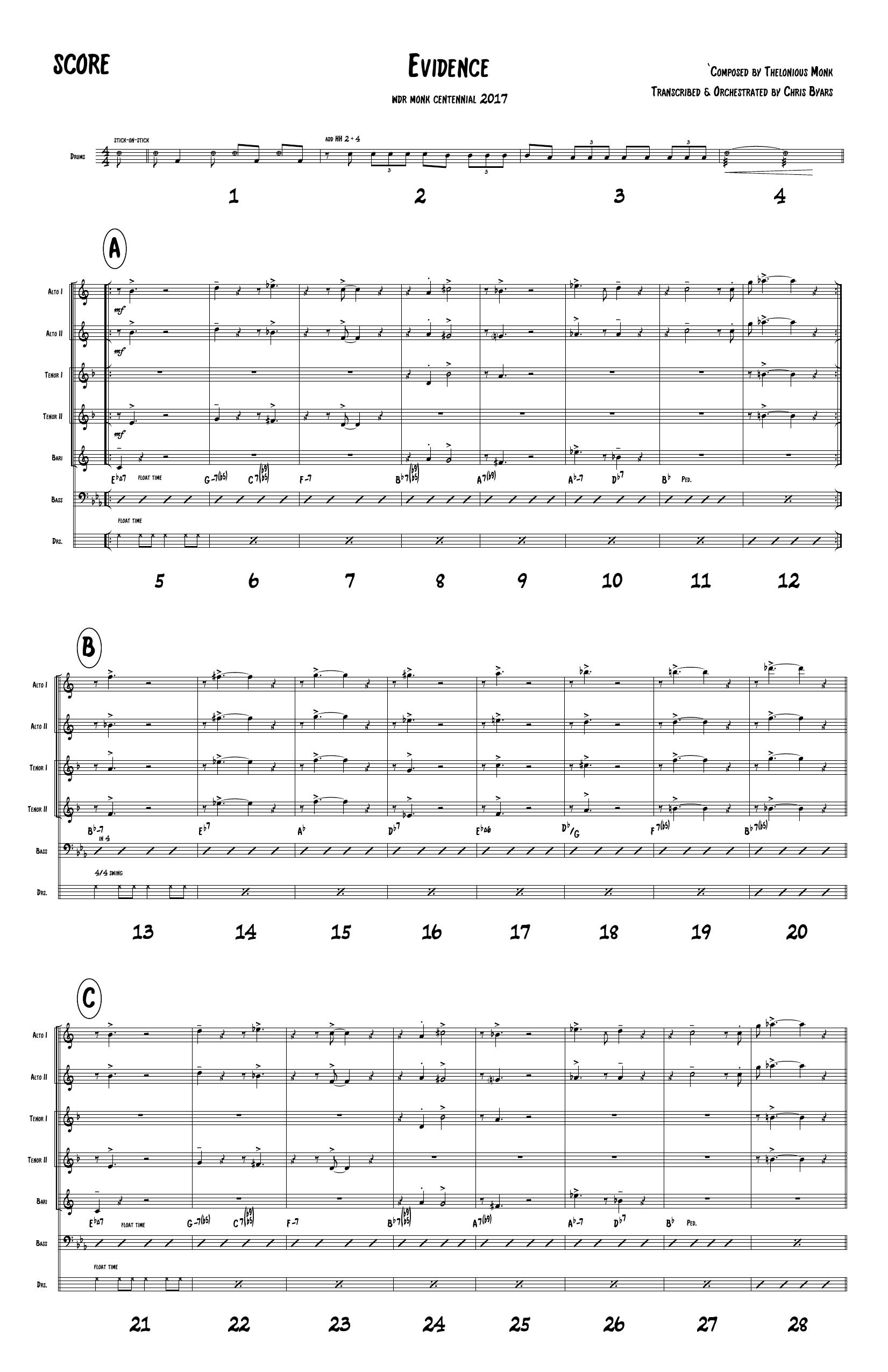
Evidence (C.Byars)
Composed by Thelonious Monk
Arranged by Thelonious Monk (arr.C.Byars)
- Ensemble: Big Band
- Pages: 15
- Instruments (19): Alto Saxophone I, Alto Saxophone II, Tenor Saxophone I, Tenor Saxophone II, Baritone Saxophone, Soprano Saxophone, Flute, Piccolo, Trumpet I, Trumpet II, Trumpet III, Trumpet IV, Trumpet V, Trombone I, Trombone II, Trombone III, Trombone IV, Double Bass, Drums
- Difficulty: easy
- Content: Individual Parts
- Format: PDF Download (Instant)
- Price: $24.99
Thelonious Monk’s angular masterpiece "Evidence," first recorded for Blue Note Records in 1948, stands as one of the most intellectually stimulating compositions of the bebop era. Built upon the harmonic framework of standard chord changes—specifically drawing inspiration from the Tin Pan Alley tune "Just You, Just Me"—Monk turned traditional songwriting upside down by utilizing jagged, disjunct melodic fragments and unexpected rhythmic displacements. The title itself is a clever play on words, referencing both the detective work required to trace its harmonic roots and Monk's own idiosyncratic piano style. This sophisticated big band adaptation by C. Byars successfully translates Monk's intensely private, highly eccentric piano voicings into a sprawling, multi-layered orchestral canvas that retains all the wry humor and harmonic daring of the original small-group recordings. Driving forward with a sharp, insistent medium-tempo swing feel in 4/4 time, this arrangement captures the tense, probing energy characteristic of Monk’s greatest contributions to the jazz canon. The mood shifts fluidly between playful rhythmic hide-and-seek and fierce, driving big band intensity. Byars exploits the full 19-instrument palette to mimic Monk's sparse yet heavy-handed chordal attacks, distributing dissonant cluster voicings across the brass sections while leaving sudden, dramatic silences that demand absolute rhythmic precision from the ensemble. The chart opens with a stark, unsettling introduction before locking into a relentless groove that keeps both performers and listeners on edge, evoking the urban nocturnal atmosphere of 1940s New York bebop clubs. The arranging approach brilliantly navigates the challenge of expanding a notoriously idiosyncratic piano-driven tune for a large jazz orchestra. Rather than diluting Monk's stark counterpoint, Byars amplifies it through brilliant sectional writing, utilizing tight sax solis and biting, muted brass counterlines that dissect the melody in unexpected ways. The reeds frequently carry the disjointed thematic material, while the lower brass and rhythm section anchor the groove with subterranean syncopation. A blistering shout chorus near the climax serves as the emotional peak, recontextualizing Monk’s motifs into a thunderous collective statement before winding down to a characteristically dry, tongue-in-cheek final cadence. Advanced collegiate, community, and professional big bands will find this chart an exhilarating centerpiece for a concert program or festival performance. Because the music relies heavily on subtle micro-timing, strange harmonic intervals, and a deep understanding of Monk's specific brand of swing, it requires an ensemble with advanced reading skills and a mature ear for modern jazz vocabulary. Featured solo sections provide ample space for horns to stretch out over Monk's demanding changes, making it a deeply rewarding vehicle for groups looking to showcase sophisticated arranging and fearless improvisational chops. Achieving an authentic performance of this arrangement requires absolute rhythmic unity, particularly during the jagged, asymmetrical head statements where unison lines must snap together with razor-sharp precision. The tempo should remain a steady, confident medium swing—avoiding the temptation to rush the syncopated figures or drag the backbeats. Conductors must pay close attention to dynamic contrast; the abrupt shifts from aggressive fortissimo ensemble punches to sparse, whispering rhythm-section backing are crucial to capturing Monk’s signature aesthetic. Brass players should utilize straight mutes or cup mutes where indicated to replicate the dry, nasal timbre central to the bebop era sound. Rehearsals should initially isolate the rhythm section to lock in the stubborn, accented accompaniment figures before layering the complex horn voicings on top. Emphasize that silence is just as important as sound in this chart; the written rests must be executed with intense collective focus to preserve the suspenseful, unpredictable atmosphere inherent in Monk's compositional legacy. Q: What instruments and parts are included in this arrangement? A: The arrangement is scored for a standard 19-instrument big band, consisting of Alto Saxophone 1, Alto Saxophone 2, Tenor Saxophone 1, Tenor Saxophone 2, Baritone Saxophone, 4 Trumpets, 4 Trombones, Piano, Guitar, Bass, Drums, and a comprehensive conductor score. Q: What is the difficulty level of this chart? A: This arrangement is graded as advanced, making it best suited for college, conservatory, community, and professional big bands that possess strong reading skills and familiarity with bebop harmonies. Q: What is the historical style and background of this piece? A: Based on Thelonious Monk's iconic 1948 composition which borrows its hidden harmonic framework from "Just You, Just Me," this chart represents the pinnacle of bebop-era modernism adapted for large jazz ensemble. Q: What makes this specific C. Byars arrangement unique? A: It uniquely translates Monk’s notoriously sparse, eccentric piano voicings and angular phrasing into massive, interlocking big band textures without losing the whimsical, avant-garde edge of the original small-group recording. Q: What is the performance duration and tempo feel of the piece? A: The arrangement runs approximately 5 to 6 minutes and is anchored by a driving, insistent medium-tempo swing feel in 4/4 time.
Questions and answers
- What is included in the Evidence (C.Byars) PDF?
- The verified current file contains a conductor score across 15 pages.
- How many instruments or parts are listed for Evidence (C.Byars)?
- The verified instrumentation list contains 19 entries for this Big Band arrangement.
- Who is credited for Evidence (C.Byars)?
- Composer: Thelonious Monk. Arranger: Thelonious Monk (arr.C.Byars).
- What difficulty is listed for Evidence (C.Byars)?
- The verified difficulty level is easy.
- Can I preview Evidence (C.Byars) before buying?
- Yes. The product page provides a preview generated from the current PDF file.
- How is Evidence (C.Byars) delivered?
- After successful payment, the digital PDF is made available for download. The displayed price is $24.99.
Musicians Also Search For
Evidence Thelonious Monk (arr.C.Byars) PDF • Evidence Thelonious Monk (arr.C.Byars) sheet music • Evidence arranged by Thelonious Monk (arr.C.Byars) • Thelonious Monk (arr.C.Byars) big band charts • Thelonious Monk (arr.C.Byars) jazz arrangements PDF • Evidence Thelonious Monk sheet music • Evidence Thelonious Monk big band arrangements • Thelonious Monk big band charts • Evidence big band arrangements • Evidence big band PDF download • Evidence jazz sheet music • big band sheet music download • Evidence conductor score PDF • Evidence sheet music PDF • buy Evidence sheet music • download Evidence PDF • Evidence jazz charts • best Thelonious Monk (arr.C.Byars) big band arrangements • Thelonious Monk arranged by Thelonious Monk (arr.C.Byars) • Evidence printable sheet music • big band repertoire PDF