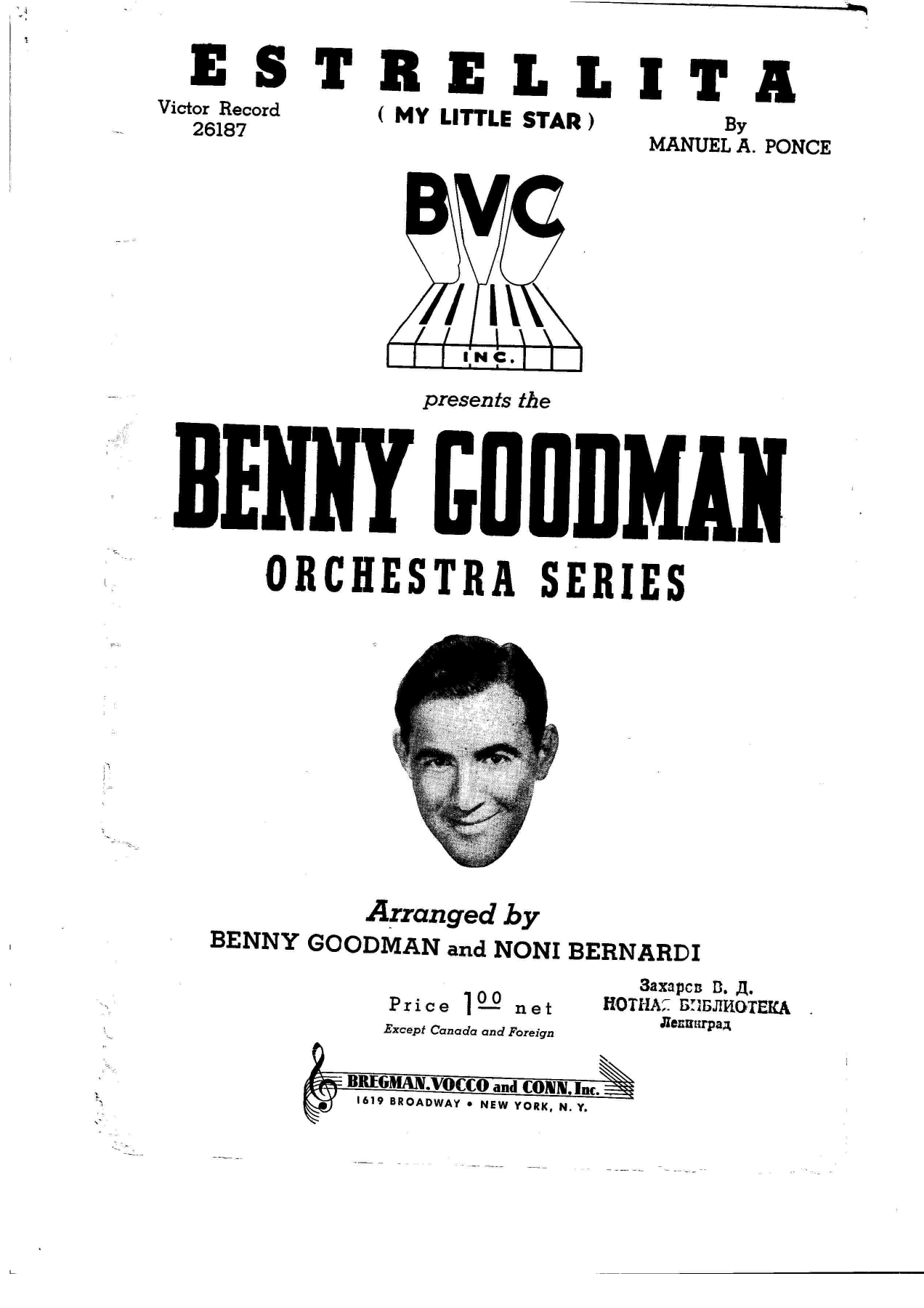
Estrellita (B.Goodman)
Composed by Manuel Ponce
Arranged by Benny Goodman
- Ensemble: Big Band
- Style: Jazz Standard
- Pages: 32
- Instruments (14): 1st Saxophone Eb Alto, 3rd Saxophone Eb Alto, 2nd Saxophone Bb Tenor, 4th Saxophone Bb Tenor, 1st Trumpet in Bb, 2nd Trumpet in Bb, 3rd Trumpet in Bb, 1st Trombone, 2nd Trombone, Guitar, Piano, Bass, Drums, Violins
- Difficulty: medium
- Content: Individual Parts
- Format: PDF Download (Instant)
- Price: $24.99
Manuel Ponce's enchanting "Estrellita" (Little Star) began its life as a romantic Mexican art song, composed in 1912. Its tender, lyrical melody quickly transcended classical circles, becoming a beloved folk tune and eventually a staple in the jazz repertoire. This arrangement, penned by the legendary "King of Swing" Benny Goodman himself, captures the song's inherent beauty while imbuing it with the sophisticated swing era aesthetic that defined Goodman's iconic sound. It represents a fascinating cross-pollination of classical lyricism and big band jazz, showcasing how a timeless melody can be reinterpreted through a new rhythmic and harmonic lens. The piece’s enduring popularity lies in its memorable, singable theme, which allows for both faithful interpretation and creative improvisation, making it a natural fit for jazz artists seeking a vehicle for expression. Goodman's treatment of "Estrellita" transforms the original 3/4 waltz into a medium-slow, expressive swing ballad in 4/4, typically performed around 80-90 BPM. The key of C major provides a bright, accessible harmonic landscape, allowing the melody to shine with clarity. The overall mood is one of tender romance and nostalgic warmth, evoking the golden age of big band ballads. Goodman's signature approach is evident in the meticulous voicings, which often feature close-knit saxophone harmonies supporting the main melodic line, creating a rich, velvety texture. Expect the brass to enter with warm, sustained chords, punctuated by tasteful, understated fills that enhance rather than overpower the melody. The arrangement masterfully balances ensemble precision with opportunities for individual expression. The melody is primarily carried by the alto saxophone, often doubled or harmonized by the tenor saxophones, creating a classic Goodman-era saxophone section sound. A significant feature is the extended clarinet solo, a hallmark of Goodman's own playing style, which provides a lyrical and technically engaging centerpiece. This solo, often written out or with chord changes for improvisation, requires a player with a strong sense of melodic phrasing and a warm tone. Following the solo, the arrangement builds to a beautifully voiced ensemble soli section, where the full band re-enters with lush harmonies, leading to a gentle, sustained coda. Technical challenges include achieving a cohesive, blended sound within the saxophone section, maintaining a consistent, relaxed swing feel at a slower tempo, and precise articulation in the brass. The rewarding aspect lies in the opportunity to perform a truly beautiful melody with the rich harmonic and textural possibilities of a full big band. This arrangement is ideally suited for college-level jazz ensembles, advanced community bands, and professional groups. Its blend of melodic beauty, harmonic sophistication, and a featured clarinet solo offers significant educational value in terms of ensemble blend, ballad interpretation, and understanding swing era arranging techniques. While the technical demands are moderate, the musicality required to perform it with genuine emotion and stylistic authenticity makes it a rewarding challenge for bands seeking to add a classic, lyrical piece to their repertoire. "Estrellita" should be approached as a medium-slow swing ballad, ideally around 80-90 BPM, emphasizing a relaxed, flowing 4/4 feel rather than a rigid pulse. The key to its success lies in achieving a warm, blended ensemble sound, particularly within the saxophone section, where close voicings demand careful intonation and balance. Conductors should encourage a lyrical, vocal approach to the melody, allowing it to breathe naturally. The featured clarinet solo requires a player with a strong melodic sense and a beautiful tone; while chord changes are provided, the written solo (if present) offers valuable insight into Goodman's phrasing. Articulation in the brass should be smooth and sustained, avoiding overly aggressive attacks. Rehearsal time should focus on shaping phrases, balancing dynamics to highlight the melody, and ensuring a cohesive, expressive ensemble sound throughout, particularly in the sustained chords and the final, gentle fade. No special techniques like plunger mutes or doits are required; focus is on pure tone and musicality. Q: What instruments and parts are included in this arrangement? A: This arrangement is scored for a standard 17-piece big band, including Alto Saxophone 1 & 2, Tenor Saxophone 1 & 2, Baritone Saxophone, Trumpet 1-4, Trombone 1-4, Piano, Bass, Drums, and features a prominent Clarinet part, often played by the lead alto saxophonist. Q: What is the difficulty level of this arrangement? A: This arrangement is rated as medium-advanced. While not overtly technically demanding, it requires strong musicianship, excellent intonation, and a mature understanding of swing ballad style, making it suitable for college, advanced community, and professional ensembles. Q: What is the musical style and historical context of "Estrellita (B.Goodman)"? A: This is a swing era big band ballad arrangement of Manuel Ponce's classic Mexican art song. Benny Goodman's arrangement transforms the original 3/4 waltz into a medium-slow 4/4 swing, showcasing the lush harmonies and lyrical soloing characteristic of the 1930s and 40s big band sound. Q: What makes Benny Goodman's arrangement of "Estrellita" unique? A: Goodman's arrangement is distinctive for its transformation of a classical melody into a sophisticated swing ballad, its characteristic close-voiced saxophone harmonies, and the prominent, lyrical clarinet solo, which reflects Goodman's own legendary playing. Q: What is the typical performance duration and tempo for this piece? A: "Estrellita" is typically performed as a medium-slow swing ballad, around 80-90 BPM. Its performance duration usually ranges from approximately 3 to 4 minutes, depending on the tempo and any improvised sections.
Questions and answers
- What is included in the Estrellita (B.Goodman) PDF?
- The verified current file contains individual parts across 32 pages.
- How many instruments or parts are listed for Estrellita (B.Goodman)?
- The verified instrumentation list contains 14 entries for this Big Band arrangement.
- Who is credited for Estrellita (B.Goodman)?
- Composer: Manuel Ponce. Arranger: Benny Goodman.
- What difficulty is listed for Estrellita (B.Goodman)?
- The verified difficulty level is medium.
- What style is listed for Estrellita (B.Goodman)?
- The catalog lists the style as Jazz Standard.
- Can I preview Estrellita (B.Goodman) before buying?
- Yes. The product page provides a preview generated from the current PDF file.
- How is Estrellita (B.Goodman) delivered?
- After successful payment, the digital PDF is made available for download. The displayed price is $24.99.
Musicians Also Search For
Estrellita Benny Goodman PDF • Estrellita Benny Goodman sheet music • Estrellita arranged by Benny Goodman • Benny Goodman big band charts • Benny Goodman jazz arrangements PDF • Estrellita Manuel Ponce sheet music • Estrellita Manuel Ponce big band arrangements • Manuel Ponce big band charts • Estrellita big band arrangements • Estrellita big band PDF download • Estrellita jazz sheet music • big band sheet music download • Estrellita individual parts download • Estrellita sheet music PDF • Estrellita Jazz Standard charts • Jazz Standard big band arrangements • buy Estrellita sheet music • download Estrellita PDF • Estrellita jazz charts • best Benny Goodman big band arrangements • Manuel Ponce arranged by Benny Goodman • Estrellita printable sheet music • big band repertoire PDF