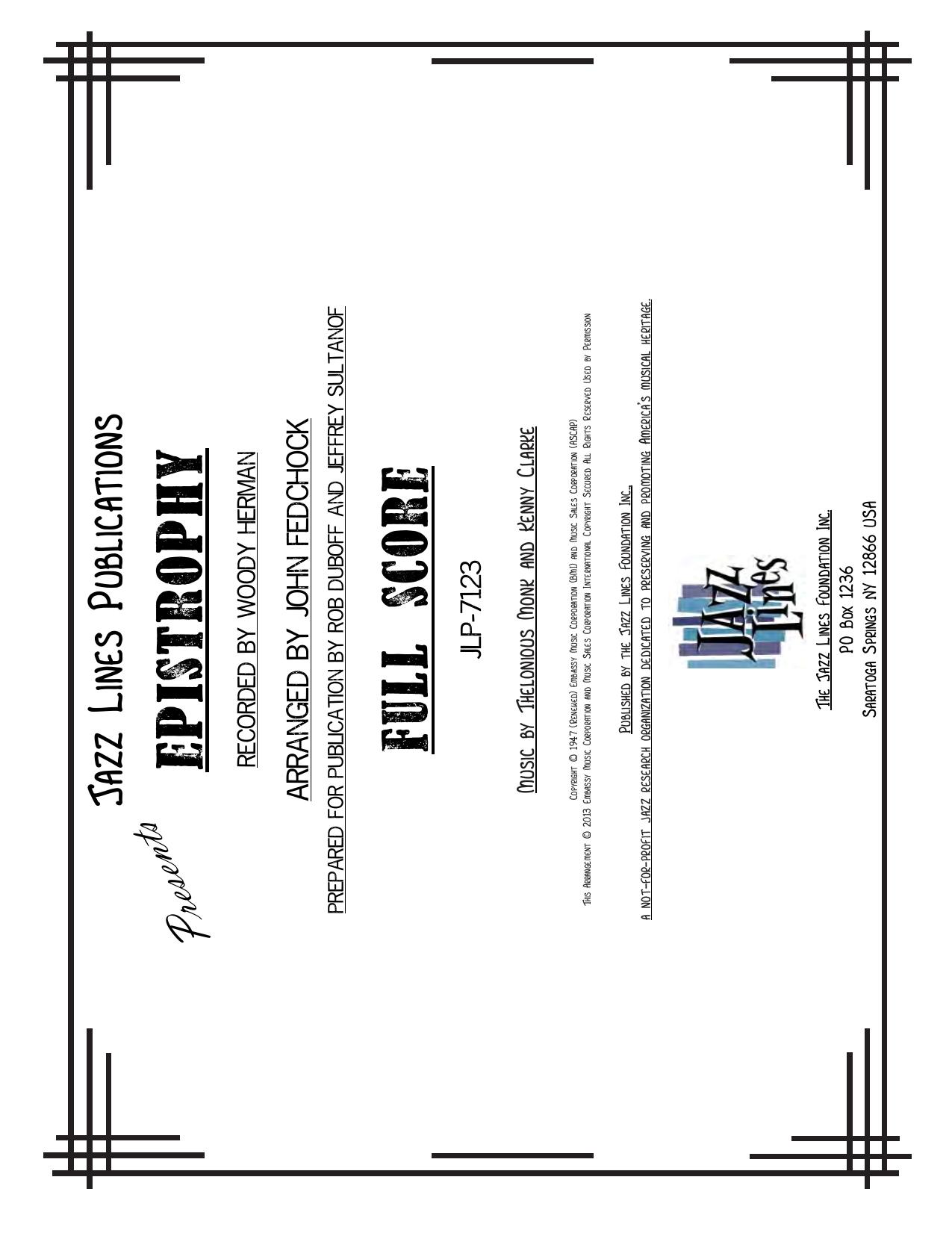
Epistrophy (J.Fedchock)
Composed by Thelonious Monk
Arranged by John Fedchock
- Ensemble: Big Band
- Pages: 128
- Instruments (18): Alto Sax 1, Alto Sax 2, Tenor Sax 1, Tenor Sax 2, Baritone Sax, Trumpet 1, Trumpet 2, Trumpet 3, Trumpet 4, Trumpet 5, Trombone 1, Trombone 2, Trombone 3, Trombone 4, Guitar, Piano, Bass, Drum Set
- Difficulty: advanced
- Content: Individual Parts
- Format: PDF Download (Instant)
- Price: $24.99
Thelonious Monk and Kenny Clarke’s angular masterpiece "Epistrophy" stands as one of the most structurally and harmonically arresting compositions in modern jazz history. First recorded by Cootie Williams and His Orchestra in 1942, and later immortalized as the signature theme song for Thelonious Monk’s quartet performances, the tune is defined by its dissonant interval leaps, chromatic descending bass movement, and a cyclical form that defies traditional bebop predictability. It represents a vital bridge between the swing era and the birth of modern jazz, challenging interpreters with its elusive tonal center and jagged thematic motifs. Monk’s genius lay in creating a framework where suspense and rhythmic displacement dictate the musical narrative, making any serious big band treatment an acid test for modern ensemble cohesion. Master trombonist, arranger, and composer John Fedchock approaches this monumental canvas with his trademark virtuosic flair, razor-sharp harmonic sophistication, and deep reverence for the jazz tradition. Fedchock’s arrangement infuses the iconic theme with high-octane modern big band energy, shifting the rhythmic focal points while maintaining the composition's inherent tension. The chart opens with an arresting, angular intro that immediately establishes a driving, aggressive swing feel. Fedchock utilizes dense, contemporary chord voicings that push the brass and saxophones to the outer edges of tonality, creating a rich texture that honors Monk’s idiosyncratic piano voicings while expanding them for a full 18-piece ensemble. The dynamic contrast is staggering, moving seamlessly from whisper-quiet, suspenseful background figures to roaring, monolithic shout choruses that exploit the full dynamic spectrum of the contemporary big band. Throughout the arrangement, the melodic weight is distributed shrewdly across the sections, with blistering woodwind solis alternating with powerhouse brass counterlines. Solo opportunities are provided for key improvisers, supported by harmonically rich, driving ensemble shout choruses that demand absolute precision in articulation and rhythmic placement. The technical challenges are substantial: the intricate syncopations, rapid tempo, and altered dominant harmonies require an ensemble with advanced reading skills and a mature concept of swing subdivision. Performers and audiences alike will find the chart deeply rewarding due to its ingenious structural twists, unexpected modulations, and the sheer exhilaration of navigating Fedchock’s sophisticated reharmonization of Monk’s timeless motifs. Advanced collegiate ensembles, top-tier high school jazz bands, and professional or community big bands will find this arrangement an exceptional vehicle for showcasing technical prowess and stylistic versatility. Because it demands absolute stylistic unity, particularly in handling short, punchy bebop figures and driving swing feels, it serves as an ideal centerpiece for festival programs, competition repertoires, and advanced concert settings where musicians can stretch their harmonic and improvisational boundaries. Navigating John Fedchock’s dynamic chart requires meticulous attention to articulation, balance, and time-feel. The primary technical challenge lies in the execution of Monk’s jagged thematic intervals at a brisk, driving tempo; the brass and saxophones must lock in their tonguing and placement to ensure the angular lines sound cohesive rather than fragmented. Conductors should emphasize a forward-moving swing feel with a distinct articulation of the upbeat accents, avoiding any tendency for the rhythm section to drag. The rhythm section is the engine here: the pianist should reference Monk's sparse, percussive comping style without over-playing, while the drummer must drive the ensemble with crisp ride-cymbal definition and well-placed interactive accents during the stop-time and shout chorus figures. Special techniques include sharp, clipped staccatos and controlled dynamic crescendos into ensemble hits. Rehearsal should begin slowly, isolating the dense ensemble solis to build sectional balance before bringing the tempo up to performance speed. Q: What instruments and parts are included in this arrangement? A: This standard 18-instrument big band arrangement includes full instrumentation for 5 saxophones (2 altos, 2 tenors, baritone), 4 trumpets, 4 trombones, guitar, piano, bass, and drums, accompanied by a comprehensive 128-page conductor score. Q: What is the difficulty level of this arrangement? A: This piece is rated as advanced, making it best suited for collegiate ensembles, advanced high school jazz bands, and professional big bands that possess strong reading skills and refined stylistic control. Q: What is the historical style and context of this piece? A: Originally composed by Thelonious Monk and Kenny Clarke in 1942, "Epistrophy" is a foundational modern jazz standard reimagined here through a contemporary big band lens by master arranger John Fedchock. Q: What makes this specific arrangement unique? A: John Fedchock’s treatment stands out due to its cutting-edge modern harmonies, intricate woodwind solis, dynamic contrasting textures, and ingenious reharmonization that expands upon Monk's original architectural design. Q: What is the performance duration and tempo feel? A: The arrangement is designed as a high-energy, driving medium-up to fast swing chart that typically clocks in around 4 to 6 minutes, depending on the length of the improvised solo sections.
Questions and answers
- What is included in the Epistrophy (J.Fedchock) PDF?
- The verified current file contains a conductor score and individual parts across 128 pages.
- How many instruments or parts are listed for Epistrophy (J.Fedchock)?
- The verified instrumentation list contains 18 entries for this Big Band arrangement.
- Who is credited for Epistrophy (J.Fedchock)?
- Composer: Thelonious Monk. Arranger: John Fedchock.
- What difficulty is listed for Epistrophy (J.Fedchock)?
- The verified difficulty level is advanced.
- Can I preview Epistrophy (J.Fedchock) before buying?
- Yes. The product page provides a preview generated from the current PDF file.
- How is Epistrophy (J.Fedchock) delivered?
- After successful payment, the digital PDF is made available for download. The displayed price is $24.99.
Musicians Also Search For
Epistrophy John Fedchock PDF • Epistrophy John Fedchock sheet music • Epistrophy arranged by John Fedchock • John Fedchock big band charts • John Fedchock jazz arrangements PDF • Epistrophy Thelonious Monk sheet music • Epistrophy Thelonious Monk big band arrangements • Thelonious Monk big band charts • Epistrophy big band arrangements • Epistrophy big band PDF download • Epistrophy jazz sheet music • big band sheet music download • Epistrophy conductor score PDF • Epistrophy individual parts download • Epistrophy sheet music PDF • buy Epistrophy sheet music • download Epistrophy PDF • Epistrophy jazz charts • best John Fedchock big band arrangements • Thelonious Monk arranged by John Fedchock • Epistrophy printable sheet music • big band repertoire PDF