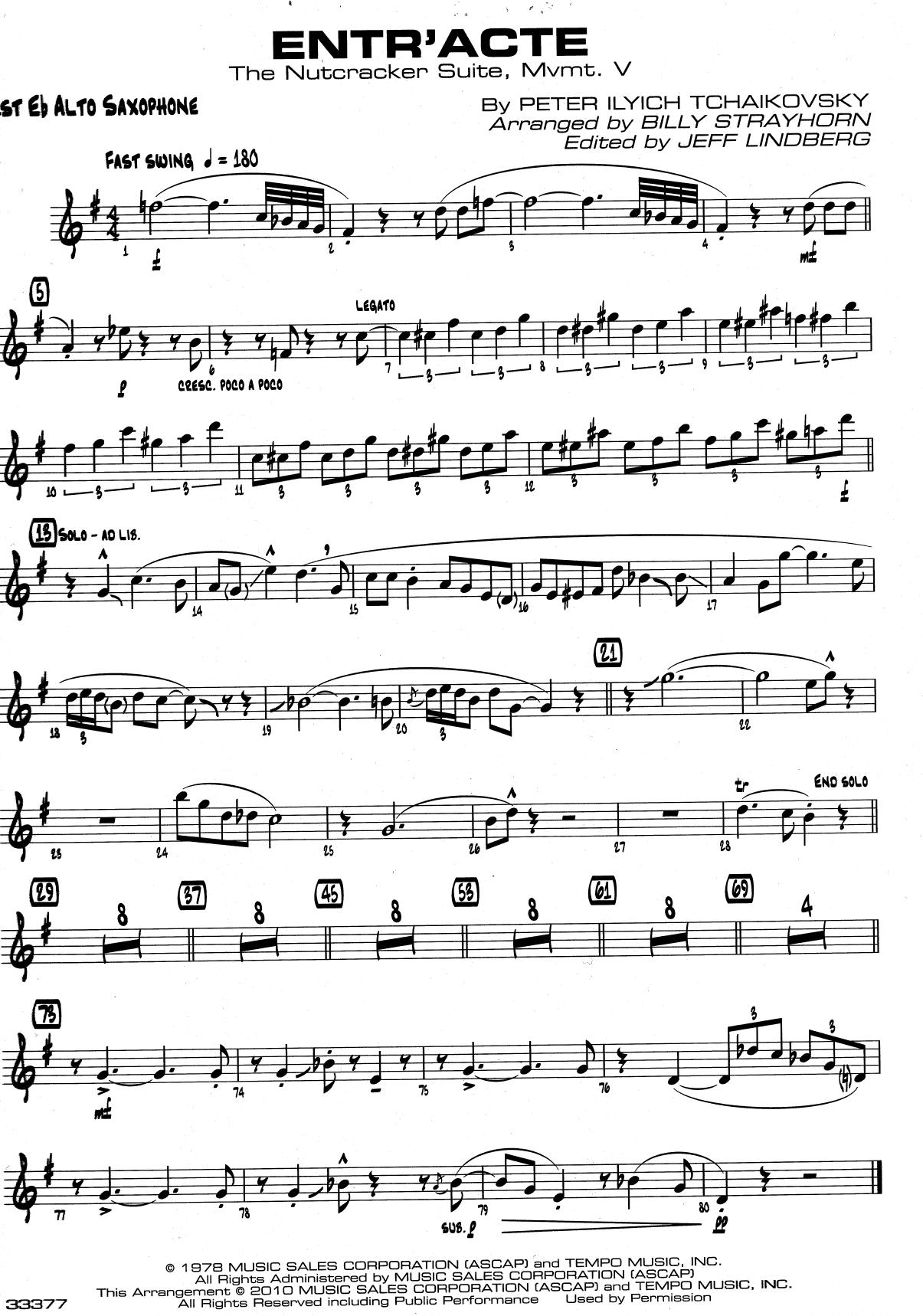
Entr'Acte (B.Strayhorn)
Composed by Pyotr Ilyich Tchaikovsky
Arranged by Billy Strayhorn
- Ensemble: Big Band
- Pages: 24
- Instruments (17): 1st Eb Alto Saxophone, 2nd Eb Alto Saxophone, 1st Bb Tenor Saxophone / Bb Clarinet, 2nd Bb Tenor Saxophone, Eb Baritone Saxophone, 1st Bb Trumpet, 2nd Bb Trumpet, 3rd Bb Trumpet, 4th Bb Trumpet, 1st Trombone, 2nd Trombone, 3rd Trombone, 4th Trombone, Guitar, Piano, Bass, Drums
- Difficulty: medium
- Content: Individual Parts
- Format: PDF Download (Instant)
- Price: $24.99
Pyotr Ilyich Tchaikovsky’s timeless melodies undergo a remarkable transatlantic transformation in *Entr'Acte*, brilliantly reimagined for jazz orchestra by the inimitable Billy Strayhorn. Rooted in the sophisticated aesthetic of the Duke Ellington Orchestra’s inner circle, this 1940s-era masterpiece bridges the gap between 19th-century Russian classical Romanticism and Harlem swing innovation. Strayhorn, celebrated for his lush harmonic palette and exquisite sensitivity to color and texture, takes thematic material from Tchaikovsky's theatrical works and reframes it within a sophisticated big band context. Rather than treating the classical source material as a novelty, Strayhorn honors its architectural integrity while imbuing it with the relaxed swing, harmonic extensions, and cool sophistication that defined his signature compositional voice. Musically, the chart unfolds with a luminous medium-tempo swing feel, anchored by a supple bass line and understated drum propulsion that keeps the rhythmic energy buoyant without ever feeling rushed. The mood shifts fluidly between regal, sweeping romanticism and playful, urbane syncopation. Strayhorn’s voicings are unmistakably transparent; rather than relying on dense, wall-of-sound block chords, he utilizes open-interval writing, clarinet doublings, and rich chord extensions (major sevenths, ninths, and altered dominants) to create an airy, floating sonority. The woodwind section plays a pivotal role, often weaving intricate countermelodies around the brass statements, evoking the delicate orchestration of the original ballet scores while maintaining a distinctly modern jazz-club atmosphere. The melodic weight is shared equitably across the ensemble, though the saxophone section enjoys several lush, harmonized soli passages that demand pristine intonation and a seamless collective blend. Strayhorn incorporates subtle harmonic modulations that elevate the emotional stakes of the chart, leading into a tightly controlled, elegant shout chorus rather than an explosive, high-note-heavy climax. Solo opportunities are integrated organically into the arrangement, allowing featured improvisers on tenor saxophone and trumpet to stretch out over sophisticated changes that nod to both the parent melody and blues-inflected idioms. The technical challenges lie primarily in maintaining a light, unforced articulation at moderate tempos and balancing the intricate inner voices within the saxophone and muted brass sections. Advanced high school, collegiate, and professional jazz orchestras will find *Entr'Acte* to be an exceptionally rewarding addition to their repertoire. Because success with this chart hinges on stylistic nuance, dynamic control, and subtle rubato-esque phrasing within a steady tempo framework, it serves as an invaluable masterclass in ensemble listening and tonal blending. Directors looking to program a sophisticated, historically rich work that showcases a band's refinement, section cohesion, and stylistic versatility will discover that Strayhorn’s Tchaikovsky adaptation offers a refreshing, intellectually stimulating alternative to standard swing-era repertoire. Conductors approaching Billy Strayhorn’s *Entr'Acte* must prioritize balance, restraint, and transparency over sheer volume. The tempo should settle comfortably into a relaxed medium swing; rushing the tempo destroys the inherent grace of Strayhorn's voicings. Saxophone sections should focus on a light, dry articulation, avoiding heavy accents unless specifically marked. Brass players ought to utilize cup or straight mutes where indicated to achieve that velvety, Ellingtonian timbre, ensuring that background figures never obscure the lead melodic voices. Rehearsals should begin section by section, isolating the intricate counterpoint between the reeds and brass before combining forces. Pay close attention to intonation during the harmonized soli sections, as Strayhorn's extended chords require precise tuning of thirds and sevenths to ring properly. The percussionist should favor a feather-weight ride cymbal pattern with a crisp 2-and-4 hi-hat chop, keeping the groove floating and transparent. Q: What instruments and parts are included in this big band arrangement? A: The arrangement is scored for a standard 16-instrument big band lineup, consisting of 2 alto saxophones, 2 tenor saxophones, 1 baritone saxophone, 4 trumpets, 3 trombones, 1 bass trombone, and a 4-piece rhythm section (piano, guitar, bass, and drums). Q: What is the difficulty level of this chart? A: This arrangement is rated as advanced, primarily suited for collegiate, advanced high school, and professional jazz ensembles due to its sophisticated harmonic language, subtle dynamic demands, and requirement for refined section blend. Q: What is the style and historical context of this piece? A: Composed by Billy Strayhorn, this piece merges Pyotr Ilyich Tchaikovsky’s classical Romantic themes with the sophisticated, urbane swing style of the mid-20th-century Duke Ellington orbit, showcasing Strayhorn's unique ability to adapt classical motifs into jazz masterpieces. Q: What makes this specific arrangement by Billy Strayhorn unique? A: Unlike typical big band arrangements that rely on heavy brass shout choruses, Strayhorn utilizes transparent, open-interval voicings, delicate woodwind counterpoint, and subtle harmonic modulations that honor Tchaikovsky's original orchestration while maintaining a distinct jazz-club elegance. Q: What is the performance duration and recommended tempo feel? A: The piece runs approximately 4 to 5 minutes and is anchored by a relaxed, buoyant medium-swing feel that requires precise time-keeping and understated rhythmic propulsion from the rhythm section.
Questions and answers
- What is included in the Entr'Acte (B.Strayhorn) PDF?
- The verified current file contains individual parts across 24 pages.
- How many instruments or parts are listed for Entr'Acte (B.Strayhorn)?
- The verified instrumentation list contains 17 entries for this Big Band arrangement.
- Who is credited for Entr'Acte (B.Strayhorn)?
- Composer: Pyotr Ilyich Tchaikovsky. Arranger: Billy Strayhorn.
- What difficulty is listed for Entr'Acte (B.Strayhorn)?
- The verified difficulty level is medium.
- Can I preview Entr'Acte (B.Strayhorn) before buying?
- Yes. The product page provides a preview generated from the current PDF file.
- How is Entr'Acte (B.Strayhorn) delivered?
- After successful payment, the digital PDF is made available for download. The displayed price is $24.99.
Musicians Also Search For
Entr'Acte Billy Strayhorn PDF • Entr'Acte Billy Strayhorn sheet music • Entr'Acte arranged by Billy Strayhorn • Billy Strayhorn big band charts • Billy Strayhorn jazz arrangements PDF • Entr'Acte Pyotr Ilyich Tchaikovsky sheet music • Entr'Acte Pyotr Ilyich Tchaikovsky big band arrangements • Pyotr Ilyich Tchaikovsky big band charts • Entr'Acte big band arrangements • Entr'Acte big band PDF download • Entr'Acte jazz sheet music • big band sheet music download • Entr'Acte individual parts download • Entr'Acte sheet music PDF • buy Entr'Acte sheet music • download Entr'Acte PDF • Entr'Acte jazz charts • best Billy Strayhorn big band arrangements • Pyotr Ilyich Tchaikovsky arranged by Billy Strayhorn • Entr'Acte printable sheet music • big band repertoire PDF