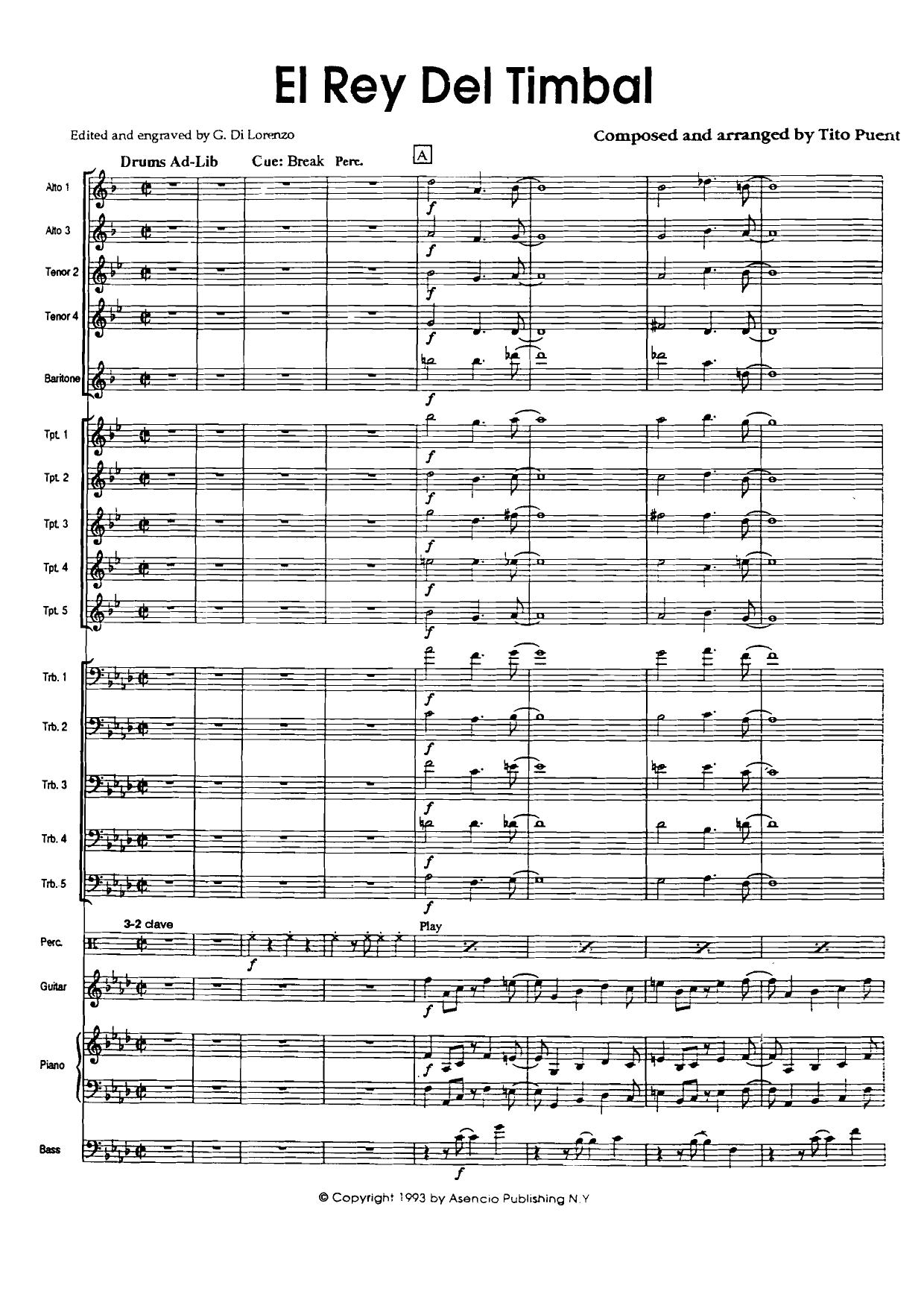
El Rey Del Timbal (T.Puente)
Composed by Tito Puente
Arranged by Tito Puente
- Ensemble: Big Band
- Pages: 48
- Instruments (19): Alto Sax 1, Alto Sax 3, Tenor Sax 2, Tenor Sax 4, Baritone Sax, Trumpet 1, Trumpet 2, Trumpet 3, Trumpet 4, Trumpet 5, Trombone 1, Trombone 2, Trombone 3, Trombone 4, Trombone 5, Piano, Guitar, Bass, Perc/Drms.
- Difficulty: medium
- Content: Individual Parts
- Format: PDF Download (Instant)
- Price: $24.99
Composed and popularized by the legendary "King of Latin Music," Tito Puente, "El Rey Del Timbal" stands as an immortal masterwork of Afro-Cuban jazz and big band orchestration. Originally recorded during the height of the Palladium Ballroom era in New York City, this iconic composition bridges the explosive rhythmic complexity of traditional Cuban *mambo* and *guaracha* with the sophisticated harmonic sensibilities of modern jazz big band writing. Puente, renowned as a virtuosic timbalero and visionary composer, crafted the tune as a definitive showcase for percussion-driven big band arrangements, cementing its status as an essential milestone in Latin jazz history that continues to electrify audiences worldwide. Driven by an infectious, high-octane Latin groove in 4/4 time, "El Rey Del Timbal" crackles with relentless energy, vibrant brass stabs, and interlocking percussion patterns. The mood is celebratory, fierce, and utterly commanding, evoking the sweat, glamour, and unbridled kinetic joy of mid-century dance halls. The arrangement opens with Puente’s signature driving timbale motifs before launching into a powerhouse thematic statement. The brass and woodwind sections trade razor-sharp counterlines against a relentless montuno piano and bass vamp, building an escalating wall of sound that demands absolute rhythmic precision and stamina from every player in the ensemble. Written by Puente himself, this definitive big band chart utilizes classic 19-instrument scoring—including a robust five-saxophone section (Alto Saxophones 1 and 3, Tenor Saxophones 2 and 4, and Baritone Saxophone), trumpets, trombones, and a full rhythm section anchored by auxiliary percussion. Puente’s approach marries heavy mambo block-chord voicings in the brass with soaring, linear woodwind solis. The arrangement features fiery call-and-response sections between the brass and reeds, punctuated by blistering shout choruses and structural open spaces designed specifically for extended timbale and percussion solos. The harmonic language is rich with bright dominant alterations, suspended chords, and chromatic passing tones that elevate traditional Caribbean dance forms into sophisticated jazz art. Performing this 48-page arrangement is a deeply rewarding, albeit physically demanding, exercise in ensemble cohesion and stylistic authenticity. The melody is carried primarily by the saxophone and trumpet sections, often doubled in bright octaves to cut through the thunderous rhythm section. Technical challenges center around the articulation of syncopated Latin figures (clave-based phrasing), rapid-fire sixteenth-note passages in the woodwinds, and maintaining an unhurried, driving tempo. The rhythm section—particularly the piano, bass, and percussionists—bears a heavy responsibility in locking down the groove, making an authentic percussion setup (including timbales, congas, and cowbell) essential for capturing the true character of Puente's writing. Due to its intricate rhythmic demands, syncopated phrasing, and stamina requirements, this chart is ideally suited for advanced college ensembles, community jazz orchestras, and professional big bands. While advanced high school bands with strong rhythm sections and mature section leaders can successfully tackle the chart, it requires an ensemble that is comfortable stepping outside standard swing feels to embrace the deep, polyrhythmic traditions of Afro-Cuban big band jazz. Executing "El Rey Del Timbal" successfully requires a deep understanding of Afro-Cuban phrasing and rhythmic displacement. The foundational challenge lies in internalizing the 2-3 or 3-2 clave feel; all syncopated horn punches must lock tightly with the percussion section rather than rushing ahead of the beat. Conductor and bandleaders should establish a brisk, driving tempo that prioritizes danceability over sheer velocity, ensuring the sixteenth-note lines in the saxophones remain articulate and clean. Special attention must be given to articulation markings: staccato notes should be clipped and punchy, while accented lines require a fat, resonant tone without harshness. Brass players should avoid overblowing during the high-register ensemble hits to maintain core sound quality. Rehearsals should initially isolate the rhythm section—specifically piano montunos and bass tumbao patterns—before layering in the horn sections section by section to ensure the polyrhythmic fabric is secure. Q: What instruments and parts are included in this arrangement? A: The 19-instrument big band instrumentation includes Alto Saxophone 1, Alto Saxophone 3, Tenor Saxophone 2, Tenor Saxophone 4, Baritone Saxophone, a full brass section of trumpets and trombones, and a complete rhythm section with auxiliary percussion parts spanning a comprehensive 48-page conductor score and set of parts. Q: What is the difficulty level of this arrangement? A: This arrangement is graded as advanced, making it best suited for college jazz orchestras, professional big bands, and elite high school ensembles with strong technical proficiency and rhythmic maturity. Q: What is the style and historical context of the piece? A: Written and recorded by Tito Puente, the piece is a foundational Afro-Cuban jazz standard rooted in the vibrant New York City Latin big band and mambo explosion of the 1950s Palladium era. Q: What makes this specific arrangement unique? A: Authored by Tito Puente himself, it authentically captures his signature compositional style, featuring explosive horn shouts, intricate mambo-derived counterlines, and designated space for authentic percussion improvisation. Q: What is the performance duration and tempo feel of the arrangement? A: The piece features a fast, high-energy Latin groove (up-tempo 4/4) designed to maintain intense momentum, with a typical performance duration of approximately 4 to 5 minutes depending on the length of the improvised percussion solos.
Questions and answers
- What is included in the El Rey Del Timbal (T.Puente) PDF?
- The verified current file contains a conductor score and individual parts across 48 pages.
- How many instruments or parts are listed for El Rey Del Timbal (T.Puente)?
- The verified instrumentation list contains 19 entries for this Big Band arrangement.
- Who is credited for El Rey Del Timbal (T.Puente)?
- Composer: Tito Puente. Arranger: Tito Puente.
- What difficulty is listed for El Rey Del Timbal (T.Puente)?
- The verified difficulty level is medium.
- Can I preview El Rey Del Timbal (T.Puente) before buying?
- Yes. The product page provides a preview generated from the current PDF file.
- How is El Rey Del Timbal (T.Puente) delivered?
- After successful payment, the digital PDF is made available for download. The displayed price is $24.99.
Musicians Also Search For
El Rey Del Timbal Tito Puente PDF • El Rey Del Timbal Tito Puente sheet music • El Rey Del Timbal arranged by Tito Puente • Tito Puente big band charts • Tito Puente jazz arrangements PDF • El Rey Del Timbal Tito Puente big band arrangements • El Rey Del Timbal big band arrangements • El Rey Del Timbal big band PDF download • El Rey Del Timbal jazz sheet music • big band sheet music download • El Rey Del Timbal conductor score PDF • El Rey Del Timbal individual parts download • El Rey Del Timbal sheet music PDF • buy El Rey Del Timbal sheet music • download El Rey Del Timbal PDF • El Rey Del Timbal jazz charts • best Tito Puente big band arrangements • El Rey Del Timbal printable sheet music • big band repertoire PDF