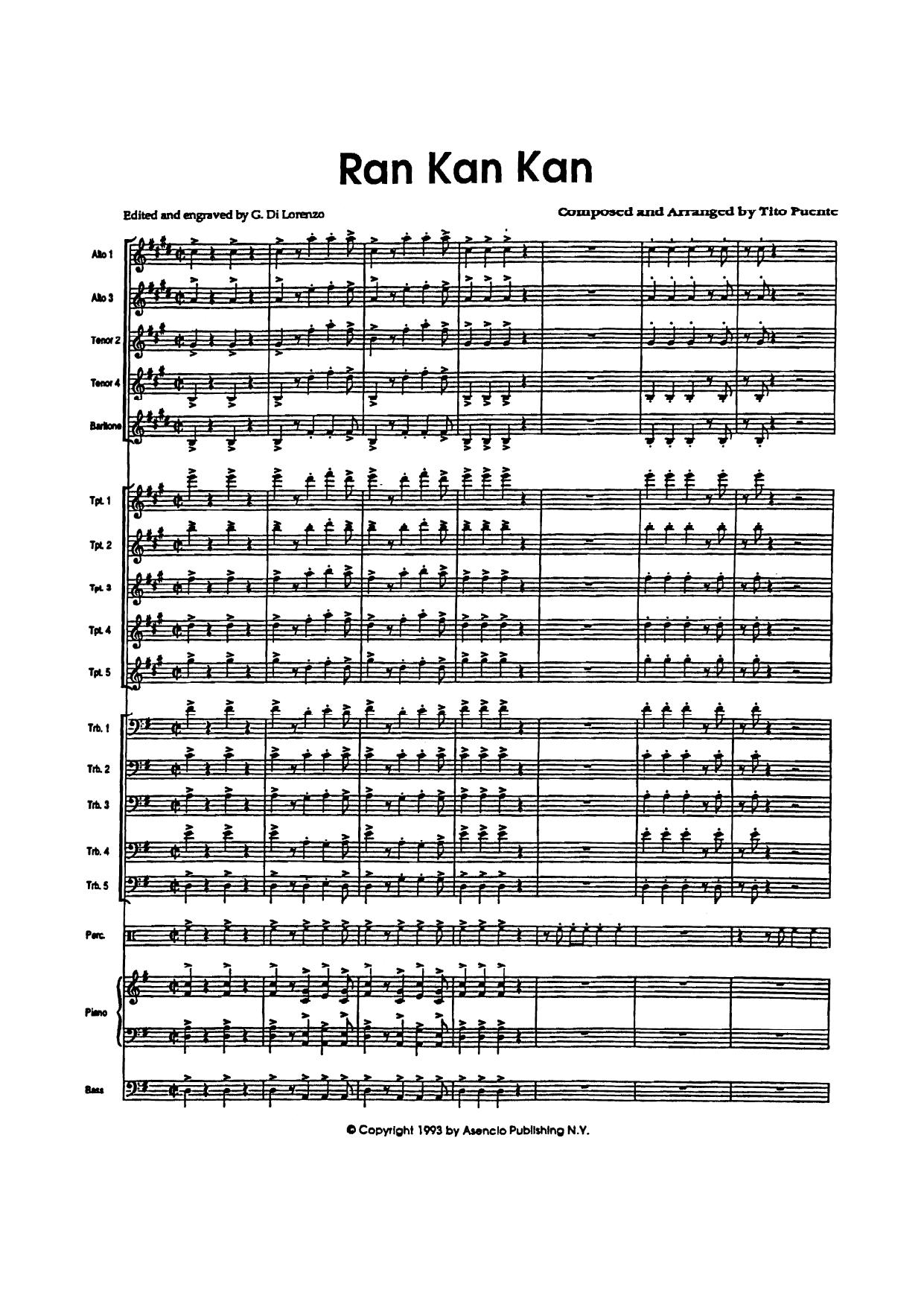
Ran Kan Kan (T.Puente)
Composed by Tito Puente
Arranged by Tito Puente
- Ensemble: Big Band
- Pages: 46
- Instruments (18): Alto Sax 1, Alto Sax 3, Tenor Sax 2, Tenor Sax 4, Baritone Sax, Trumpet 1, Trumpet 2, Trumpet 3, Trumpet 4, Trumpet 5, Trombone 1, Trombone 2, Trombone 3, Trombone 4, Trombone 5, Piano, Bass, Percussion/Drums
- Difficulty: medium
- Content: Individual Parts
- Format: PDF Download (Instant)
- Price: $24.99
Composed by the legendary "King of the Timbales" Tito Puente during his service in World War II and later refined at The Juilliard School, "Ran Kan Kan" stands as one of the definitive pillars of the mid-20th-century mambo craze and a cornerstone of Latin jazz history. Originally made famous by Puente’s high-octane big band at legendary venues like the Palladium Ballroom, this enduring composition bridges sophisticated Afro-Cuban rhythmic structures with the punchy, brass-heavy delivery of American jazz orchestration. It remains a masterclass in fusing infectious dance grooves with intricate harmonic writing. Driven by a relentless, high-energy up-tempo mambo groove in 4/4 time, the musical character is explosive, joyous, and rhythmically demanding. Built on a vibrant harmonic foundation, the arrangement features sparkling brass punches, interlocking woodwind lines, and a relentless cowbell-and-timbales pulse that commands physical movement. The mood shifts dynamically between tense, driving background vamps and wide-open, celebratory shout choruses that evoke the electric atmosphere of New York City's golden era of Latin dance music. Puente’s personal approach to the arrangement showcases his signature mastery of big band orchestration, highlighting tight, harmonized trumpet and trombone solis that weave fluidly around the underlying clave. The charts utilize bright, searing brass voicings and aggressive counterlines in the saxophones, ensuring that every section shares in the rhythmic propulsion. Call-and-response figures between the brass and reed sections mimic the traditional guajeo patterns found in Cuban son and mambo, while extended chord extensions give the work a distinctly sophisticated jazz edge. The melody is primarily carried by the full brass and reed sections in unison or rich block chords, punctuated by blistering horn breaks and iconic mambo hooks. Featured solo sections provide ample space for virtuosic improvisation—traditionally for timbales, piano, or saxophone—testing the ensemble's ability to maintain a rock-solid time feel over complex montuno vamps. Achieving success with this 17-instrument arrangement requires absolute precision in articulation and a deep understanding of Latin phrasing, making it an extraordinarily rewarding centerpiece for advanced college ensembles, community big bands, and professional orchestras looking to challenge their rhythm section and horn players alike. Executing "Ran Kan Kan" successfully demands immense stamina, crisp articulation, and a deep collective understanding of Afro-Cuban time. The tempo should be brisk and driving, but never rushed; lock the quarter note firmly with the rhythm section to maintain the authentic mambo propulsion. Key technical challenges lie in the precision of the staccato horn punches and the seamless integration of the percussion section. Brass players must execute sharp, accented tonguing without sacrificing a warm tone, paying close attention to written falls and doits that add stylistic authenticity. The rhythm section—specifically the piano, bass, and auxiliary percussion—serves as the engine of the chart; the montuno patterns must remain even and hypnotic beneath the blazing ensemble shout choruses. Rehearsal should begin with the rhythm section alone to lock in the 2-3 or 3-2 clave before introducing the horns. Drill the syncopated brass figures slowly, isolating the off-beat entrances until they speak with absolute unity. Conductors should emphasize that dynamic contrast is vital; pull back slightly during underlying vamps so the eventual ensemble crescendos and high-note trumpet climaxes achieve maximum impact. Q: What instruments and parts are included in this arrangement? A: This 46-page big band chart is scored for a standard 17-instrument instrumentation, comprising 4 trumpets, trombones (beginning with Trombone 1), a full saxophone section, and a complete rhythm section including dedicated percussion parts. Q: What is the difficulty level of this arrangement? A: This piece is best suited for advanced high school, collegiate, and professional big bands due to its brisk tempo, demanding syncopation, and high technical requirements for both the horn and rhythm sections. Q: What is the musical style and historical background of the piece? A: Written by Tito Puente during World War II and refined at Juilliard, "Ran Kan Kan" is a classic mambo and Latin jazz standard that defined the mid-century New York Latin dance scene. Q: What makes this specific arrangement unique? A: It features Tito Puente's authentic signature orchestrations, incorporating blistering brass solis, traditional montuno vamps, and intricate call-and-response figures that authentically replicate the energy of his historic orchestra recordings. Q: What is the performance duration and recommended tempo feel? A: The arrangement is built for an up-tempo Latin mambo groove, generally clocking in at around 4 to 5 minutes of high-energy performance time depending on the length of the open solo sections.
Questions and answers
- What is included in the Ran Kan Kan (T.Puente) PDF?
- The verified current file contains a conductor score and individual parts across 46 pages.
- How many instruments or parts are listed for Ran Kan Kan (T.Puente)?
- The verified instrumentation list contains 18 entries for this Big Band arrangement.
- Who is credited for Ran Kan Kan (T.Puente)?
- Composer: Tito Puente. Arranger: Tito Puente.
- What difficulty is listed for Ran Kan Kan (T.Puente)?
- The verified difficulty level is medium.
- Can I preview Ran Kan Kan (T.Puente) before buying?
- Yes. The product page provides a preview generated from the current PDF file.
- How is Ran Kan Kan (T.Puente) delivered?
- After successful payment, the digital PDF is made available for download. The displayed price is $24.99.
Musicians Also Search For
Ran Kan Kan Tito Puente PDF • Ran Kan Kan Tito Puente sheet music • Ran Kan Kan arranged by Tito Puente • Tito Puente big band charts • Tito Puente jazz arrangements PDF • Ran Kan Kan Tito Puente big band arrangements • Ran Kan Kan big band arrangements • Ran Kan Kan big band PDF download • Ran Kan Kan jazz sheet music • big band sheet music download • Ran Kan Kan conductor score PDF • Ran Kan Kan individual parts download • Ran Kan Kan sheet music PDF • buy Ran Kan Kan sheet music • download Ran Kan Kan PDF • Ran Kan Kan jazz charts • best Tito Puente big band arrangements • Ran Kan Kan printable sheet music • big band repertoire PDF