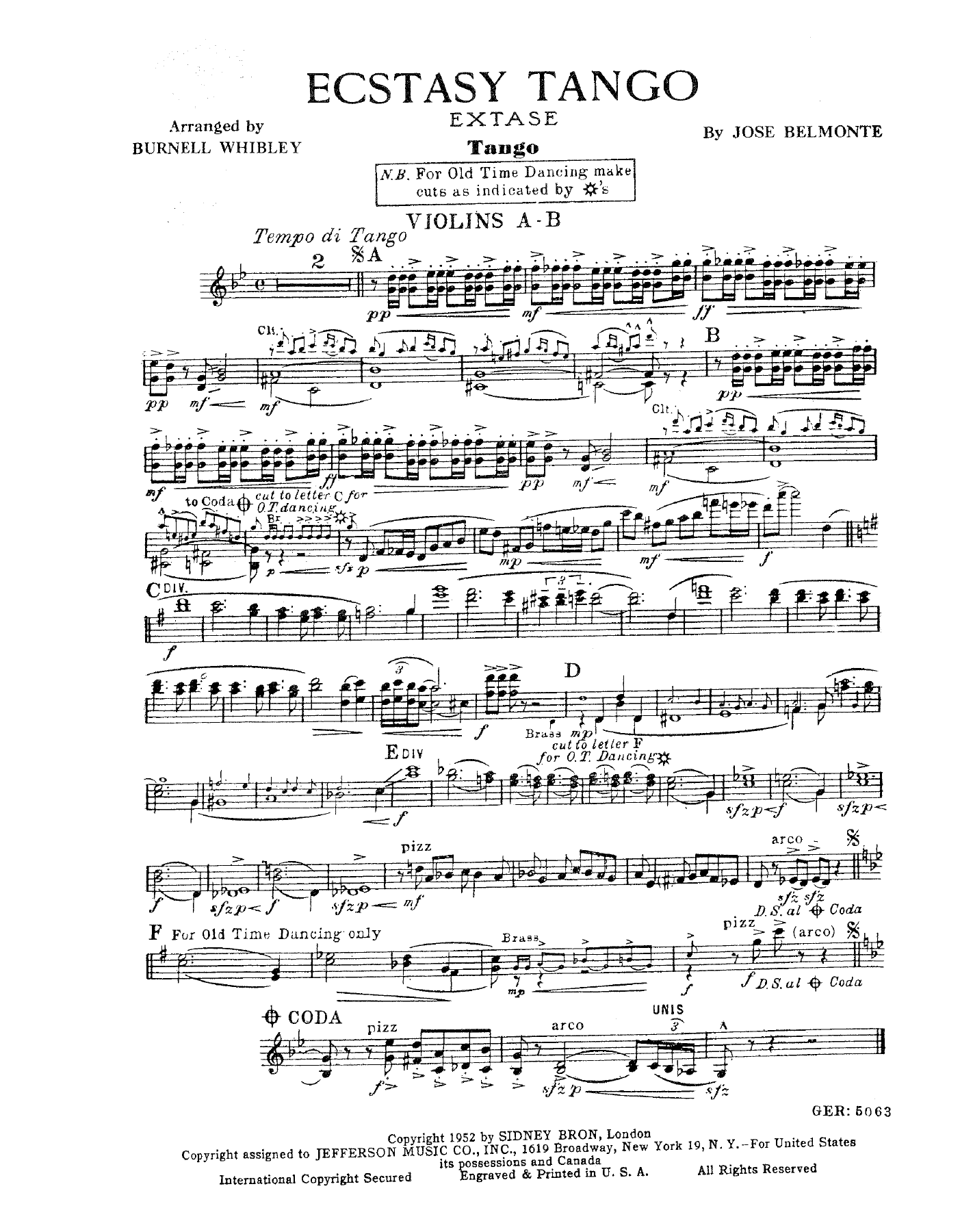
Ecstasy Tango (B.Whibley)
Composed by B. Whibley
Arranged by B. Whibley
- Ensemble: Big Band
- Style: Tango
- Pages: 18
- Instruments (16): Violins A-B, Violin C, 1st Sax Eb Alto, 3rd Sax Eb Alto, 2nd Sax Bb Tenor, 4th Sax Bb Tenor, 5th Sax Eb Baritone, 1st Bb Trumpet, 2nd Bb Trumpet, 3rd Bb Trumpet, 1st Trombone, 2nd Trombone, Guitar, Piano Conductor & Accordion Guide, Bass, Drums
- Difficulty: easy
- Content: Individual Parts
- Format: PDF Download (Instant)
- Price: $24.99
"Ecstasy Tango," an original composition and arrangement by B. Whibley, presents a captivating foray into the vibrant world of the tango, reimagined for the power and sophistication of the big band idiom. While not a historical jazz standard, this piece draws its inspiration from the rich tradition of Argentinian tango, a genre that emerged in the late 19th century and flourished through the Golden Age of the 1930s and 40s with iconic figures like Astor Piazzolla later pushing its boundaries. Whibley's work here channels the passionate intensity and dramatic flair inherent in the tango, offering a fresh, contemporary perspective that bridges classical Latin American dance forms with modern big band orchestration. It evokes a mood of sophisticated allure and simmering passion, characteristic of the dance itself, making it a compelling addition to any ensemble's repertoire. Whibley’s musical characterization of "Ecstasy Tango" is defined by a medium-slow, deliberate tempo, typically around 96-108 BPM, maintaining the characteristic 2/4 or 4/4 feel with a strong, grounded pulse that encourages a subtle sway rather than a pronounced swing. The primary key signature provides a rich, melancholic foundation, often exploring minor modes and harmonic minor scales to achieve its dramatic effect. The piece is imbued with a sense of romantic tension and release, utilizing dynamic contrasts from hushed, intimate passages to full-throated, passionate declarations from the brass and saxophone sections. The energy fluctuates between brooding intensity and moments of soaring melodicism, creating a narrative arc that is both emotionally resonant and musically engaging. B. Whibley's arranging prowess is evident in the masterful orchestration and intricate voicings. The arrangement opens with a haunting melodic statement, often carried by a unison or harmonized saxophone section, establishing the tango's signature melancholic beauty. Throughout the piece, Whibley employs sophisticated counterpoint and rich harmonic extensions that add depth and color without sacrificing the fundamental tango character. Expect well-crafted soli sections, particularly for the saxophones, showcasing their collective agility and blend. The brass sections contribute dramatic fanfares and sustained chords, providing both rhythmic drive and harmonic support. While there isn't a traditional "shout chorus" in the jazz sense, the arrangement builds to powerful climaxes through layered orchestration and dynamic swells. Featured solo opportunities are strategically placed, often for a lead alto saxophone or trumpet, allowing for expressive improvisation over the tango's distinctive harmonic progressions. Performing "Ecstasy Tango" offers a rewarding experience for a variety of ensembles. The primary melodic lines are distributed thoughtfully, ensuring engagement across sections. Technical challenges include precise articulation to capture the tango's rhythmic nuances, maintaining consistent dynamic control, and achieving a cohesive ensemble blend, particularly in the harmonically dense passages. The piece is well-suited for college-level jazz ensembles, community big bands with strong sight-reading abilities, and professional groups seeking to expand their repertoire beyond traditional jazz. Its unique stylistic blend makes it an excellent choice for concert programs looking for a piece with strong emotional impact and a distinctive Latin flavor, providing a refreshing contrast to swing or funk charts. Conductors should emphasize a precise, yet flowing, rhythmic interpretation to capture the authentic tango feel; avoid rushing the tempo. The characteristic *marcato* articulation in the bass line and lower brass should be distinct but not overly aggressive, providing a strong rhythmic foundation. Pay close attention to dynamic markings, as the piece relies heavily on dramatic shifts from *pianissimo* to *fortissimo* to convey its emotional depth. Rehearsal time should be dedicated to balancing the intricate voicings, particularly in the saxophone soli sections, ensuring clarity of inner lines. Horn players should practice the sustained, expressive melodic phrases, focusing on breath support and consistent tone. There are no specific extended techniques (like plungers or doits) explicitly called for, allowing the focus to remain on core musicianship, blend, and dynamic control. Encourage soloists to embrace the passionate, lyrical nature of the tango in their improvisations. Q: What instruments are included in this arrangement? A: This big band arrangement includes parts for 17 instruments: Alto Saxophone 1, Alto Saxophone 2, Tenor Saxophone 1, Tenor Saxophone 2, Baritone Saxophone, Trumpet 1, Trumpet 2, Trumpet 3, Trumpet 4, Trombone 1, Trombone 2, Trombone 3, Trombone 4, Guitar, Piano, Bass, and Drums. Q: What is the difficulty level of "Ecstasy Tango (B.Whibley)"? A: This arrangement is considered advanced intermediate to advanced. It requires solid sight-reading skills, good ensemble blend, dynamic control, and expressive soloists, making it suitable for strong college, community, or professional big bands. Q: What musical style does "Ecstasy Tango" represent, and what is its historical context? A: "Ecstasy Tango" is an original composition and arrangement in the tango style, adapted for big band. It draws inspiration from the traditional Argentinian tango, a passionate dance and musical genre that originated in the late 19th century, rather than being a historical jazz standard. Q: What makes B. Whibley's arrangement of "Ecstasy Tango" unique? A: B. Whibley's arrangement is unique for its successful fusion of traditional tango elements with sophisticated big band orchestration, featuring rich harmonic voicings, dynamic contrasts, and well-crafted soli sections that highlight the ensemble's capabilities while maintaining the genre's inherent passion and drama. Q: What is the typical performance duration and tempo for this piece? A: The typical performance duration for "Ecstasy Tango" is approximately 4-5 minutes. It is designed to be played at a medium-slow tango tempo, generally around 96-108 beats per minute, emphasizing a deliberate and expressive feel.
Questions and answers
- What is included in the Ecstasy Tango (B.Whibley) PDF?
- The verified current file contains a conductor score and individual parts across 18 pages.
- How many instruments or parts are listed for Ecstasy Tango (B.Whibley)?
- The verified instrumentation list contains 16 entries for this Big Band arrangement.
- Who is credited for Ecstasy Tango (B.Whibley)?
- Composer: B. Whibley. Arranger: B. Whibley.
- What difficulty is listed for Ecstasy Tango (B.Whibley)?
- The verified difficulty level is easy.
- What style is listed for Ecstasy Tango (B.Whibley)?
- The catalog lists the style as Tango.
- Can I preview Ecstasy Tango (B.Whibley) before buying?
- Yes. The product page provides a preview generated from the current PDF file.
- How is Ecstasy Tango (B.Whibley) delivered?
- After successful payment, the digital PDF is made available for download. The displayed price is $24.99.
Musicians Also Search For
Ecstasy Tango B. Whibley PDF • Ecstasy Tango B. Whibley sheet music • Ecstasy Tango arranged by B. Whibley • B. Whibley big band charts • B. Whibley jazz arrangements PDF • Ecstasy Tango B. Whibley big band arrangements • Ecstasy Tango big band arrangements • Ecstasy Tango big band PDF download • Ecstasy Tango jazz sheet music • big band sheet music download • Ecstasy Tango conductor score PDF • Ecstasy Tango individual parts download • Ecstasy Tango sheet music PDF • Ecstasy Tango Tango charts • Tango big band arrangements • buy Ecstasy Tango sheet music • download Ecstasy Tango PDF • Ecstasy Tango jazz charts • best B. Whibley big band arrangements • Ecstasy Tango printable sheet music • big band repertoire PDF