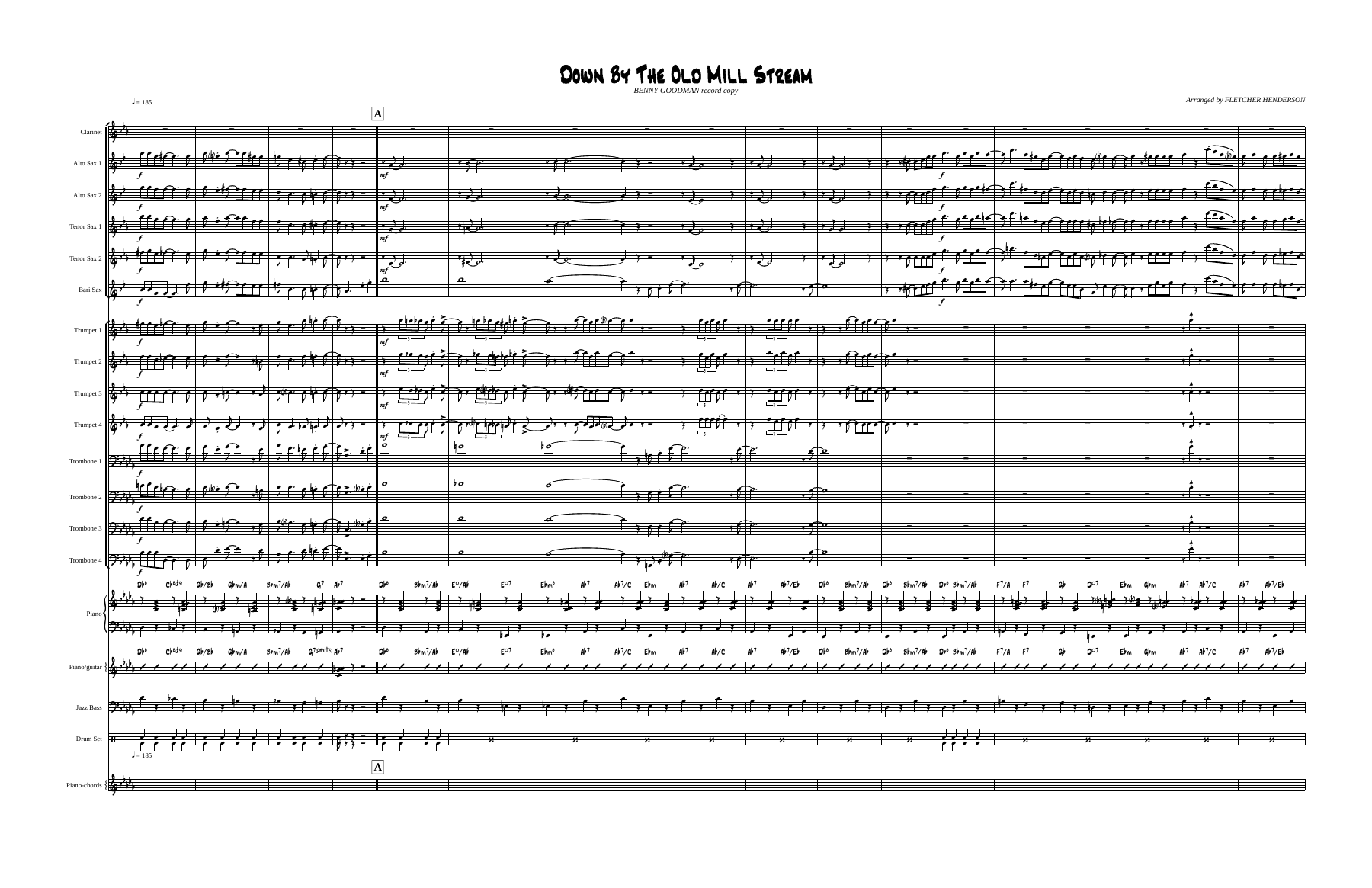
Down By The Old Mill Stream (F.Henderson)
Composed by Tell Taylor
Arranged by Benny Goodman
- Ensemble: Big Band
- Style: Jazz Standard
- Pages: 60
- Instruments (17): Alto Saxophone 1, Alto Saxophone 2, Tenor Saxophone 1, Tenor Saxophone 2, Baritone Saxophone, Trumpet 1, Trumpet 2, Trumpet 3, Trumpet 4, Trombone 1, Trombone 2, Trombone 3, Bass Trombone, Guitar, Piano, Bass, Drums
- Difficulty: advanced
- Content: Individual Parts
- Format: PDF Download (Instant)
- Price: $24.99
"Down By The Old Mill Stream," a timeless American parlor song penned by Tell Taylor in 1910, found a vibrant new life and solidified its place in the jazz lexicon through the transformative lens of the swing era. While initially a sentimental ballad, its enduring melody and chord progression made it a natural candidate for jazz interpretation, particularly during the 1930s and 40s. This arrangement, attributed to the legendary "King of Swing" Benny Goodman, captures the infectious energy and sophisticated orchestration that defined his iconic big band sound. It represents a pivotal moment when popular tunes were elevated into sophisticated jazz vehicles, showcasing the era's innovative arranging techniques and the burgeoning virtuosity of jazz soloists. The piece, in Goodman's hands, transcends its humble origins to become a quintessential example of a swing-era jazz standard, celebrated for its melodic charm and rhythmic drive. This particular rendition of "Down By The Old Mill Stream" is a quintessential medium-up swing chart, typically performed in 4/4 time at a brisk, yet relaxed, tempo around 180-200 BPM. The overall mood is joyous and effervescent, evoking the golden age of big band dance halls. Goodman's characteristic approach shines through with bright, often brass-led, melodic statements and a driving rhythm section that propels the piece forward. Expect a dynamic journey through classic swing harmonies, punctuated by the crisp articulation and precise ensemble work that were hallmarks of the Goodman orchestra. The arrangement maintains a bright, optimistic key, likely F or Bb major, allowing the brass to soar and the saxophones to weave intricate lines with clarity. Benny Goodman's arranging style, even when credited to him, often reflects the collective genius of his staff arrangers (like Fletcher Henderson, who is sometimes associated with this particular chart's foundational elements, as indicated in the title's parenthetical). This arrangement showcases classic swing big band techniques: tightly voiced saxophone soli passages that weave counter-melodies against brass punches, powerful shout choruses that build intensity, and call-and-response figures between sections. Expect Goodman's signature clarinet to be featured prominently, either carrying the melody or taking a virtuosic solo. The arrangement masterfully builds tension and release, moving from full ensemble statements to more intimate sectional dialogues, all while maintaining an irresistible swing feel. The technical demands are significant, requiring strong section playing, precise articulation, and a keen sense of swing rhythm. The arrangement typically opens with a full ensemble statement of the main theme, often featuring the brass or a combined sax/brass melody, before transitioning into a series of improvised solos over the familiar chord changes. The clarinet solo, if present, will be a highlight, showcasing agility and melodic invention. Following the solos, a powerful shout chorus will likely emerge, building to a thrilling climax before a final, often playful, restatement of the theme. This chart is ideally suited for advanced high school, collegiate, community, and professional big bands. Its historical significance, combined with its demanding yet rewarding musical content, makes it an excellent choice for developing ensemble precision, swing feel, and an understanding of classic big band aesthetics. Performing this piece offers a deep dive into the heart of the swing era, challenging musicians while delighting audiences with its timeless appeal. This arrangement demands a crisp, unified articulation from all sections to achieve the authentic Goodman sound. Emphasize a medium-up swing tempo, around 180-200 BPM, ensuring the rhythm section provides a consistent, driving pulse without rushing. Key technical challenges include fast saxophone soli passages requiring excellent finger dexterity and breath control, and precise brass attacks and releases, particularly in the shout choruses. Conductors should focus on dynamic contrasts, moving from nuanced sectional playing to powerful full-ensemble statements. Pay close attention to cut-offs and phrase endings, ensuring they are clean and together. The clarinet solo, if present, requires a soloist with strong improvisational skills and a clear, agile tone. Rehearsal time should be dedicated to locking in the swing feel, achieving balance between sections, and perfecting the tight ensemble voicings. Q: What instruments/parts are included in this arrangement? A: This big band arrangement is scored for 17 instruments, including Alto Saxophone 1, Alto Saxophone 2, Tenor Saxophone 1, Tenor Saxophone 2, Baritone Saxophone, Trumpet 1, Trumpet 2, Trumpet 3, Trumpet 4, Trombone 1, Trombone 2, Trombone 3, Trombone 4, Piano, Bass, Drums, and Guitar. The full score is 60 pages. Q: What is the difficulty level of this arrangement? A: This arrangement is considered advanced, suitable for experienced high school, collegiate, community, and professional big bands. It requires strong section playing, precise articulation, and a solid understanding of swing rhythm and harmony. Q: What is the musical style and historical context of this arrangement? A: This is a classic jazz standard in the medium-up swing style, originally composed by Tell Taylor in 1910 and arranged by Benny Goodman. It embodies the vibrant big band sound of the 1930s and 40s, showcasing sophisticated orchestration and energetic swing rhythms. Q: What makes this particular arrangement unique or distinctive? A: Attributed to Benny Goodman, this arrangement features his signature big band sound, characterized by tightly voiced saxophone soli, powerful brass shout choruses, and a driving swing feel. It likely includes a prominent clarinet feature, reflecting Goodman's own virtuosity. Q: What is the typical performance duration and recommended tempo for this piece? A: The typical performance duration for this arrangement is approximately 3-4 minutes, depending on the number and length of improvised solos. The recommended tempo is a medium-up swing, generally between 180-200 beats per minute.
Musicians Also Search For
Down By The Old Mill Stream Benny Goodman PDF • Down By The Old Mill Stream Benny Goodman sheet music • Down By The Old Mill Stream arranged by Benny Goodman • Benny Goodman big band charts • Benny Goodman jazz arrangements PDF • Down By The Old Mill Stream Tell Taylor sheet music • Down By The Old Mill Stream Tell Taylor big band arrangement • Tell Taylor big band charts • Down By The Old Mill Stream big band arrangement • Down By The Old Mill Stream big band PDF download • Down By The Old Mill Stream jazz ensemble sheet music • big band sheet music instant download • Down By The Old Mill Stream individual parts download • Down By The Old Mill Stream sheet music with parts • Down By The Old Mill Stream Jazz Standard chart • Jazz Standard big band arrangements • buy Down By The Old Mill Stream sheet music online • download Down By The Old Mill Stream PDF • Down By The Old Mill Stream jazz chart • best Benny Goodman big band arrangements • Tell Taylor songs arranged by Benny Goodman • Down By The Old Mill Stream printable sheet music • big band repertoire PDF