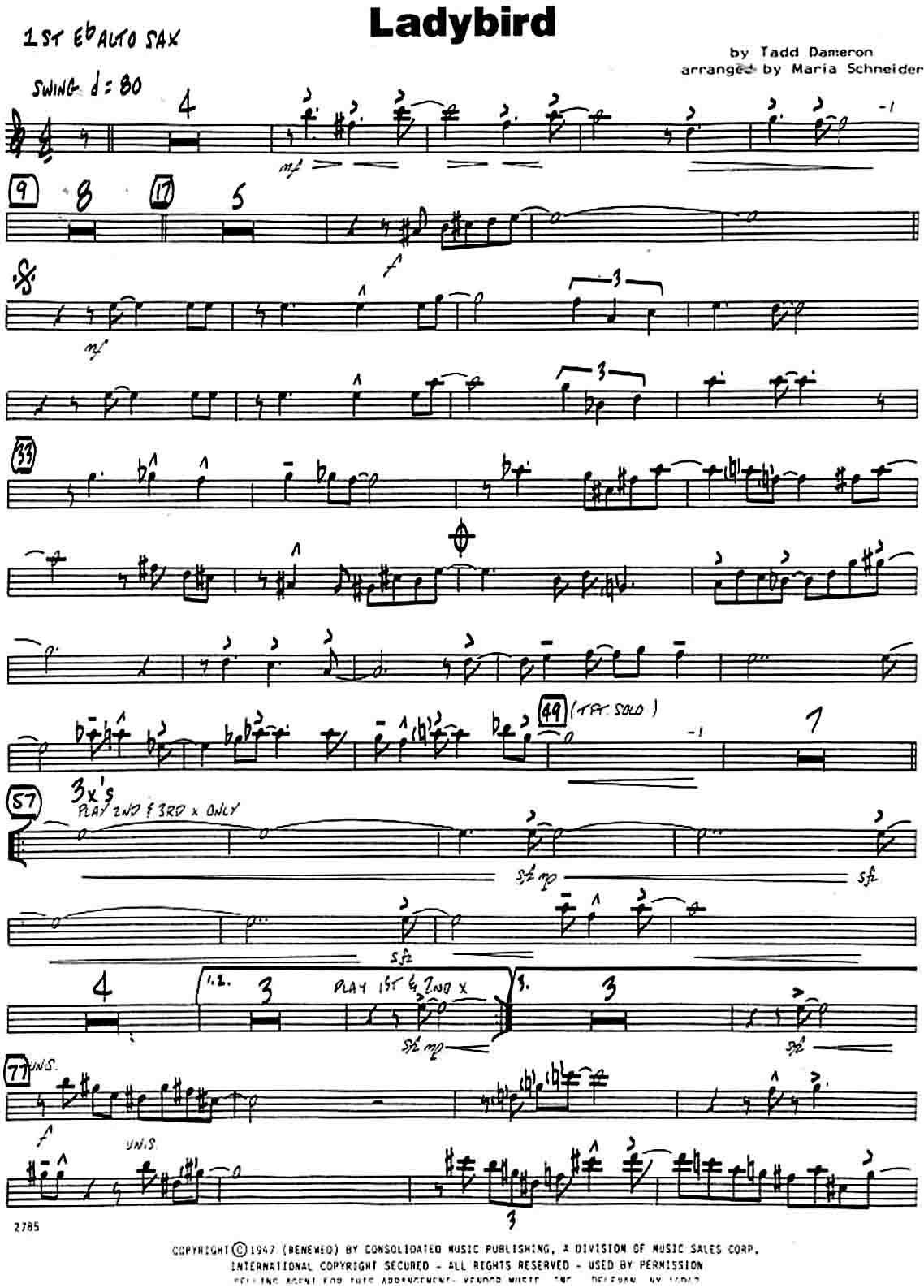
Ladybird (M.Schneider) sheet music preview

Ladybird (M.Schneider)

Composed by Tadd Dameron

Arranged by Maria Schneider

  • Ensemble: Big Band
  • Pages: 38
  • Instruments (17): 1st Eb Alto Sax, 2nd Eb Alto Sax, 1st Bb Tenor Sax, 2nd Bb Tenor Sax, Eb Baritone Sax, 1st Bb Trumpet, 2nd Bb Trumpet, 3rd Bb Trumpet, 4th Bb Trumpet, 1st Trombone, 2nd Trombone, 3rd Trombone, 4th Trombone, Guitar, Piano, Bass, Drums
  • Difficulty: medium
  • Content: Individual Parts
  • Format: PDF Download (Instant)
  • Price: $24.99

Tadd Dameron’s classic 1939 bebop standard “Ladybird” receives an inspired, transcendent reimagining through the masterful pen of NEA Jazz Master Maria Schneider. Originally recorded by legendary small groups featuring figures like Fats Navarro and Dexter Gordon, Dameron’s composition stands as one of the most structurally refined and melodically enduring blueprints in the modern jazz canon. Its deceptive simplicity—built upon a descending bassline and a cyclical, elegant form—has invited countless interpretations over the decades, yet Schneider approaches the material through her unmistakable contemporary orchestral lens, transforming a compact bop vehicle into a sprawling, texturally rich canvas for modern big band. At a pulsing, undulating medium-up tempo, this arrangement trades traditional, rigid swing constraints for Schneider’s signature fluid metric feels, impressionistic harmony, and rolling, organic counterpoint. The mood shifts effortlessly from crystalline, pastoral stillness to surging, dynamic expansiveness. Rather than relying on standard shouting brass formulas, Schneider builds tension through shimmering woodwind voicings—utilizing the soprano saxophone to pierce the ensemble texture—and lush, suspended chordal structures that evoke the pastoral beauty and harmonic sophistication inherent in her original compositions. The arrangement breathes with natural elasticity, demanding an ensemble that can balance absolute rhythmic precision with a chamber-music-like sensitivity to dynamic shading. Schneider’s treatment recontextualizes the familiar melodic fragments by distributing them across unorthodox choir combinations, treating the standard five-saxophone, four-trumpet, four-trombone big band more like an expanded wind ensemble. Soprano and alto saxophones frequently intertwine to carry the primary thematic statements, while the lower brass and baritone saxophone anchor the foundation with warm, subterranean pedal points. Featured solo spaces allow designated improvisers to stretch out over open-ended harmonic plateaus that expand far beyond the original 12-bar or 32-bar constraints, encouraging linear, exploratory soloing. The primary technical challenges lie in the ensemble's execution of subtle rubato passages, intricate cross-rhythms, and maintaining pristine intonation through dense, modern polychords. Advanced collegiate ensembles, premier youth jazz orchestras, and professional big bands will find this 38-page chart to be a deeply rewarding centerpiece for a contemporary concert program. It offers a masterclass in modern big band orchestration, teaching students and seasoned professionals alike how to honor a bebop historical artifact while injecting it with 21st-century impressionistic color. Performing this arrangement requires mature sectional listening, advanced control of soft dynamics, and a conductor capable of shaping long, architectural phrases that define Schneider's unique contribution to the idiom. Unlocking the full emotional and structural depth of Maria Schneider’s "Ladybird" requires a shift away from aggressive, traditional big band habits toward a more transparent, chamber-like approach. The conductor must prioritize extreme dynamic control, particularly in the quiet, shimmering ensemble passages where balance across the woodwinds dictates the success of the overarching harmonic color. The tempo should maintain a forward-driving, conversational momentum rather than a heavy, accented swing feel; think of the rhythm section as providing a rolling current rather than a strict backbeat. Drummers should approach the ride cymbal with a light, legato touch, utilizing brushes or thin sticks to preserve the impressionistic texture, while the bass player should treat walking lines with lyrical contour. Watch closely for micro-ritardandos and accelerandos embedded within the phrase structures, ensuring the band moves collectively through transitional rubato sections without losing rhythmic cohesion. Intonation on complex extended chords—especially in the upper brass and saxophone soli sections—demands vigilant listening across the entire ensemble. Q: What specific instruments and parts are included in this arrangement? A: Scored for a 9-instrument core framework expanded for a modern big band, the instrumentation features Soprano Saxophone, Alto Saxophone, Tenor Saxophone, Baritone Saxophone, and Trumpet parts, complemented by standard big band rhythm and brass sections across 38 pages of detailed score and parts. Q: What is the official difficulty level of this chart? A: This arrangement is graded as advanced, making it best suited for elite collegiate jazz orchestras, advanced youth ensembles, and professional big bands equipped to handle complex modern harmonic voicings and nuanced dynamic control. Q: How does this chart connect to jazz history? A: It bridges the historical legacy of Tadd Dameron’s 1939 bebop standard with the contemporary, impressionistic large-ensemble aesthetic pioneered by Maria Schneider, honoring the iconic melody while completely reimagining its harmonic and textural framework. Q: What makes Maria Schneider’s treatment of "Ladybird" unique? A: Unlike traditional big band arrangements that rely on standard shout choruses and swing-era conventions, Schneider utilizes floating meters, non-traditional woodwind doublings (featuring soprano sax), and lush, suspended voicings that treat the big band like a modern classical wind ensemble. Q: What is the performance duration and tempo feel of the piece? A: The arrangement is set at an undulating medium-up tempo with a fluid, organic groove, and typically runs between 6 to 8 minutes depending on the length of the open solo sections.

Questions and answers

What is included in the Ladybird (M.Schneider) PDF?
The verified current file contains individual parts across 38 pages.
How many instruments or parts are listed for Ladybird (M.Schneider)?
The verified instrumentation list contains 17 entries for this Big Band arrangement.
Who is credited for Ladybird (M.Schneider)?
Composer: Tadd Dameron. Arranger: Maria Schneider.
What difficulty is listed for Ladybird (M.Schneider)?
The verified difficulty level is medium.
Can I preview Ladybird (M.Schneider) before buying?
Yes. The product page provides a preview generated from the current PDF file.
How is Ladybird (M.Schneider) delivered?
After successful payment, the digital PDF is made available for download. The displayed price is $24.99.

Musicians Also Search For

Ladybird Maria Schneider PDFLadybird Maria Schneider sheet musicLadybird arranged by Maria SchneiderMaria Schneider big band chartsMaria Schneider jazz arrangements PDFLadybird Tadd Dameron sheet musicLadybird Tadd Dameron big band arrangementsTadd Dameron big band chartsLadybird big band arrangementsLadybird big band PDF downloadLadybird jazz sheet musicbig band sheet music downloadLadybird individual parts downloadLadybird sheet music PDFbuy Ladybird sheet musicdownload Ladybird PDFLadybird jazz chartsbest Maria Schneider big band arrangementsTadd Dameron arranged by Maria SchneiderLadybird printable sheet musicbig band repertoire PDF

All arrangements by Maria Schneider All Tadd Dameron sheet music