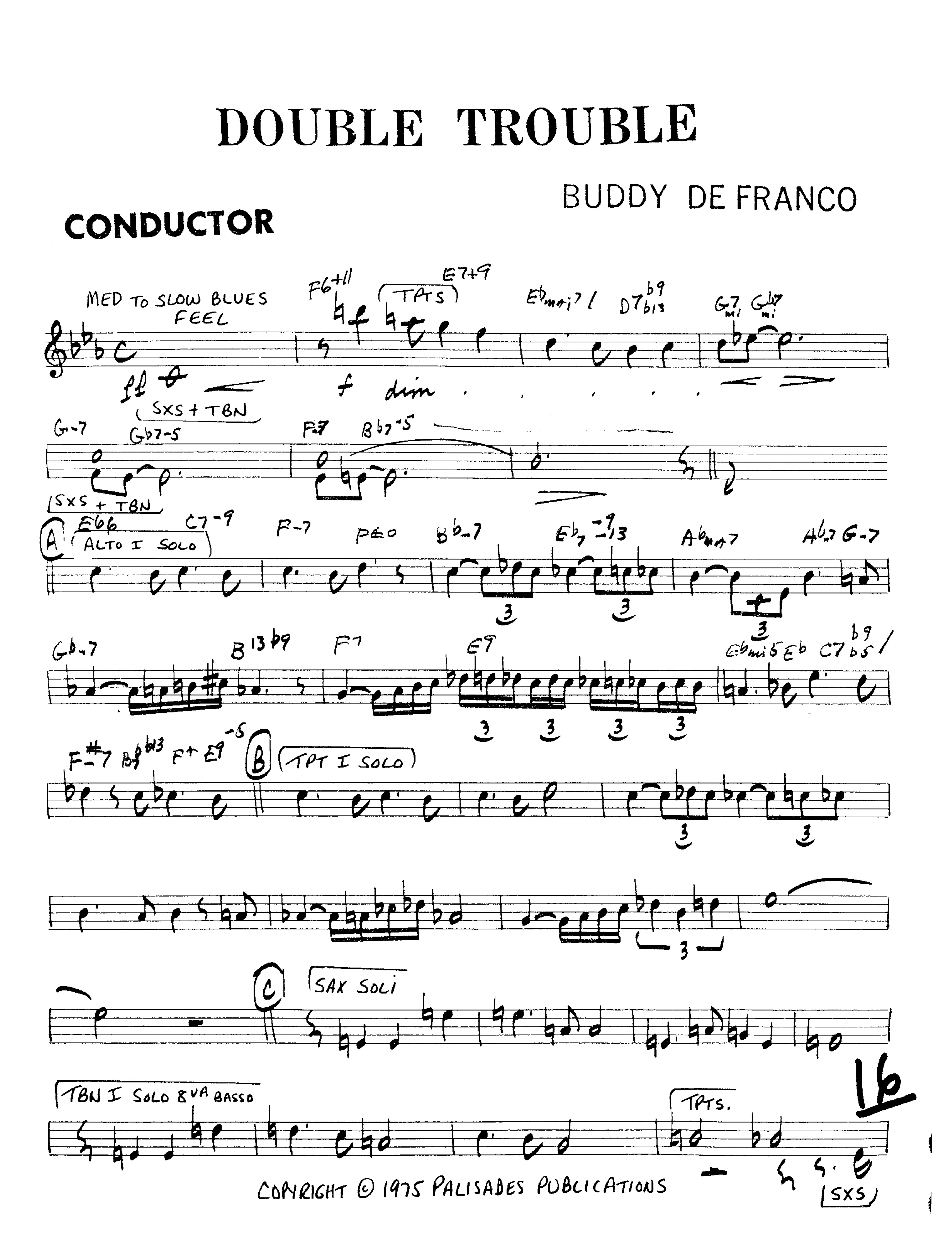
Double Trouble (B.Franco)
Composed by Buddy De Franco
Arranged by Buddy De Franco
- Ensemble: Big Band
- Style: Jazz Standard
- Pages: 59
- Instruments (19): Conductor, 1st Trumpet, 2nd Trumpet, 3rd Trumpet, 4th Trumpet, 5th Trumpet, 1st Trombone, 2nd Trombone, 3rd Trombone, 4th Trombone, 1st Alto Sax, 2nd Alto Sax, 1st Tenor Sax, 2nd Tenor Sax, Baritone Sax, Guitar, Piano, Bass, Drums
- Difficulty: advanced
- Content: Individual Parts
- Format: PDF Download (Instant)
- Price: $24.99
"Double Trouble (B.Franco)" stands as a vibrant testament to Buddy De Franco's pioneering spirit, bridging the gap between the swinging big band era and the harmonic complexities of bebop. Composed by De Franco himself, this piece emerges from a pivotal period in jazz history, reflecting the innovations of the mid-20th century when musicians like De Franco were pushing the boundaries of traditional forms. While the title "Double Trouble" might evoke associations with the blues-rock band of Stevie Ray Vaughan, this composition is an entirely distinct and original work by the legendary clarinetist, showcasing his unique voice as both a performer and a composer within the jazz idiom. De Franco, celebrated for his virtuosic clarinet playing, was instrumental in legitimizing the instrument in the post-swing era as a modern jazz vehicle, adapting the harmonic and rhythmic language of bebop to the clarinet with unparalleled fluency and precision. Musically, "Double Trouble (B.Franco)" is an exhilarating up-tempo bebop excursion, typically set in a bright, driving swing feel. It embodies the characteristic energy and intricate melodic lines associated with the bebop style, demanding a high level of technical proficiency from all sections. The mood is one of sophisticated excitement and playful tension, driven by rapid harmonic changes and syncopated rhythms. De Franco's compositional style often features complex, continuous eighth-note and sixteenth-note lines that expertly navigate advanced chord progressions, incorporating chromatic passing tones, upper-structure chord tones, and altered tensions. This arrangement is a masterclass in dynamic contrast and rhythmic interplay, evoking a sense of thrilling musical dialogue throughout. Buddy De Franco's arranging approach to his own composition is marked by his deep understanding of both big band orchestration and bebop improvisation. Expect tightly voiced saxophone soli sections that weave intricate melodic patterns, punctuated by brass interjections that are both powerful and harmonically astute. The arrangement likely features a prominent clarinet solo, a hallmark of De Franco's work, allowing the soloist to demonstrate agility and harmonic sophistication. Beyond the clarinet, there are opportunities for other sections to shine, with potential for featured solos from trumpet or saxophone, all underpinned by a driving rhythm section. Technical challenges include fast tempos, intricate ensemble passages requiring precise articulation and blend, and demanding improvisational sections. The reward for mastering these elements is a performance that captivates with its intellectual rigor and sheer musical exhilaration. This arrangement is ideally suited for advanced high school, collegiate, community, and professional jazz ensembles. Its complexity and demands on musicianship make it an excellent vehicle for developing advanced ensemble skills, particularly in navigating bebop harmony and rhythm. Bands looking to explore authentic bebop big band repertoire, featuring a challenging yet highly rewarding piece from one of the genre's true innovators, will find "Double Trouble (B.Franco)" to be an invaluable addition to their library. Approaching "Double Trouble (B.Franco)" requires meticulous attention to articulation and rhythmic precision, particularly in the fast-paced ensemble sections. Conductors should emphasize a light, driving swing feel, ensuring that eighth notes are interpreted with a classic bebop swing rather than a straight feel. The brass sections will need strong air support and clear attacks to execute the sharp, syncopated figures, while the saxophones must maintain a unified, agile sound through the intricate soli passages. Soloists should be encouraged to internalize the harmonic progression thoroughly, utilizing bebop scales and arpeggios to navigate the changes with fluidity and inventiveness. There are no specific extended techniques like plunger mutes or falls indicated, but dynamic contrasts are crucial for shaping the piece's energy. Rehearsal time should focus on isolating challenging rhythmic figures, ensuring precise entrances and cutoffs, and balancing the dense voicings to achieve clarity and impact. **Q: What instruments and parts are included in this arrangement?** A: This big band arrangement includes parts for 19 instruments, specifically: Conductor, Trumpet 1, Trumpet 2, Trumpet 3, Trumpet 4, Trombone 1, Trombone 2, Trombone 3, Trombone 4, Alto Saxophone 1, Alto Saxophone 2, Tenor Saxophone 1, Tenor Saxophone 2, Baritone Saxophone, Piano, Bass, Drums, and Guitar. **Q: What is the difficulty level of "Double Trouble (B.Franco)"?** A: This arrangement is considered advanced, suitable for experienced high school, collegiate, community, and professional jazz ensembles due to its fast tempo, intricate bebop harmonies, and technical demands on all instrumental sections. **Q: What is the musical style and historical context of this piece?** A: "Double Trouble (B.Franco)" is an original jazz standard composed by Buddy De Franco in the bebop style, representing the mid-20th century era when jazz was evolving with complex harmonies, rapid tempos, and virtuosic improvisation. **Q: What makes this arrangement unique compared to other big band charts?** A: This arrangement is unique as an original composition and arrangement by Buddy De Franco himself, showcasing his signature bebop style and offering a challenging yet authentic representation of his innovative contributions to jazz, particularly for the clarinet. **Q: What is the typical performance duration and tempo for this piece?** A: While specific duration can vary with improvisation, "Double Trouble (B.Franco)" is an up-tempo bebop piece, typically performed at a bright, driving swing tempo, resulting in a lively and energetic performance.
Questions and answers
- What is included in the Double Trouble (B.Franco) PDF?
- The verified current file contains a conductor score and individual parts across 59 pages.
- How many instruments or parts are listed for Double Trouble (B.Franco)?
- The verified instrumentation list contains 19 entries for this Big Band arrangement.
- Who is credited for Double Trouble (B.Franco)?
- Composer: Buddy De Franco. Arranger: Buddy De Franco.
- What difficulty is listed for Double Trouble (B.Franco)?
- The verified difficulty level is advanced.
- What style is listed for Double Trouble (B.Franco)?
- The catalog lists the style as Jazz Standard.
- Can I preview Double Trouble (B.Franco) before buying?
- Yes. The product page provides a preview generated from the current PDF file.
- How is Double Trouble (B.Franco) delivered?
- After successful payment, the digital PDF is made available for download. The displayed price is $24.99.
Musicians Also Search For
Double Trouble Buddy De Franco PDF • Double Trouble Buddy De Franco sheet music • Double Trouble arranged by Buddy De Franco • Buddy De Franco big band charts • Buddy De Franco jazz arrangements PDF • Double Trouble Buddy De Franco big band arrangements • Double Trouble big band arrangements • Double Trouble big band PDF download • Double Trouble jazz sheet music • big band sheet music download • Double Trouble conductor score PDF • Double Trouble individual parts download • Double Trouble sheet music PDF • Double Trouble Jazz Standard charts • Jazz Standard big band arrangements • buy Double Trouble sheet music • download Double Trouble PDF • Double Trouble jazz charts • best Buddy De Franco big band arrangements • Double Trouble printable sheet music • big band repertoire PDF