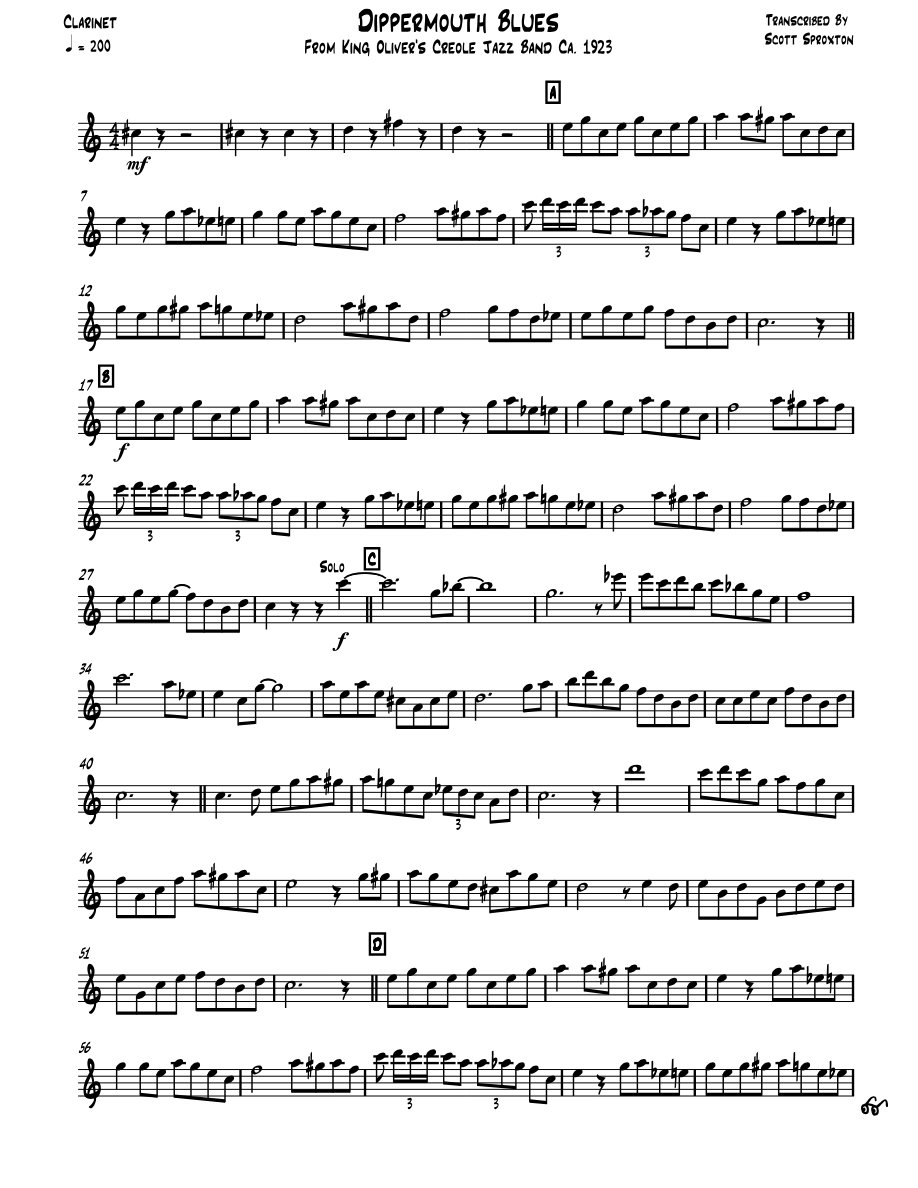
Dippermouth Blues (S.Sproxton)
Composed by King Oliver
Arranged by S.Sproxton
- Ensemble: Dixieland Band
- Style: Blues
- Pages: 14
- Difficulty: easy
- Content: Sheet Music
- Format: PDF Download (Instant)
- Price: $18.99
"Dippermouth Blues," a cornerstone of early jazz, was first recorded by King Oliver's Creole Jazz Band on April 6, 1923, for Gennett Records, followed by a second recording in June of the same year for OKeh Records. This seminal piece epitomizes the New Orleans-style jazz of the 1920s, a period marked by the migration of Southern musical traditions northward, particularly to Chicago. While primarily attributed to Joe "King" Oliver, some suggest Louis Armstrong, whose nickname "Dippermouth" inspired the title, may have also contributed to its composition. The original recording famously featured Oliver's innovative use of a plunger mute to create distinctive "wah-wah" effects, a technique that profoundly influenced subsequent jazz brass players. The track's historical significance is further underscored by the courageous act of these Black musicians recording in Indiana amidst active Ku Klux Klan presence. "Dippermouth Blues" remains a jazz standard, celebrated for its pioneering collective improvisation and its role in shaping the trajectory of jazz. This arrangement of "Dippermouth Blues" by S. Sproxton captures the vibrant, medium-swing feel characteristic of classic Dixieland. Set in a bright, driving tempo, the piece evokes a joyful and energetic mood, perfectly reflecting the celebratory spirit of early New Orleans jazz. The musical character is defined by its polyphonic texture, where multiple instruments weave together independent melodic lines, creating a rich and interwoven soundscape. The arrangement maintains the original's twelve-bar blues harmonic progression, providing a familiar yet dynamic framework for improvisation and ensemble interplay. The overall energy is infectious, designed to get audiences tapping their feet and experiencing the raw, unbridled excitement of a bygone era. S. Sproxton's approach to this iconic blues is rooted in authenticity, meticulously transcribing and adapting the original King Oliver recording for a modern Dixieland ensemble. This arrangement features the classic instrumentation of two cornets (or trumpets), clarinet, trombone, piano, banjo/guitar, bass/tuba, and drums, ensuring an authentic sonic palette. Sproxton expertly crafts the collective improvisation sections, providing fully notated parts that capture the essence of the original's spontaneous interplay while making it accessible for structured performance. Oliver's legendary plunger mute solo is fully written out, offering an invaluable study in early jazz brass articulation and phrasing. The arrangement also includes clear soli sections that showcase the ensemble's tight rhythmic and harmonic cohesion, alongside opportunities for featured solos that allow individual musicians to shine within the traditional framework. Performing this arrangement is a rewarding experience for intermediate to advanced Dixieland bands, including college, community, and semi-professional ensembles. The primary melody is often shared and passed between the cornets and clarinet, with the trombone providing harmonic counterpoint and rhythmic drive. Technical challenges include precise articulation, maintaining a consistent medium-swing feel, and navigating the intricate polyphonic textures during collective improvisation sections. The written-out solos, particularly the iconic cornet solo, require careful attention to phrasing and idiomatic expression. The arrangement's clarity and detailed notation make it an excellent vehicle for teaching and experiencing the foundational elements of Dixieland jazz, offering both historical insight and engaging performance opportunities. This arrangement should be approached with a vibrant, medium-swing feel, emphasizing a buoyant, forward-moving pulse rather than a rigid metronomic tempo. Aim for a tempo around quarter note = 180-200 BPM to capture the original's energetic drive. Key technical challenges include maintaining clarity in the collective improvisation sections; encourage musicians to listen intently and blend their voices while retaining individual character. The iconic plunger mute effects in the cornet parts are crucial; brass players should practice the "wah-wah" technique diligently, ensuring a vocal-like quality. Rhythm section players should focus on a strong, consistent two-beat feel, with the banjo or guitar providing rhythmic propulsion and the bass/tuba anchoring the harmony. Rehearsal tips include isolating the polyphonic sections to ensure each voice is distinct yet harmonically integrated, and working on the precise articulation of the written solos to capture the idiomatic phrasing of early jazz. Q: What instruments are included in this arrangement? A: This arrangement includes parts for two cornets (or trumpets), clarinet, trombone, piano, banjo/guitar, bass/tuba, and drums. This instrumentation faithfully reflects the classic Dixieland band setup of the era. Q: What is the difficulty level of this arrangement? A: This arrangement is rated as intermediate to advanced. While all parts are fully notated, it requires proficiency in Dixieland style, including precise articulation, idiomatic phrasing, and the ability to contribute to collective improvisation. Q: What is the musical style and historical context of "Dippermouth Blues"? A: "Dippermouth Blues" is a foundational piece of New Orleans-style Dixieland jazz, first recorded in 1923 by King Oliver's Creole Jazz Band. It embodies the collective improvisation, blues influences, and energetic, medium-swing feel characteristic of early jazz. Q: What makes S.Sproxton's arrangement of "Dippermouth Blues" unique? A: S. Sproxton's arrangement stands out for its meticulous transcription and adaptation of the original King Oliver recording, providing fully notated collective improvisation sections and the iconic plunger mute cornet solo. It offers an authentic yet accessible performance experience for modern Dixieland ensembles. Q: What is the typical performance duration or tempo for this piece? A: The typical performance duration for "Dippermouth Blues" is around 2.5 to 3 minutes, reflecting the length of early jazz recordings. It should be performed at a vibrant, medium-swing tempo, ideally around quarter note = 180-200 BPM, to capture its original energetic feel.
Musicians Also Search For
Dippermouth Blues S.Sproxton PDF • Dippermouth Blues S.Sproxton sheet music • Dippermouth Blues arranged by S.Sproxton • S.Sproxton dixieland band charts • S.Sproxton jazz arrangements PDF • Dippermouth Blues King Oliver sheet music • Dippermouth Blues King Oliver dixieland band arrangement • King Oliver dixieland band charts • Dippermouth Blues dixieland band arrangement • Dippermouth Blues dixieland band PDF download • Dippermouth Blues jazz ensemble sheet music • dixieland band sheet music instant download • Dippermouth Blues sheet music with parts • Dippermouth Blues Blues chart • Blues dixieland band arrangements • buy Dippermouth Blues sheet music online • download Dippermouth Blues PDF • Dippermouth Blues jazz chart • best S.Sproxton dixieland band arrangements • King Oliver songs arranged by S.Sproxton • Dippermouth Blues printable sheet music • dixieland band repertoire PDF