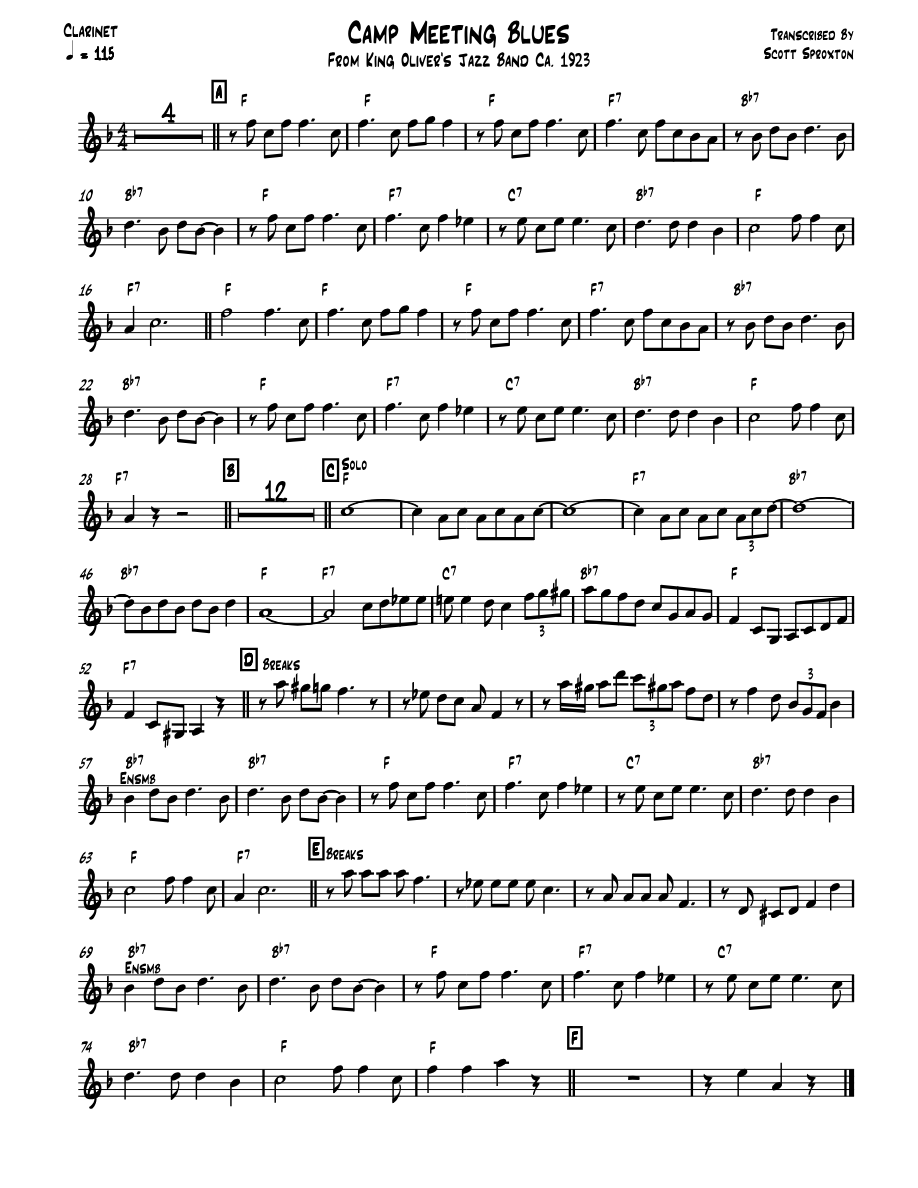
Camp Meeting Blues (S.Sproxton) sheet music preview

Camp Meeting Blues (S.Sproxton)

Composed by S. Sproxton

Arranged by S.Sproxton

  • Ensemble: Dixieland Band
  • Style: Blues
  • Pages: 9
  • Difficulty: easy
  • Content: Sheet Music
  • Format: PDF Download (Instant)
  • Price: $18.99

"Camp Meeting Blues (S.Sproxton)" is a vibrant and historically rich Dixieland band arrangement that transports listeners and performers alike to the foundational era of jazz. While the original composition date for S. Sproxton's "Camp Meeting Blues" isn't widely documented as a traditional jazz standard in the vein of Armstrong or Morton, its title and musical style firmly place it within the early 20th-century blues and ragtime traditions that heavily influenced Dixieland. This period, roughly from the 1900s through the 1920s, saw the birth of ensemble improvisation and the joyous, collective sound that defines the Dixieland genre. The piece embodies the spirit of early New Orleans jazz, characterized by its infectious energy, syncopated rhythms, and the interplay between melodic lines. It evokes a festive, communal atmosphere, reminiscent of the lively gatherings and spiritual fervor implied by its title, making it a notable representation of the genre's roots. Musically, this arrangement of "Camp Meeting Blues" is designed for a medium-up tempo two-beat feel, firmly rooted in the key of F major, offering a bright and accessible harmonic landscape. The mood is unequivocally celebratory and energetic, driven by a consistent, driving rhythm section. The piece exudes a joyful, almost rollicking character, inviting both performers and audience to tap their feet. Its bluesy melodic contours, combined with the upbeat tempo, create a sense of optimistic exuberance, making it an ideal choice for setting a lively tone. The arrangement maintains a consistent energy level throughout, building upon its initial thematic statement with increasing instrumental interplay and collective improvisation. S. Sproxton's approach to "Camp Meeting Blues" is a masterclass in authentic Dixieland arranging, showcasing a deep understanding of the style's conventions while injecting fresh vitality. The arrangement features classic Dixieland instrumentation, with the melody often carried by the trumpet, clarinet, and trombone in a traditional front-line polyphonic texture. Expect engaging soli sections where the horns weave intricate counter-melodies, and a powerful shout chorus that brings the entire ensemble together for a climactic statement. Sproxton skillfully employs call-and-response figures between the sections, maintaining interest and driving the narrative forward. While specific extended harmonies are generally avoided in favor of the genre's characteristic dominant seventh and blues-scale inflections, the arrangement's strength lies in its rhythmic drive and the clarity of its melodic lines. The arrangement is rewarding to perform due to its clear structure, opportunities for individual expression within the ensemble, and the sheer joy of playing a piece so steeped in jazz history. This arrangement is ideally suited for college and advanced high school Dixieland ensembles, as well as community bands and semi-professional groups looking to capture the authentic sound of early jazz. While the technical demands are moderate, requiring solid articulation and rhythmic precision, the true challenge and reward lie in achieving the collective improvisational feel and stylistic authenticity. The arrangement provides a fantastic educational opportunity for developing musicians to immerse themselves in the foundational elements of jazz, understanding the roles of each instrument within the Dixieland collective. Its well-crafted structure and engaging musical moments make it a standout addition to any ensemble's repertoire. To capture the authentic spirit of "Camp Meeting Blues," conductors should emphasize a medium-up tempo two-beat feel, ensuring the rhythm section lays down a solid, driving foundation without rushing. The quarter note should feel buoyant and forward-moving, rather than heavy. Key technical challenges include achieving precise articulation, particularly in the syncopated melodic lines shared by the front line. Encourage crisp, unified attacks and releases, especially during soli sections. The clarinet part requires agility for its upper register flourishes, while the trombone needs a strong, clear tone for its counter-melodies. Rehearsal should focus on balancing the collective improvisation sections, ensuring each voice is heard without overwhelming the others. Encourage musicians to listen across the ensemble, allowing their parts to interlock. Pay close attention to dynamics, using contrasts to highlight melodic phrases and build excitement towards the shout chorus. No special mutes or extended techniques are explicitly required, allowing the natural timbres of the instruments to shine. Q: What instruments and parts are included in this arrangement? A: This Dixieland band arrangement typically includes parts for Trumpet, Clarinet, Trombone, Piano, Bass (or Tuba), and Drums. Specific instrumentation may vary slightly but adheres to the standard Dixieland front line and rhythm section. Q: What is the difficulty level of "Camp Meeting Blues (S.Sproxton)"? A: This arrangement is rated as medium difficulty. It is suitable for college and advanced high school ensembles, as well as community and semi-professional Dixieland bands, requiring solid rhythmic precision and stylistic understanding. Q: What is the musical style and historical context of this piece? A: "Camp Meeting Blues" is firmly rooted in the Dixieland jazz style, representing the early 20th-century blues and ragtime traditions that defined New Orleans jazz. It embodies the infectious energy and collective improvisation characteristic of that era. Q: What makes S. Sproxton's arrangement of "Camp Meeting Blues" unique? A: S. Sproxton's arrangement stands out for its authentic Dixieland voicings, engaging soli sections, and a powerful shout chorus that brings the ensemble together. It skillfully employs call-and-response figures, providing a vibrant and historically faithful interpretation of the genre. Q: What is the typical performance duration or tempo for this arrangement? A: The arrangement is designed for a medium-up tempo two-beat feel. A typical performance duration would be approximately 3-4 minutes, depending on the chosen tempo and any optional improvised solos.

Musicians Also Search For

Camp Meeting Blues S.Sproxton PDFCamp Meeting Blues S.Sproxton sheet musicCamp Meeting Blues arranged by S.SproxtonS.Sproxton dixieland band chartsS.Sproxton jazz arrangements PDFCamp Meeting Blues S. Sproxton sheet musicCamp Meeting Blues S. Sproxton dixieland band arrangementS. Sproxton dixieland band chartsCamp Meeting Blues dixieland band arrangementCamp Meeting Blues dixieland band PDF downloadCamp Meeting Blues jazz ensemble sheet musicdixieland band sheet music instant downloadCamp Meeting Blues sheet music with partsCamp Meeting Blues Blues chartBlues dixieland band arrangementsbuy Camp Meeting Blues sheet music onlinedownload Camp Meeting Blues PDFCamp Meeting Blues jazz chartbest S.Sproxton dixieland band arrangementsS. Sproxton songs arranged by S.SproxtonCamp Meeting Blues printable sheet musicdixieland band repertoire PDF

All arrangements by S.Sproxton All S. Sproxton sheet music