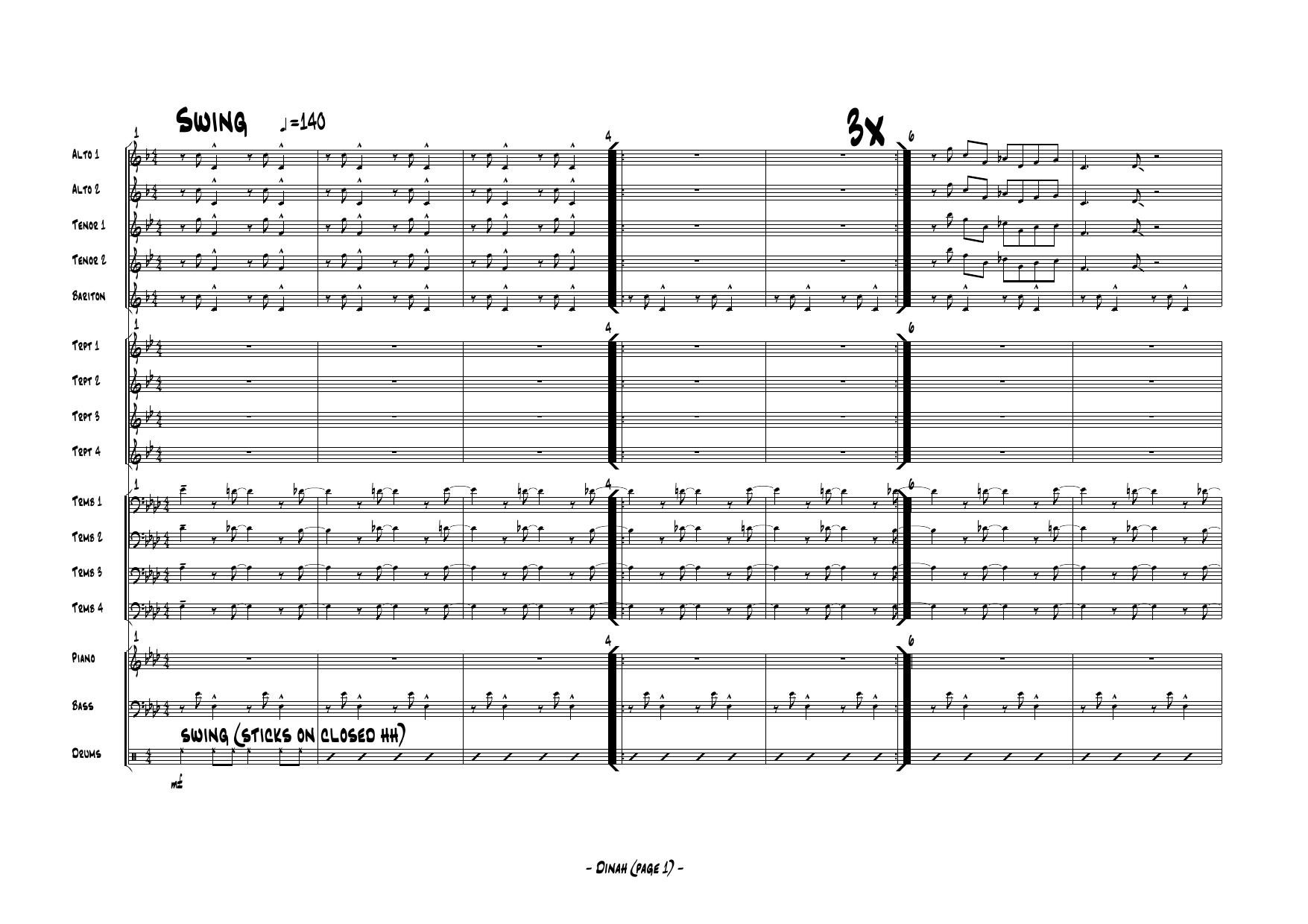
Dinah (B.May) sheet music preview

Dinah (B.May)

Composed by Harry Akst

Arranged by Billy May

  • Ensemble: Big Band
  • Pages: 44
  • Instruments (16): Alto Saxophone 1, Alto Saxophone 2, Tenor Saxophone 1, Tenor Saxophone 2, Baritone Saxophone, Trumpet 1, Trumpet 2, Trumpet 3, Trumpet 4, Trombone 1, Trombone 2, Trombone 3, Trombone 4, Piano, Bass, Drums
  • Difficulty: medium
  • Content: Individual Parts
  • Format: PDF Download (Instant)
  • Price: $24.99

Harry Akst, Sam M. Lewis, and Joe Young originally penned "Dinah" in 1925, transforming it into a roaring twenties pop standard before it was firmly adopted by the jazz pantheon through landmark recordings by icons like Ethel Waters, Louis Armstrong, and the Mills Brothers. Representing the quintessential transition from early vaudeville-era Tin Pan Alley tune to flexible swing vehicle, the composition relies on an infectious, sturdy AABA structure and an inherently buoyant melody. Over the decades, it evolved from a cheerful foxtrot into an indispensable jam session staple, embraced across stylistic boundaries from traditional New Orleans revivalists to sleek swing architects. Master arranger Billy May approaches this timeless vehicle through his signature lens of high-octane swing, dynamic tension, and unmistakable wit. Built around a driving, medium-up 4/4 swing feel, the arrangement radiates an irrepressible energy that balances sophisticated, punchy harmonic structures with a lighthearted, danceable drive. May infuses the chart with his trademark brass pyrotechnics and razor-sharp dynamic contrasts, shifting effortlessly between hushed, whispering sax solis and explosive, brass-heavy outbursts that evoke the golden age of Capitol Records studio wizardry. The mood is relentlessly optimistic, swinging with an infectious swagger that immediately engages both performers and audiences alike. May’s distinctive scoring style shines brilliantly in the treatment of the ensemble's textures, utilizing biting plunger mutes, glissandos, and characteristic jazz articulations to give the horns a vocal, expressive quality. The melody is traded fluidly across sections, preventing any monotony and keeping the dynamic narrative fresh from the first downbeat. Featured solo space allows improvisers to stretch out over traditional changes, framed by crisp background shout figures that organically build tension. The climax of the arrangement culminates in a textbook Billy May shout chorus, characterized by stacked, complex upper-structure voicings and rhythmic syncopation that demands absolute precision and stylistic unity from the entire ensemble. Advanced high school, collegiate, and professional big bands will find this arrangement an exhilarating centerpiece for a concert or festival program. While the instrumentation is streamlined to a dynamic 9-instrument configuration (Alto Sax, Tenor Sax, Baritone Sax, Trumpet, Trombone, and rhythm section support), the writing achieves a remarkably rich, full-bodied sound that punches far above its weight class. Accomplished players will relish the stylistic demands required to execute May's nuanced articulations accurately, making it an exceptionally rewarding study in mid-century swing interpretation and big band ensemble cohesion. The primary technical challenge in this Billy May arrangement lies in achieving absolute stylistic uniformity, particularly with regard to short, accented swing eighth notes and dynamic shading. The conductor should establish a comfortable, driving medium-up swing tempo that prioritizes forward momentum over sheer velocity. Brass players must master the extensive use of plunger mutes and varied lip-slurs, ensuring that half-valve effects and growls blend cohesively with open-horn passages rather than sticking out awkwardly. Rehearsal should begin by isolating the rhythm section to lock in the foundational groove, emphasizing a light, bouncing ride-cymbal pattern and a crisp, unhurried hi-hat on beats two and four. Horn sections should practice their articulated passages initially at a reduced tempo, exaggerating the distinction between tenuto and staccato notes before bringing the chart up to performance speed. Pay close attention to the dynamic peaks and valleys written into the shout choruses; letting the band overplay early will rob the climax of its necessary impact. Q: What instruments and parts are included in this 9-instrument arrangement? A: The scoring features a compact yet powerful nine-part setup consisting of Alto Saxophone, Tenor Saxophone, Baritone Saxophone, Trumpet, and Trombone, alongside a full rhythm section (piano, bass, drums, and guitar). Q: What is the difficulty level of this arrangement? A: This chart is graded as advanced, making it ideal for skilled high school, collegiate, and professional jazz ensembles due to its demanding articulations, stylistic nuances, and tempo requirements. Q: What is the historical style and background of this piece? A: Originally composed in 1925 by Harry Akst, this piece is interpreted through the lens of mid-20th-century swing, heavily influenced by arranger Billy May's trademark dynamic flair and energetic studio style. Q: What makes this specific arrangement by Billy May unique? A: May's distinct approach features clever harmonic voicings, extensive use of expressive brass mutes like the plunger, and a driving architectural buildup that leads into a signature high-energy shout chorus. Q: What is the recommended performance duration and tempo for this chart? A: The arrangement is designed to be performed at a brisk, driving medium-up swing tempo (approximately quarter note = 160-172 BPM) with a total duration of roughly 3 to 4 minutes depending on solo rotations.

Questions and answers

What is included in the Dinah (B.May) PDF?
The verified current file contains a conductor score and individual parts across 44 pages.
How many instruments or parts are listed for Dinah (B.May)?
The verified instrumentation list contains 16 entries for this Big Band arrangement.
Who is credited for Dinah (B.May)?
Composer: Harry Akst. Arranger: Billy May.
What difficulty is listed for Dinah (B.May)?
The verified difficulty level is medium.
Can I preview Dinah (B.May) before buying?
Yes. The product page provides a preview generated from the current PDF file.
How is Dinah (B.May) delivered?
After successful payment, the digital PDF is made available for download. The displayed price is $24.99.

Musicians Also Search For

Dinah Billy May PDFDinah Billy May sheet musicDinah arranged by Billy MayBilly May big band chartsBilly May jazz arrangements PDFDinah Harry Akst sheet musicDinah Harry Akst big band arrangementsHarry Akst big band chartsDinah big band arrangementsDinah big band PDF downloadDinah jazz sheet musicbig band sheet music downloadDinah conductor score PDFDinah individual parts downloadDinah sheet music PDFbuy Dinah sheet musicdownload Dinah PDFDinah jazz chartsbest Billy May big band arrangementsHarry Akst arranged by Billy MayDinah printable sheet musicbig band repertoire PDF

All arrangements by Billy May All Harry Akst sheet music