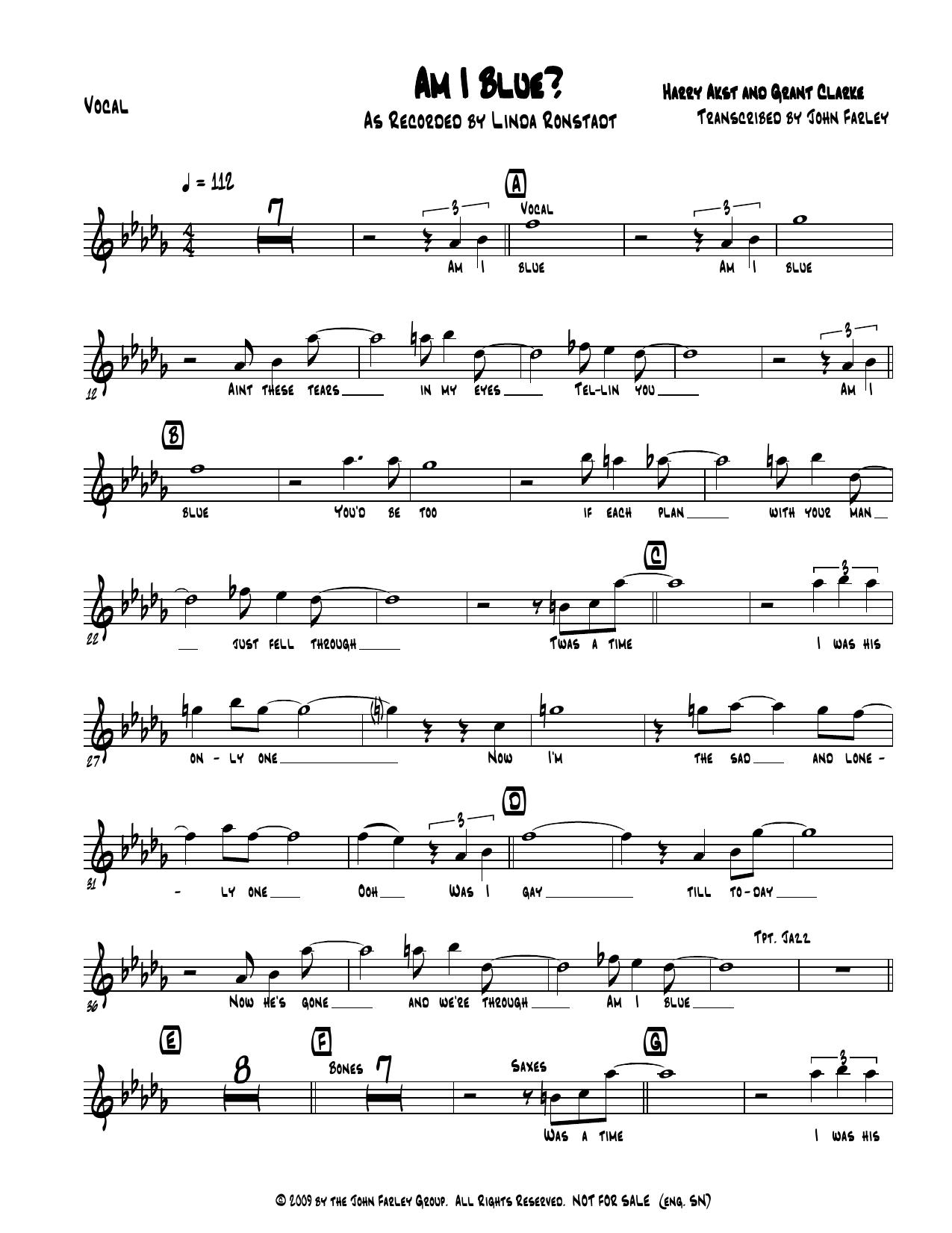
Am I Blue (J.Farley) sheet music preview

Am I Blue (J.Farley)

Composed by Harry Akst

Arranged by John Farley

  • Ensemble: Big Band
  • Pages: 30
  • Instruments (18): Vocal, Alto Sax 1, Alto Sax 2, Tenor Sax 1, Tenor Sax 2, Baritone Sax, Trumpet in Bb 1, Trumpet in Bb 2, Trumpet in Bb 3, Trumpet in Bb 4, Trombone 1, Trombone 2, Trombone 3, Trombone 4, Piano, Guitar, Bass, Drum Set
  • Difficulty: medium
  • Content: Individual Parts
  • Format: PDF Download (Instant)
  • Price: $24.99

Written by Harry Akst with lyricist Grant Clarke in 1929, "Am I Blue?" quickly transitioned from a breakout theatrical tune introduced by Ethel Waters in the film *On with the Show!* into a cornerstone of the American songbook. Embraced heavily by jazz luminaries ranging from Coleman Hawkins to Billie Holiday, the composition carries a distinct late-1920s torch-song melancholy that bridges early jazz idioms with classic swing-era introspection. Its durable harmonic framework—built on a poignant minor-to-major emotional arc—makes it an ideal canvas for sophisticated big band arranging, inviting ensembles to explore deep blues-inflected phrasing and rich, cascading harmonic textures. John Farley’s masterful adaptation reimagines this timeless classic through a sophisticated medium-slow swing lens, anchored by a smoldering, late-night atmospheric tension. Moving away from a dense, wall-of-sound orchestration, Farley utilizes a dynamic 7-instrument instrumentation (featuring Alto Saxophone, Tenor Saxophone, Trumpet, Trombone, Piano, Bass, and Drums) to create an intimate yet remarkably full big band aesthetic. The arrangement opens with a sultry, rubato piano intro that sets a reflective mood before settling into a steady, persuasive pocket at around 104 beats per minute. The emotional landscape shifts seamlessly between smoky, introspective verse statements and lush, harmonically rich chorus refrains that evoke the smoky ambiance of an after-hours Harlem jazz club. Farley’s arranging approach shines in his economic yet strikingly colorful use of counterpoint and close-interval horn voicings. Rather than relying on massive tutti blocks, the arrangement creates momentum through clever conversational interplay between the saxophone and brass sections. A standout moment arrives midway through the chart: a tightly-knit, harmonically advanced horn soli that demands impeccable intonation and unified articulation, followed by an open solo section designed to showcase a featured instrumentalist over a refined, walking-bass blues background. The voicings incorporate extended chord extensions—major 9ths, altered dominants, and subtle chromatic passing tones—giving the chart a sophisticated modern-jazz coloration while fiercely respecting the traditional roots of the melody. Advanced high school ensembles, collegiate jazz combos, and professional community big bands will find this chart to be an exceptionally rewarding addition to their repertoire. The primary technical challenges do not lie in breakneck velocity, but rather in the mature control of time, dynamic subtlety, and stylistic cohesion. Horn players must master the nuanced execution of subtle falls, ghosted notes, and warm, vibrato-laden sustained tones. Because of its transparent 7-instrument scoring, every player functions as an essential voice within the harmonic tapestry, making it an outstanding vehicle for developing chamber-jazz listening skills, sectional balance, and deep stylistic authenticity in a compact ensemble setting. Conductors should approach John Farley’s arrangement of "Am I Blue?" with a strict focus on breath control, relaxed swing eighth-notes, and subtle dynamic contrast. The tempo should remain a steady, unhurried medium swing (approx. quarter note = 104 BPM); pushing the tempo will rob the chart of its inherent blues gravity. The rhythm section serves as the anchor: the pianist should voice chords with a sparse, Count Basie-esque economy, avoiding clutter behind the horns, while the drummer maintains a feather-light ride cymbal pattern with a crisp hi-hat on beats 2 and 4. Horn players must pay close attention to unison blend during the structured soli sections, ensuring that vibrato is matched and tuned carefully across the alto, tenor, trumpet, and trombone voices. Articulation should lean toward a legato, blues-drenched approach with soft tongue attacks on upbeat syncopations. Utilize cup or straight mutes where indicated to achieve the desired vintage vocal coloration, keeping balance subservient to the primary melody carrier at all times. Q: What instruments and parts are included in this arrangement? A: This chart is scored for a specialized 7-instrument ensemble comprising Alto Saxophone, Tenor Saxophone, Trumpet, Trombone, Piano, Bass, and Drums. Q: What is the difficulty level of this chart? A: It is graded as intermediate-advanced (suitable for strong high school, collegiate, and professional chamber jazz ensembles), requiring mature breath control, blend, and stylistic swing execution rather than extreme technical velocity. Q: What is the historical style and musical context of the piece? A: Originally composed by Harry Akst in 1929 and made famous by icons like Ethel Waters and Billie Holiday, this arrangement reframes the classic torch song in a smoky, medium-slow swing big band style. Q: What makes John Farley’s arrangement unique? A: Farley scales down traditional big band grandeur into an intimate 7-instrument format, utilizing transparent, harmonically advanced chord extensions and conversational horn counterpoint instead of dense, wall-of-sound tutti sections. Q: What is the performance duration and suggested tempo? A: The arrangement runs approximately 3.5 to 4 minutes in length and is anchored by a relaxed, driving medium-swing tempo of around 104 beats per minute.

Questions and answers

What is included in the Am I Blue (J.Farley) PDF?
The verified current file contains a conductor score and individual parts across 30 pages.
How many instruments or parts are listed for Am I Blue (J.Farley)?
The verified instrumentation list contains 18 entries for this Big Band arrangement.
Who is credited for Am I Blue (J.Farley)?
Composer: Harry Akst. Arranger: John Farley.
What difficulty is listed for Am I Blue (J.Farley)?
The verified difficulty level is medium.
Can I preview Am I Blue (J.Farley) before buying?
Yes. The product page provides a preview generated from the current PDF file.
How is Am I Blue (J.Farley) delivered?
After successful payment, the digital PDF is made available for download. The displayed price is $24.99.

Musicians Also Search For

Am I Blue John Farley PDFAm I Blue John Farley sheet musicAm I Blue arranged by John FarleyJohn Farley big band chartsJohn Farley jazz arrangements PDFAm I Blue Harry Akst sheet musicAm I Blue Harry Akst big band arrangementsHarry Akst big band chartsAm I Blue big band arrangementsAm I Blue big band PDF downloadAm I Blue jazz sheet musicbig band sheet music downloadAm I Blue conductor score PDFAm I Blue individual parts downloadAm I Blue sheet music PDFbuy Am I Blue sheet musicdownload Am I Blue PDFAm I Blue jazz chartsbest John Farley big band arrangementsHarry Akst arranged by John FarleyAm I Blue printable sheet musicbig band repertoire PDF

All arrangements by John Farley All Harry Akst sheet music