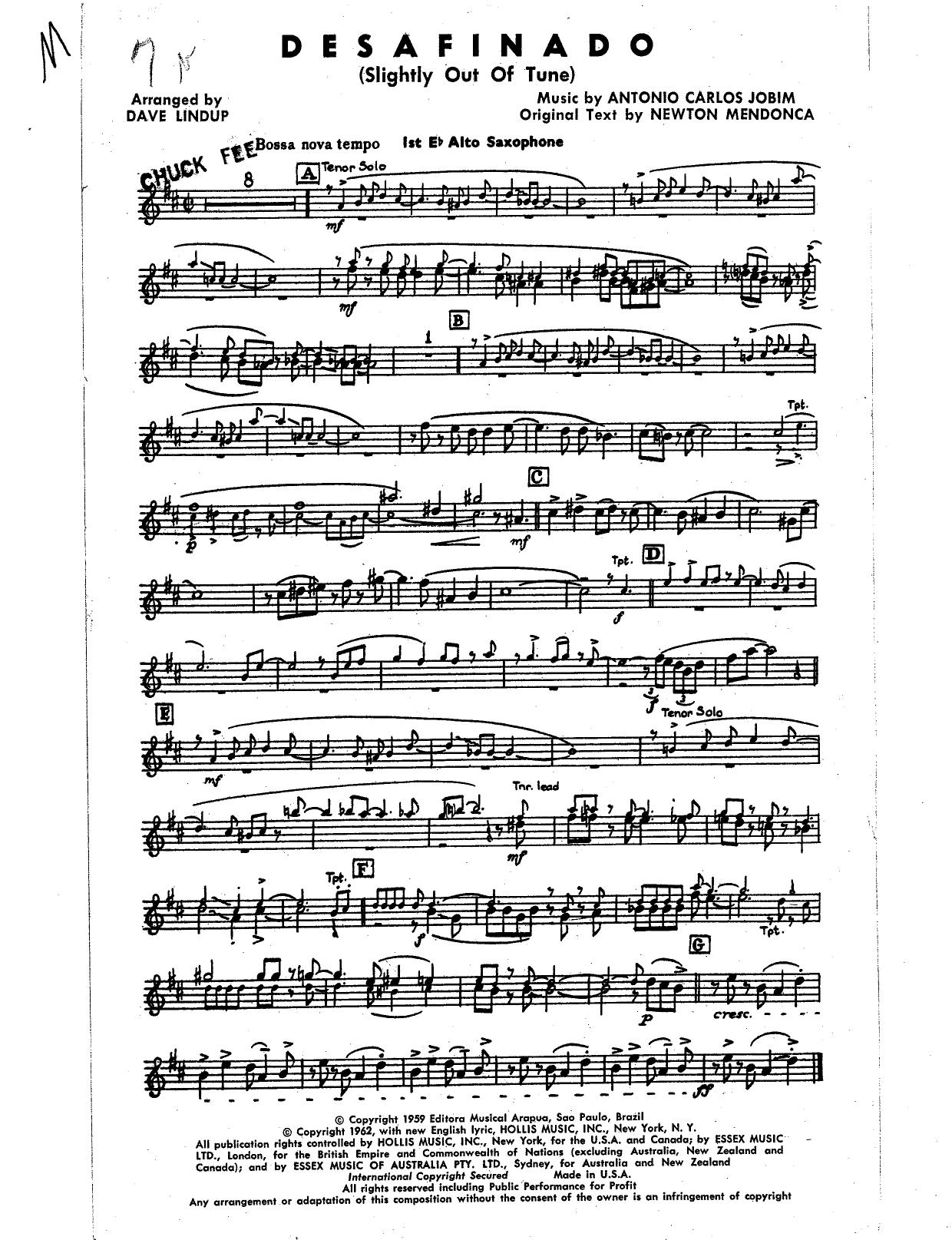
Desafinado (D.Lindup)
Composed by Antonio Carlos Jobim
Arranged by Dave Lindup
- Ensemble: Big Band
- Style: Jazz Standard
- Pages: 17
- Instruments (15): 1st Eb Alto Saxophone, 2nd Eb Alto Saxophone, 1st Bb Tenor Saxophone, 2nd Bb Tenor Saxophone, Eb Baritone Saxophone, 1st Trumpet in Bb, 2nd Trumpet in Bb, 3rd Trumpet in Bb, 1st Trombone, 2nd Trombone, 3rd Trombone, Guitar, Bass, Drums, Piano Conductor
- Difficulty: easy
- Content: Individual Parts
- Format: PDF Download (Instant)
- Price: $24.99
Antonio Carlos Jobim's "Desafinado," meaning "slightly out of tune" or "off-key," emerged as a pivotal composition during the nascent stages of Bossa Nova in the late 1950s, solidifying its status as a jazz standard. First recorded by João Gilberto in 1959, its international fame was cemented by Stan Getz and Charlie Byrd's groundbreaking 1962 album, *Jazz Samba*, which introduced the sophisticated, understated rhythms and harmonies of Brazilian bossa nova to a global audience. The piece itself is a masterclass in melodic and harmonic subtlety, characterized by its deceptively simple, yet intricately chromatic melody and its gentle, melancholic mood. It represents a departure from the more overt swing and bebop styles of the era, offering a cooler, more introspective sound that quickly captivated musicians and listeners alike, becoming a touchstone for the genre's unique blend of jazz improvisation and Brazilian lyricism. Dave Lindup's arrangement of "Desafinado" for big band masterfully captures the original's intimate bossa nova spirit while expanding it for a larger ensemble. Lindup's distinctive approach is evident in his choice of a relaxed, medium bossa nova groove, maintaining the original's contemplative key of F major, which lends itself beautifully to the piece's inherent wistfulness. Rather than overwhelming the delicate melody with heavy brass, Lindup employs a nuanced orchestration, utilizing sophisticated voicings that allow the rich harmonies to shimmer, particularly in the saxophone section. His signature technique of weaving intricate counter-melodies and subtle rhythmic interplay ensures that the arrangement feels both authentic to the source material and fresh in its big band interpretation. Expect lush saxophone soli sections that articulate the melody with a warm, blended sound, punctuated by carefully placed brass figures that add depth without sacrificing the characteristic lightness of bossa nova. This arrangement is a rewarding experience for both performers and audience, offering a chance to delve into the elegant complexities of bossa nova within a big band setting. The melody is sensitively passed between the lead alto saxophone and the trumpet section, requiring a lyrical and expressive approach from both. Featured solo opportunities are provided for tenor saxophone and trumpet, allowing for improvisational exploration over the tune's iconic chord changes. While the overall feel is relaxed, the technical challenge lies in maintaining precise rhythmic articulation within the bossa nova groove and executing Lindup's harmonically rich voicings with balance and blend. The subtle dynamic shifts and the ensemble's ability to support the soloists with a light, rhythmic foundation are crucial. This arrangement is particularly well-suited for college and community big bands seeking to expand their repertoire with a sophisticated, yet accessible, jazz standard, as well as professional ensembles looking for a fresh take on a beloved classic. This arrangement demands a consistent, relaxed medium bossa nova groove throughout, with a strong emphasis on rhythmic precision in the percussion and bass sections to establish the foundational feel. Conductors should encourage a light, lyrical approach to the melody, particularly from the lead alto saxophone and featured trumpet. Key technical challenges include maintaining blend and balance within the saxophone soli sections, ensuring that the intricate voicings speak clearly without any single voice dominating. Brass players should focus on precise articulation and controlled dynamics, using plunger mutes where indicated to achieve the characteristic muted brass sound. Rehearsal time should be dedicated to refining the ensemble's dynamic control, especially in supporting soloists, and ensuring that the rhythmic interplay between sections is fluid and cohesive. Pay close attention to the subtle harmonic shifts and encourage musicians to listen across the ensemble for intonation and blend. Q: What instruments are included in this arrangement? A: This arrangement is scored for 14 instruments, specifically: Alto Saxophone 1, Alto Saxophone 2, Tenor Saxophone 1, Tenor Saxophone 2, Baritone Saxophone, Trumpet 1, Trumpet 2, Trumpet 3, Trumpet 4, Trombone 1, Trombone 2, Trombone 3, Bass Trombone, and a rhythm section (Piano, Bass, Drums). It also includes a conductor score. Q: What is the difficulty level of this arrangement? A: This arrangement is considered to be of a medium-advanced difficulty, suitable for college, community, and professional big bands. It requires good rhythmic precision, nuanced dynamic control, and an understanding of bossa nova stylistic elements. Q: What musical style and historical context does "Desafinado" represent? A: "Desafinado" is a seminal jazz standard in the bossa nova style, originally composed by Antonio Carlos Jobim in the late 1950s. It is known for its sophisticated harmonies, gentle rhythms, and melancholic mood, marking a significant moment in the fusion of Brazilian music with jazz. Q: What makes Dave Lindup's arrangement of "Desafinado" unique? A: Dave Lindup's arrangement distinguishes itself through its sophisticated voicings, particularly in the saxophone soli sections, and his ability to maintain the intimate bossa nova feel within a big band context. He employs subtle counter-melodies and careful orchestration to create a rich, yet understated, interpretation of the classic. Q: What is the typical performance duration and tempo for this piece? A: The performance duration for this arrangement typically ranges from 4 to 5 minutes, depending on the length of the improvised solos. It should be performed at a relaxed, medium bossa nova tempo, generally around quarter note = 120-132 BPM.
Questions and answers
- What is included in the Desafinado (D.Lindup) PDF?
- The verified current file contains a conductor score and individual parts across 17 pages.
- How many instruments or parts are listed for Desafinado (D.Lindup)?
- The verified instrumentation list contains 15 entries for this Big Band arrangement.
- Who is credited for Desafinado (D.Lindup)?
- Composer: Antonio Carlos Jobim. Arranger: Dave Lindup.
- What difficulty is listed for Desafinado (D.Lindup)?
- The verified difficulty level is easy.
- What style is listed for Desafinado (D.Lindup)?
- The catalog lists the style as Jazz Standard.
- Can I preview Desafinado (D.Lindup) before buying?
- Yes. The product page provides a preview generated from the current PDF file.
- How is Desafinado (D.Lindup) delivered?
- After successful payment, the digital PDF is made available for download. The displayed price is $24.99.
Musicians Also Search For
Desafinado Dave Lindup PDF • Desafinado Dave Lindup sheet music • Desafinado arranged by Dave Lindup • Dave Lindup big band charts • Dave Lindup jazz arrangements PDF • Desafinado Antonio Carlos Jobim sheet music • Desafinado Antonio Carlos Jobim big band arrangements • Antonio Carlos Jobim big band charts • Desafinado big band arrangements • Desafinado big band PDF download • Desafinado jazz sheet music • big band sheet music download • Desafinado conductor score PDF • Desafinado individual parts download • Desafinado sheet music PDF • Desafinado Jazz Standard charts • Jazz Standard big band arrangements • buy Desafinado sheet music • download Desafinado PDF • Desafinado jazz charts • best Dave Lindup big band arrangements • Antonio Carlos Jobim arranged by Dave Lindup • Desafinado printable sheet music • big band repertoire PDF