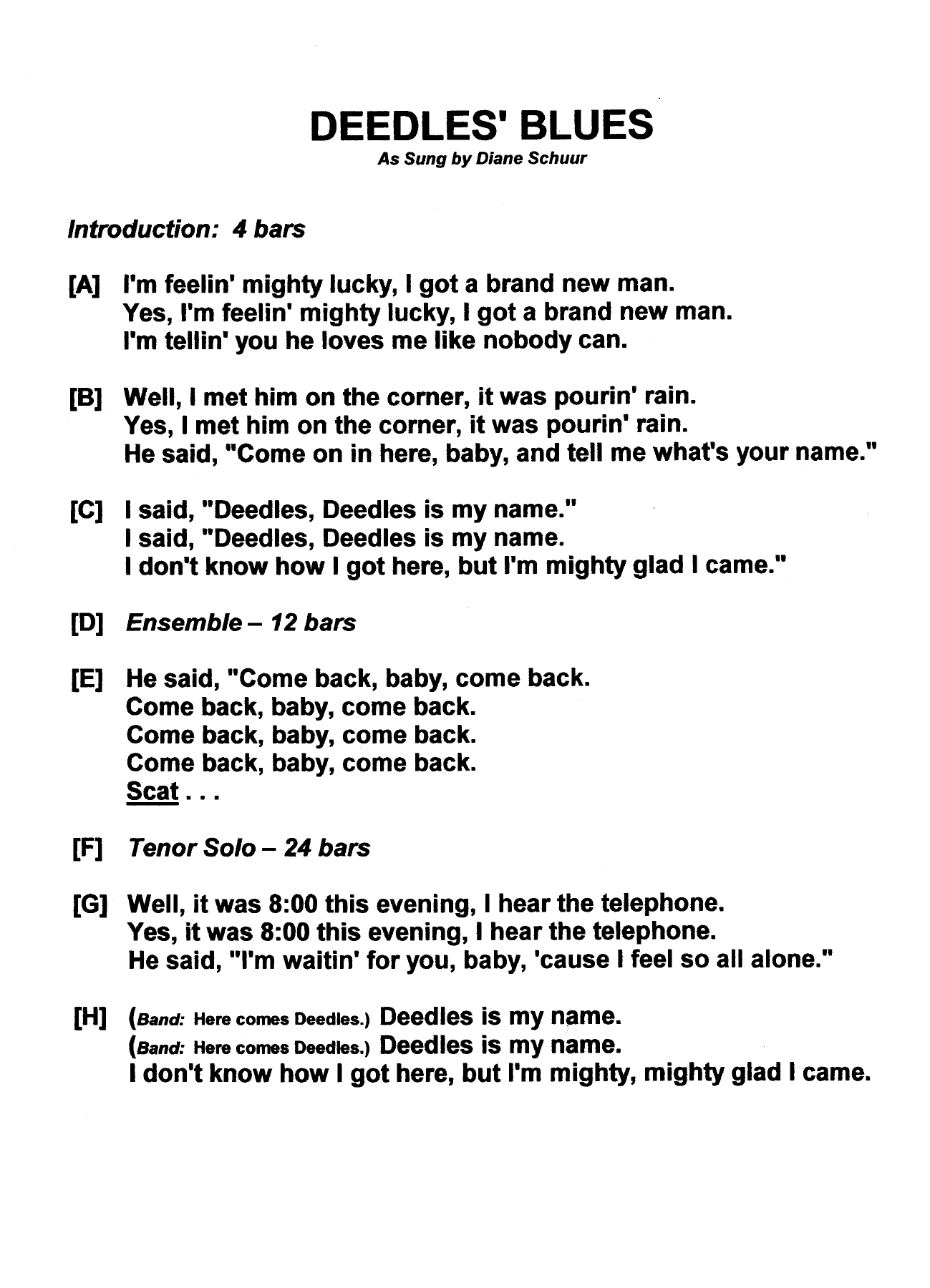
Deedles' Blues (F.Foster) C.Basie-D.Schuur) sheet music preview

Deedles' Blues (F.Foster) C.Basie-D.Schuur)

Composed by Frank Foster

Arranged by Count Basie

  • Ensemble: Big Band
  • Style: Jazz Standard
  • Pages: 53
  • Instruments (18): Vocal, 1st Alto Saxophone, 2nd Alto Saxophone, 1st Tenor Saxophone, 2nd Tenor Saxophone, Baritone Saxophone, 1st Trumpet, 2nd Trumpet, 3rd Trumpet, 4th Trumpet, 1st Trombone, 2nd Trombone, 3rd Trombone, Bass Trombone, Piano, Guitar, Bass, Drums
  • Difficulty: advanced
  • Content: Individual Parts
  • Format: PDF Download (Instant)
  • Price: $24.99

"Deedles' Blues" is a vibrant jazz standard that gained significant prominence through its recording by vocalist Diane Schuur with the Count Basie Orchestra in 1987. While Frank Foster is credited as the original composer, the version that captured widespread attention and earned a Grammy for Foster's arrangement was the one featuring Schuur. This piece embodies the quintessential big band sound of the post-swing era, infused with a soulful blues sensibility and the dynamic energy characteristic of the Basie ensemble. The title "Deedles' Blues" is a playful nod to Diane Schuur's childhood nickname, "Deedles," given to her by her mother. Musically, this arrangement is a medium-up tempo swing blues, typically performed in the key of Db, modulating to Eb for a powerful shout chorus. It exudes a confident, driving energy with a rich, full-bodied sound that is both sophisticated and deeply rooted in the blues tradition. The mood is generally ebullient and exciting, building from a more understated vocal introduction to a climactic, full-ensemble roar. The infectious melody, combined with Morgan Ames' sultry lyrics, makes it an outstanding feature for a powerhouse vocalist. The arrangement showcases the Basie band's signature ability to swing effortlessly, creating a propulsive rhythmic foundation that invites both listening and dancing. Count Basie's approach, executed here by Frank Foster, emphasizes clarity, rhythmic precision, and powerful ensemble sections. Foster, a long-time member and later leader of the Basie Orchestra, masterfully blends the band's iconic riff-based writing with more complex harmonic and melodic ideas. Expect tight, often closed-voiced brass sections delivering impactful punches, contrasted with more open-voiced saxophone soli that maintain the Basie tradition of each section sounding complete unto itself. The arrangement features a prominent vocal melody throughout, punctuated by instrumental fills and a significant ensemble shout chorus where the band plays at full strength. There are opportunities for featured solos, most notably a tenor saxophone solo, originally performed by Foster himself, which builds on simple yet catchy ensemble riffs. The interplay between the vocalist and the band, particularly during the call-and-response sections and the building intensity towards the finale, is a highlight. This arrangement is best suited for advanced high school, collegiate, community, or professional big bands. Its technical demands, particularly in the brass ranges, ensemble precision, and stylistic authenticity, require experienced musicians. The rewarding aspects lie in the sheer joy of performing a classic Basie-style chart, the dynamic interplay between sections, and the opportunity for a vocalist to shine within a legendary big band sound. Conductors should emphasize a consistent, driving medium-up swing feel throughout, ensuring the rhythm section lays down a solid, unflagging foundation in the Basie tradition. The key technical challenges include maintaining precise articulation and blend within the brass and saxophone sections, especially during the powerful shout choruses and unison figures. Trumpet players should be prepared for sustained high notes and strong attacks, while the trombones need to articulate clearly and with authority. The saxophone soli sections require excellent intonation and rhythmic accuracy. Rehearsal should focus on balancing the ensemble behind the vocalist, allowing the vocal line to always sit comfortably on top. Pay close attention to dynamic contrasts, building intensity gradually towards the climactic ensemble passages and the final, roaring blast. The tenor saxophone solo, while not overly complex harmonically, benefits from a bluesy, confident approach, utilizing the provided riff-based accompaniment effectively. **Q: What instruments/parts are included in this arrangement?** A: This arrangement includes parts for a full big band, consisting of Vocal, Alto Saxophone 1, Alto Saxophone 2, Tenor Saxophone 1, Tenor Saxophone 2, Baritone Saxophone, Trumpet 1, Trumpet 2, Trumpet 3, Trumpet 4, Trombone 1, Trombone 2, Trombone 3, Bass Trombone, Guitar, Piano, Bass, and Drums. **Q: What is the difficulty level of "Deedles' Blues (F.Foster) C.Basie-D.Schuur)"?** A: This arrangement is considered advanced, suitable for experienced high school, collegiate, community, or professional big bands. It requires strong technical proficiency, precise ensemble playing, and a solid understanding of the Basie big band style. **Q: What is the musical style and historical context of this arrangement?** A: "Deedles' Blues" is a jazz standard in a medium-up swing blues style. It was notably recorded in 1987 by Diane Schuur with the Count Basie Orchestra, with Frank Foster's arrangement earning a Grammy Award. It represents a classic example of the post-swing era big band sound, blending traditional blues with sophisticated jazz orchestration. **Q: What makes this specific arrangement unique or distinctive?** A: This arrangement, by Frank Foster for the Count Basie Orchestra, is distinctive for its powerful ensemble shout choruses, driving swing feel, and the dynamic interplay between the featured vocalist and the band. It showcases Foster's masterful ability to combine Basie's signature riff-based writing with rich harmonies and a building intensity. **Q: What is the typical performance duration or tempo for this piece?** A: "Deedles' Blues" is typically performed at a medium-up swing tempo. The original recording by Diane Schuur with the Count Basie Orchestra runs approximately 3 minutes and 27 seconds.

Questions and answers

What is included in the Deedles' Blues (F.Foster) C.Basie-D.Schuur) PDF?
The verified current file contains individual parts across 53 pages.
How many instruments or parts are listed for Deedles' Blues (F.Foster) C.Basie-D.Schuur)?
The verified instrumentation list contains 18 entries for this Big Band arrangement.
Who is credited for Deedles' Blues (F.Foster) C.Basie-D.Schuur)?
Composer: Frank Foster. Arranger: Count Basie.
What difficulty is listed for Deedles' Blues (F.Foster) C.Basie-D.Schuur)?
The verified difficulty level is advanced.
What style is listed for Deedles' Blues (F.Foster) C.Basie-D.Schuur)?
The catalog lists the style as Jazz Standard.
Can I preview Deedles' Blues (F.Foster) C.Basie-D.Schuur) before buying?
Yes. The product page provides a preview generated from the current PDF file.
How is Deedles' Blues (F.Foster) C.Basie-D.Schuur) delivered?
After successful payment, the digital PDF is made available for download. The displayed price is $24.99.

Musicians Also Search For

Deedles' Blues Count Basie PDFDeedles' Blues Count Basie sheet musicDeedles' Blues arranged by Count BasieCount Basie big band chartsCount Basie jazz arrangements PDFDeedles' Blues Frank Foster sheet musicDeedles' Blues Frank Foster big band arrangementsFrank Foster big band chartsDeedles' Blues big band arrangementsDeedles' Blues big band PDF downloadDeedles' Blues jazz sheet musicbig band sheet music downloadDeedles' Blues individual parts downloadDeedles' Blues sheet music PDFDeedles' Blues Jazz Standard chartsJazz Standard big band arrangementsbuy Deedles' Blues sheet musicdownload Deedles' Blues PDFDeedles' Blues jazz chartsbest Count Basie big band arrangementsFrank Foster arranged by Count BasieDeedles' Blues printable sheet musicbig band repertoire PDF

All arrangements by Count Basie All Frank Foster sheet music