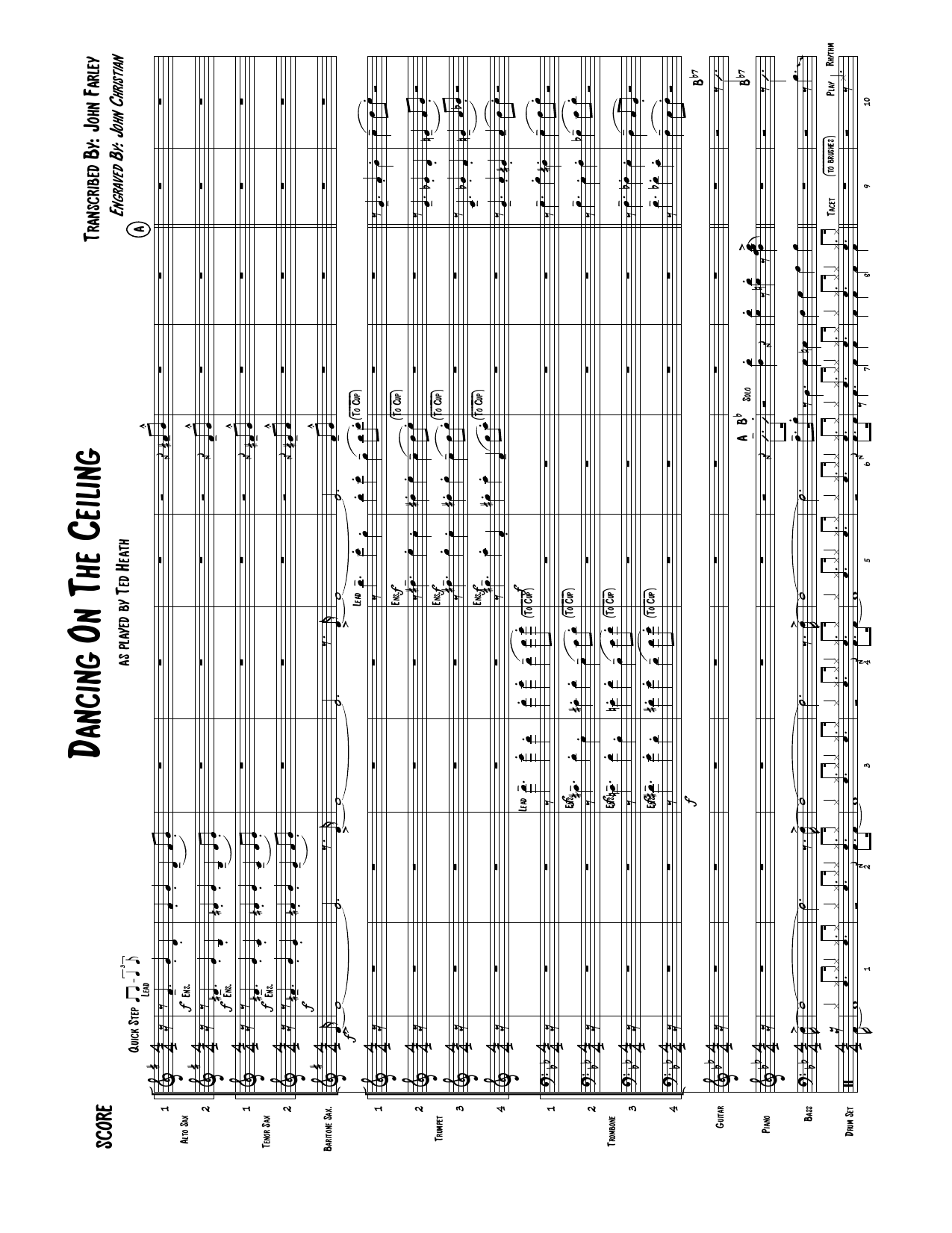
Dancing On The Ceiling (J.Farley-T.Heath. (T.Heath) sheet music preview

Dancing On The Ceiling (J.Farley-T.Heath. (T.Heath)

Composed by Ted Heath

Arranged by Ted Heath

  • Ensemble: Big Band
  • Pages: 44
  • Instruments (17): Alto Saxophone 1, Alto Saxophone 2, Tenor Saxophone 1, Tenor Saxophone 2, Baritone Saxophone, Trumpet 1, Trumpet 2, Trumpet 3, Trumpet 4, Trombone 1, Trombone 2, Trombone 3, Trombone 4, Guitar, Piano, Bass, Drum Set
  • Difficulty: medium
  • Content: Individual Parts
  • Format: PDF Download (Instant)
  • Price: $24.99

British big band master Ted Heath defined the sophisticated sound of post-war UK jazz through precision orchestration and swinging momentum, and this arrangement of "Dancing On The Ceiling" captures that signature London Palladium brilliance at its peak. Originally penned by Rodgers and Hart, the tune was famously adapted into the Heath orchestra's repertoire as a vehicle for showcasing immaculate section blend, crisp articulation, and driving rhythmic vitality. Emerging from an era when British big bands successfully integrated American swing innovations with a distinctly polished European elegance, this chart stands as a masterclass in mid-century arranging craft, bridging classic Tin Pan Alley songwriting with high-energy modern big band execution. Driving medium-up swing propels the arrangement, fueled by a crisp rhythm section foundation and sparkling brass counterlines that evoke an atmosphere of sophisticated urbane revelry. The chart opens with an engaging, harmonically rich introduction that immediately establishes the buoyant tempo before giving way to lithe, intertwined saxophone solis. Heath's scoring favors luminous upper-register trumpet voicings offset by warm, vocal trombone choruses, creating a dynamic textural contrast that keeps the listener engaged. As the chart builds toward a triumphant, high-octane shout chorus, the harmonic tension ratchets upward through clever chromatic passing chords and swinging modulations, ultimately resolving into a breathless, high-energy climax. Ted Heath’s arranging hand is immediately recognizable in the meticulous voice-leading and the clever interweaving of woodwinds with muted brasses. Rather than relying on simple block chords, Heath utilizes sophisticated 9th and 13th extensions that give the brass section a rich, modern bite while maintaining absolute clarity in the counterpoint. The saxophones act as a unified, fluid voice capable of executing lightning-fast bebop-inflected lines with effortless grace, while the rhythm section is provided with enough syncopated kicks and rhythmic push to keep the groove relentlessly swinging without ever feeling rushed or over-cluttered. Advanced high school, collegiate, and professional big bands will find this chart an exceptional centerpiece for festival programs or concert sets, offering immense artistic rewards for ensembles that prioritize section cohesion and stylistic authenticity. While the technical demands require nimble fingerwork from the saxophones and strong endurance in the upper brass registers, the payoff lies in the sheer infectiousness of the groove and the clever interplay between sections. Featured solo space allows frontline improvisers to stretch out over changes that shimmer with classic swinging sophistication, making it a perennial favorite for audiences and players alike. The primary technical challenge in executing this Ted Heath arrangement lies in maintaining a ultra-precise, lightweight swing eighth-note feel at a brisk tempo. Conductor and rhythm section should lock in a driving, feather-light ride cymbal pulse that avoids heavy backbeats, allowing the horns to float effortlessly over the changes. Saxophone sections must pay meticulous attention to dynamic shading during the intricate soli passages, ensuring that internal voice-leading remains audible beneath the primary melody. Brass players should approach high-register entrances with controlled air support rather than brute force, keeping mutes clean and uniform where specified in the score. Rehearsals should initially focus on sectional isolation of the syncopated rhythmic figures before locking the horn interplay together with the bass and drums. Pay careful attention to the dynamic peaks leading into the shout chorus; pulling back slightly on the sub-dominant chords will maximize the explosive impact of the final climax. Q: What specific instrumentation and parts are included in this 44-page publication? A: This arrangement is scored for an 8-instrument core ensemble featuring Alto Saxophone, Tenor Saxophone, Baritone Saxophone, Trumpet, Trombone, alongside a full rhythm section framework to support the foundational big band texture. Q: What is the overall difficulty level of this Ted Heath arrangement? A: This chart is graded as advanced, best suited for collegiate, professional, or highly accomplished high school big bands equipped with strong section leaders and agile improvisers. Q: What is the historical background and stylistic approach of the piece? A: Written and styled in the signature post-war British big band tradition pioneered by Ted Heath, the arrangement transforms the classic Rodgers and Hart standard into a vibrant, swinging showcase of sophisticated European jazz orchestration. Q: What makes this particular arrangement unique compared to other big band charts of the era? A: It distinguishes itself through Heath’s masterclass use of lush, extended 9th and 13th brass voicings, fluid woodwind counterpoint, and a dynamically structured shout chorus that continuously builds tension. Q: What is the recommended tempo feel and performance duration for this arrangement? A: The chart is designed to be performed at a bright, buoyant medium-up swing tempo that typically yields a performance duration of approximately 3 to 4 minutes depending on solo extensions.

Questions and answers

What is included in the Dancing On The Ceiling (J.Farley-T.Heath. (T.Heath) PDF?
The verified current file contains a conductor score and individual parts across 44 pages.
How many instruments or parts are listed for Dancing On The Ceiling (J.Farley-T.Heath. (T.Heath)?
The verified instrumentation list contains 17 entries for this Big Band arrangement.
Who is credited for Dancing On The Ceiling (J.Farley-T.Heath. (T.Heath)?
Composer: Ted Heath. Arranger: Ted Heath.
What difficulty is listed for Dancing On The Ceiling (J.Farley-T.Heath. (T.Heath)?
The verified difficulty level is medium.
Can I preview Dancing On The Ceiling (J.Farley-T.Heath. (T.Heath) before buying?
Yes. The product page provides a preview generated from the current PDF file.
How is Dancing On The Ceiling (J.Farley-T.Heath. (T.Heath) delivered?
After successful payment, the digital PDF is made available for download. The displayed price is $24.99.

Musicians Also Search For

Dancing On The Ceiling Ted Heath PDFDancing On The Ceiling Ted Heath sheet musicDancing On The Ceiling arranged by Ted HeathTed Heath big band chartsTed Heath jazz arrangements PDFDancing On The Ceiling Ted Heath big band arrangementsDancing On The Ceiling big band arrangementsDancing On The Ceiling big band PDF downloadDancing On The Ceiling jazz sheet musicbig band sheet music downloadDancing On The Ceiling conductor score PDFDancing On The Ceiling individual parts downloadDancing On The Ceiling sheet music PDFbuy Dancing On The Ceiling sheet musicdownload Dancing On The Ceiling PDFDancing On The Ceiling jazz chartsbest Ted Heath big band arrangementsDancing On The Ceiling printable sheet musicbig band repertoire PDF

All arrangements by Ted Heath All Ted Heath sheet music