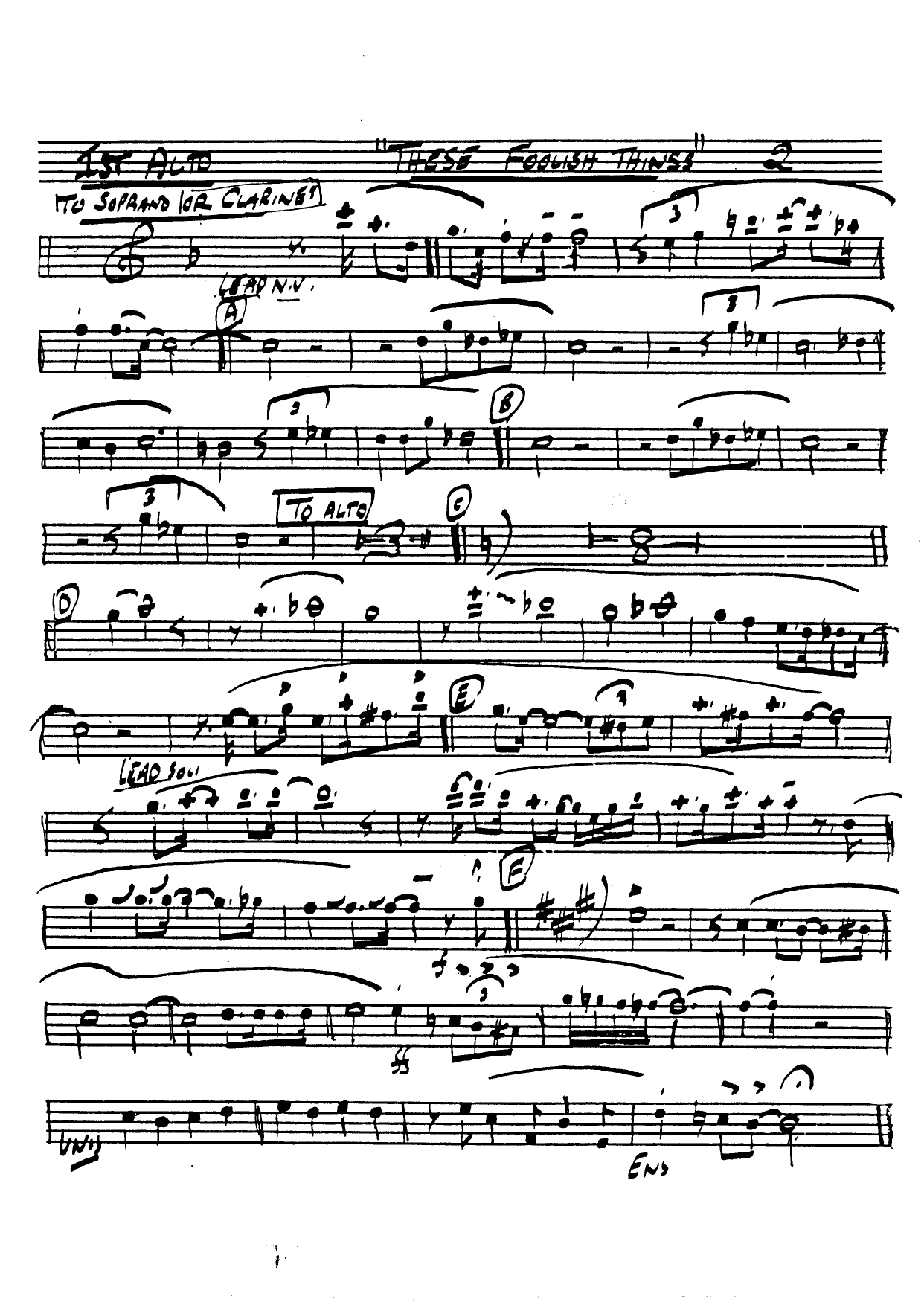
These Foolish Things (T.Heath)
Composed by Ted Heath
Arranged by Ted Heath
- Ensemble: Big Band
- Pages: 17
- Instruments (17): 1st Alto Saxophone (doubles Soprano Saxophone, Clarinet), 2nd Alto Saxophone, 1st Tenor Saxophone, 2nd Tenor Saxophone, Baritone Saxophone (doubles Alto Saxophone), 1st Trumpet, 2nd Trumpet, 3rd Trumpet, 4th Trumpet, 1st Trombone, 2nd Trombone, 3rd Trombone, 4th Trombone, Piano, Guitar, Double Bass, Drums
- Difficulty: easy
- Content: Individual Parts
- Format: PDF Download (Instant)
- Price: $24.99
"These Foolish Things (Remind Me of You)," the classic 1936 Eric Maschwitz and Jack Strachey British standard, found one of its most sophisticated and swinging instrumental interpretations through the legendary British bandleader Ted Heath. During the post-war golden era of British big bands, the Ted Heath Orchestra established an international reputation for precision, dynamic power, and a distinctly polished Anglo-American swing aesthetic. Heath’s treatment of this timeless standard elevates the lush, sentimental ballad into a masterclass of big band arrangement, balancing sweeping melodic beauty with crisp, driving ensemble articulation that echoes the finest traditions of the contemporary American jazz scene. At a graceful, flowing medium-swing tempo, this arrangement establishes an atmosphere of sophisticated nostalgia. The key signature and structural layout provide a rich canvas where velvety chordal textures contrast sharply with bright, punchy brass accents. The emotional landscape shifts seamlessly from introspective, tender lyricism to bursts of vibrant, optimistic swing energy. Ted Heath’s signature arranging approach is immediately recognizable in the meticulous voice-leading and the lush, block-voiced sax solis that cushion the primary theme. Rather than relying on heavy-handed modernizations, Heath respects the gorgeous harmonic architecture of the original composition while injecting subtle, extended harmonies and sophisticated counter-lines that keep both performers and listeners fully engaged. The woodwind section—featuring parts for Alto, Tenor, and Baritone Saxophones—carries a significant portion of the thematic weight, often weaving intricate countermelodies behind the brass or taking the lead in buttery, full-ensemble soli passages. Trumpet and trombone sections trade conversational phrases, punctuated by warm cup-muted or open-bell voicings that evoke the quintessential 1950s London Palladium broadcast sound. Soloists are given ample breathing room to stretch out over standard changes, making this chart an ideal vehicle for a lyrical tenor saxophonist or a smooth-toned trumpeter. Technically, the chart demands precise rhythmic synchronization, particularly during swung eighth-note passages and dynamic swells, rewarding ensembles that possess strong sectional cohesion and a refined sense of swing phrasing. Advanced high school, collegiate, and professional community big bands will find this 17-page chart an exceptional addition to their repertoire. While the individual note reading is accessible, the true challenge and reward lie in achieving the sleek, professional polish characteristic of the Ted Heath library. Conductors will appreciate how naturally the arrangement sits under the fingers of the players, allowing the ensemble to focus entirely on stylistic nuances, intonation, and maintaining a buoyant, driving macro-groove from the first downbeat to the final chord. Mastering this Ted Heath arrangement requires a primary focus on stylistic unity and sectional balance. The tempo should remain a steady, relaxed medium swing; avoid rushing the upbeat eighth notes, as the groove relies entirely on a laid-back, infectious pocket. The rhythm section is the anchor here: the drummer should employ a crisp, feather-light ride cymbal pattern with a subtle two-and-four hi-hat chick, while the bassist walks a clean, acoustic-style line that outlines the harmonic movement without overpowering the horns. Brass players should pay close attention to dynamic markings, ensuring that background figures remain subservient to whichever section carries the primary melody. Articulation is paramount: shorter notes must be clipped neatly, and longer notes should bloom with a warm, controlled vibrato typical of mid-century British dance orchestras. Rehearsal should begin by isolating the sax soli to lock in intonation and blend before integrating the brass counterlines. Encourage soloists to build their improvisational statements organically, matching the romantic yet swinging ethos of the ensemble's surrounding context. Q: What specific instruments and parts are included in this 17-page arrangement? A: This arrangement is scored for a streamlined 9-instrument big band instrumentation, featuring parts for Alto Saxophone, Tenor Saxophone, Baritone Saxophone, Trumpet, and Trombone, alongside a complete rhythm section framework. Q: What is the difficulty level of this Ted Heath arrangement? A: This chart is best suited for advanced high school, collegiate, and professional community big bands due to its demand for precise sectional blend, stylistic swing phrasing, and mature intonation control. Q: What is the historical context and musical style of this piece? A: Written in the classic British big band style popularized by Ted Heath during the post-war era, this arrangement transforms the 1936 standard into a sophisticated, medium-swing vehicle that bridges American jazz orchestration with British elegance. Q: What makes this particular arrangement by Ted Heath unique? A: It is distinguished by Heath's signature lush block-voiced sax solis, meticulous voice-leading, and clever dynamic contrasts that elevate a traditional ballad into a swinging, texturally rich showcase. Q: What is the performance duration and tempo feel of the piece? A: The arrangement is set at a comfortable, flowing medium-swing tempo designed to highlight the lyrical quality of the melody while maintaining a buoyant, danceable groove throughout its standard duration.
Questions and answers
- What is included in the These Foolish Things (T.Heath) PDF?
- The verified current file contains individual parts across 17 pages.
- How many instruments or parts are listed for These Foolish Things (T.Heath)?
- The verified instrumentation list contains 17 entries for this Big Band arrangement.
- Who is credited for These Foolish Things (T.Heath)?
- Composer: Ted Heath. Arranger: Ted Heath.
- What difficulty is listed for These Foolish Things (T.Heath)?
- The verified difficulty level is easy.
- Can I preview These Foolish Things (T.Heath) before buying?
- Yes. The product page provides a preview generated from the current PDF file.
- How is These Foolish Things (T.Heath) delivered?
- After successful payment, the digital PDF is made available for download. The displayed price is $24.99.
Musicians Also Search For
These Foolish Things Ted Heath PDF • These Foolish Things Ted Heath sheet music • These Foolish Things arranged by Ted Heath • Ted Heath big band charts • Ted Heath jazz arrangements PDF • These Foolish Things Ted Heath big band arrangements • These Foolish Things big band arrangements • These Foolish Things big band PDF download • These Foolish Things jazz sheet music • big band sheet music download • These Foolish Things individual parts download • These Foolish Things sheet music PDF • buy These Foolish Things sheet music • download These Foolish Things PDF • These Foolish Things jazz charts • best Ted Heath big band arrangements • These Foolish Things printable sheet music • big band repertoire PDF