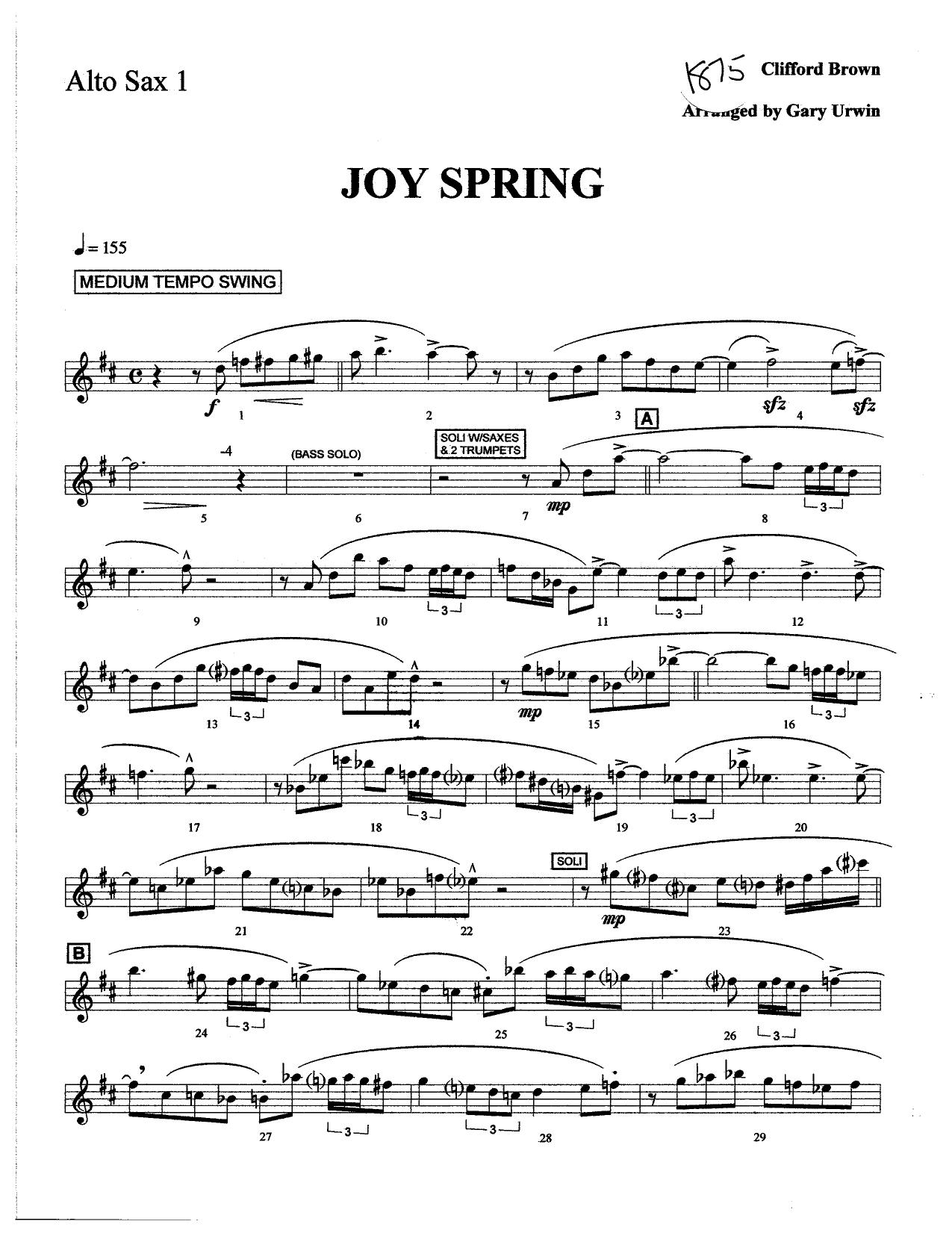
Joy Spring (G.Urwin)
Composed by Clifford Brown
Arranged by Gary Urwin
- Ensemble: Big Band
- Pages: 79
- Instruments (18): Alto Sax 1, Alto Sax 2, Tenor Sax 1, Tenor Sax 2, Baritone Sax, Trumpet 1, Trumpet 2, Composite Trumpet 3, Composite Trumpet 4, Composite Trumpet 5, Trombone 1, Trombone 2, Trombone 3, Bass Trombone, Piano, Bass, Drums, Guitar
- Difficulty: advanced
- Content: Individual Parts
- Format: PDF Download (Instant)
- Price: $24.99
Clifford Brown’s enduring hard bop masterpiece "Joy Spring," originally recorded on his landmark 1954 EmArcy session with Max Roach, stands as one of the most sophisticated yet jubilantly accessible compositions in the modern jazz canon. Characterized by its infectious, serpentine melody and harmonically rich AABA form, Brown's anthem bridges the gap between the labyrinthine complexities of early bebop and the soul-inflected warmth of the 1950s east coast jazz revival. The tune demands a high level of linear agility and harmonic awareness, making it a perennial rite of passage for improvisers navigating complex chord substitutions and fast-moving cadence progressions. Gary Urwin’s masterful big band adaptation captures the exuberant spirit of the original small-group recording while reimagining its architecture for a full 18-piece jazz orchestra. Set at a brisk, invigorating medium-up swing tempo, the arrangement opens with crisp, interlocking horn figures that immediately establish a high-energy mood of unbridled optimism. Urwin utilizes contemporary extended harmonies and luminous brass voicings to amplify the modal colorations hidden within Brown’s original changes. The saxophones are treated to a blistering, tightly interwoven soli that mirrors the fluid brilliance of the original trumpet-and-saxophone head, while the brass section interjects with razor-sharp dynamic punctuation that drives the rhythm forward with relentless momentum. Throughout the chart, Urwin showcases brilliant sectional contrast, alternating between sparse, transparent rhythm-section-and-horn textures and roaring, all-hands-on-deck shout choruses. The arrangement carves out ample space for featured soloists over the form, supported by dynamic background figures that build in intensity without muddying the harmonic landscape. Technical demands center primarily on articulation clarity, high-register endurance for the lead trumpet, and the stamina required to sustain a bright swing feel across complex, fast-moving 4/4 lines. The saxophones will find the rapid scalar passages deeply rewarding, while the rhythm section is tasked with maintaining an agile, driving pulse that locks tightly with the horns. Advanced high school ensembles, collegiate jazz orchestras, and professional big bands will find this chart to be a premier centerpiece for festival repertoires or formal concerts. Because of its demanding tempo and intricate harmonic language, it requires a mature ensemble with strong section leaders and confident improvisers. Yet, the sheer melodic beauty and joyful exuberance of Urwin's writing guarantee that the hard work in rehearsal pays off in an unforgettable performance experience that will leave audiences exhilarated. Unlocking the brilliance of Gary Urwin's "Joy Spring" requires rigorous attention to articulation, balance, and tempo discipline. The chart should live in a bright, driving swing feel (approx. quarter note = 208–216), but the conductor must ensure that the rhythm section does not rush; the groove must remain buoyant and relaxed even at high speeds. Technically, the primary challenge lies in the rapid, synchronous unison lines shared between the saxophones and upper brass. Rehearsals should isolate these passages at a reduced tempo, focusing on a uniform, light-tongued articulation style that makes eighth-note lines sound effortless rather than heavy. Lead trumpet players will need to manage endurance carefully, particularly during the soaring ensemble climaxes leading into the shout chorus. Encourage the rhythm section to lock in tightly with the ride cymbal and walking bass, avoiding over-playing during the sparse head statements. Section leaders must meticulously balance the dynamic shading, ensuring that background figures remain subservient to featured soloists while still maintaining their characteristic bite. Q: What instruments and parts are included in this big band arrangement? A: The 79-page score and parts package is scored for a standard 18-piece big band instrumentation, comprising 2 alto saxophones, 2 tenor saxophones, 1 baritone saxophone, 4 trumpets, 4 trombones, piano, guitar, bass, and drums. Q: What is the overall difficulty level of Gary Urwin's arrangement of "Joy Spring"? A: This arrangement is graded as advanced, making it best suited for college jazz orchestras, professional big bands, and top-tier high school ensembles with experienced improvisers and strong section leaders. Q: What is the historical background of the musical material used in this chart? A: The piece is based on jazz trumpeter Clifford Brown's iconic 1954 hard bop composition, celebrated for its complex harmonic structure, joyous mood, and status as an essential modern jazz standard. Q: What makes this specific arrangement by Gary Urwin unique? A: Urwin brilliantly scales up the intimate energy of Brown's small-group masterpiece for a full big band, utilizing luminous extended voicings, dazzling sax solis, and dynamic shout choruses that elevate the original harmonic architecture. Q: What is the recommended performance tempo and duration for this arrangement? A: The chart is designed to be played at a bright, energetic medium-up swing tempo (around quarter note = 210), with a total performance duration typically running between 4 and 5 minutes depending on the length of the improvised solos.
Questions and answers
- What is included in the Joy Spring (G.Urwin) PDF?
- The verified current file contains individual parts across 79 pages.
- How many instruments or parts are listed for Joy Spring (G.Urwin)?
- The verified instrumentation list contains 18 entries for this Big Band arrangement.
- Who is credited for Joy Spring (G.Urwin)?
- Composer: Clifford Brown. Arranger: Gary Urwin.
- What difficulty is listed for Joy Spring (G.Urwin)?
- The verified difficulty level is advanced.
- Can I preview Joy Spring (G.Urwin) before buying?
- Yes. The product page provides a preview generated from the current PDF file.
- How is Joy Spring (G.Urwin) delivered?
- After successful payment, the digital PDF is made available for download. The displayed price is $24.99.
Musicians Also Search For
Joy Spring Gary Urwin PDF • Joy Spring Gary Urwin sheet music • Joy Spring arranged by Gary Urwin • Gary Urwin big band charts • Gary Urwin jazz arrangements PDF • Joy Spring Clifford Brown sheet music • Joy Spring Clifford Brown big band arrangements • Clifford Brown big band charts • Joy Spring big band arrangements • Joy Spring big band PDF download • Joy Spring jazz sheet music • big band sheet music download • Joy Spring individual parts download • Joy Spring sheet music PDF • buy Joy Spring sheet music • download Joy Spring PDF • Joy Spring jazz charts • best Gary Urwin big band arrangements • Clifford Brown arranged by Gary Urwin • Joy Spring printable sheet music • big band repertoire PDF