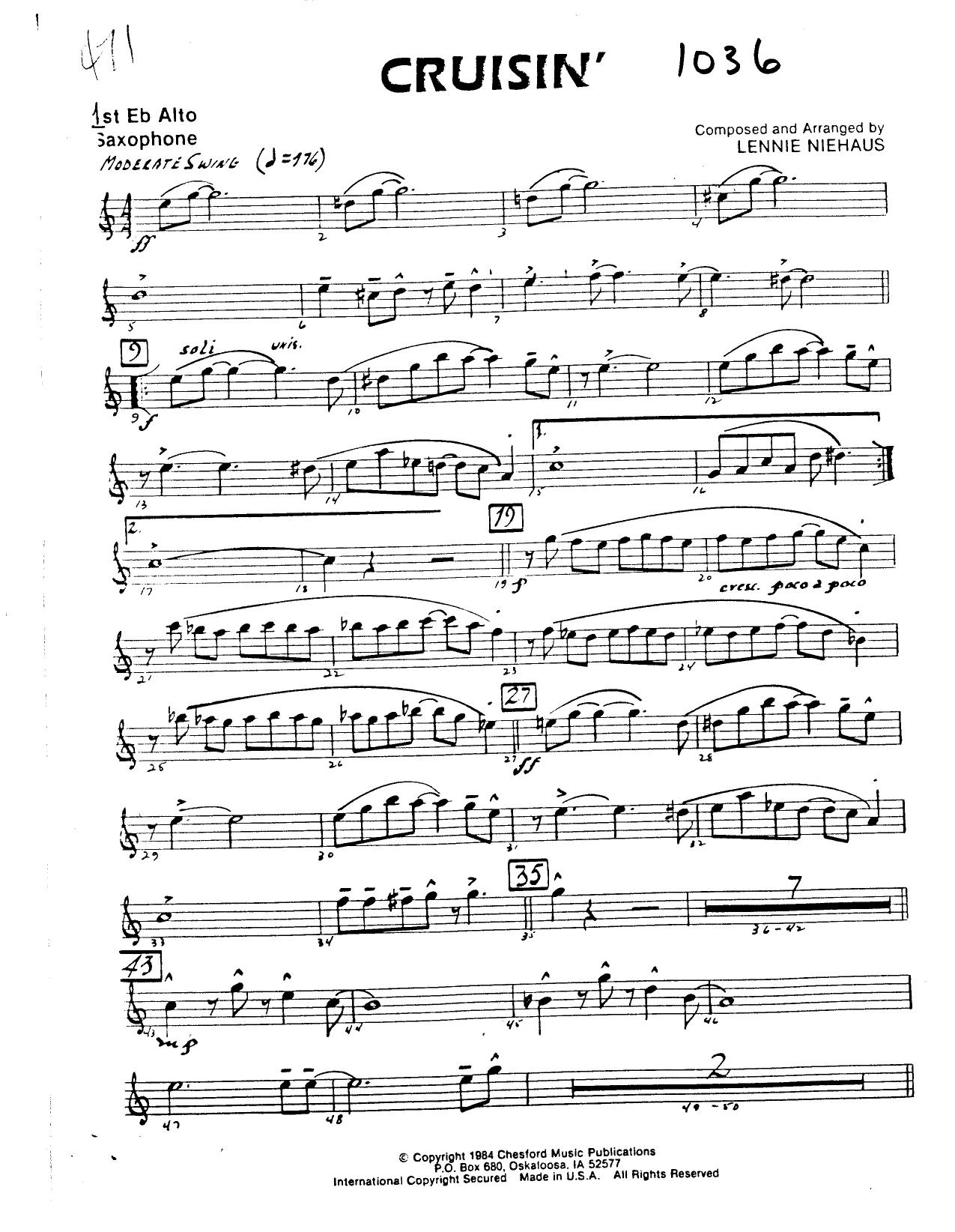
Cruisin' (L.Niehaus)
Composed by Lennie Niehaus
Arranged by Lennie Niehaus
- Ensemble: Big Band
- Pages: 37
- Instruments (17): 1st Eb Alto Saxophone, 2nd Eb Alto Saxophone, 1st Bb Tenor Saxophone, 2nd Bb Tenor Saxophone, Eb Baritone Saxophone, 1st Bb Trumpet, 2nd Bb Trumpet, 3rd Bb Trumpet, 4th Bb Trumpet, 1st Trombone, 2nd Trombone, 3rd Trombone, 4th Trombone, Piano, Bass, Guitar, Drums
- Difficulty: medium
- Content: Individual Parts
- Format: PDF Download (Instant)
- Price: $24.99
Lennie Niehaus, a foundational figure in West Coast jazz and a master alto saxophonist who honed his craft in the Stan Kenton Orchestra, brought an exceptional ear for counterpoint and linear writing to big band composition. "Cruisin'" captures the essence of the cool jazz era, translating the sophisticated, relaxed yet intellectually rigorous harmonic language of 1950s modernist jazz into an accessible, high-energy chart for standard big band instrumentation. Rooted in the West Coast tradition pioneered by figures like Gerry Mulligan and Shorty Rogers, Niehaus's writing avoids heavy, bombastic scoring in favor of transparent textures, intricate horizontal voice-leading, and infectious forward momentum that keeps both performers and audiences deeply engaged. Medium-tempo swing drives "Cruisin'", establishing an effortless, cruising attitude right from the downbeat. The composition opens with a crisp, rhythmic hook that immediately sets a confident, swaggering mood. The harmonic framework relies on extended chord extensions, sophisticated secondary dominants, and subtle chromaticism typical of Niehaus's writing, yet it remains firmly anchored in a blues-infused, swinging 4/4 feel. The emotional landscape is upbeat, sophisticated, and coolly exuberant, evoking late-night drives down Pacific Coast highways and the polished sophistication of mid-century modern jazz clubs. Niehaus utilizes a compositional approach characterized by tightly interwoven saxophone solis, crisp brass punches, and clever counter-melodies that bounce between sections. Rather than relying on massive, wall-of-sound tutti passages throughout, Niehaus treats the big band like an agile chamber ensemble, frequently pitting the saxes against the brass in witty call-and-response patterns. The melodic material is shared generously across sections, with the alto and tenor saxophones handling intricate, linear bebop-inflected lines, while the rhythm section—driven by a steady, buoyant walking bassline and crisp ride cymbal pulse—maintains an unyielding groove. Solos are allotted to featured horn players, providing ample space for imaginative improvisation over accessible, modern-swing chord changes. Advanced high school ensembles, collegiate jazz orchestras, and professional community big bands will find "Cruisin'" an ideal vehicle for developing ensemble articulation, section blend, and style awareness. While the technical demands require clean execution of sixteenth-note runs and tight stylistic uniformity—particularly in the saxophone section's unison and harmony passages—the rewards far outweigh the challenges. The chart teaches young players how to swing with a lighter, more articulate West Coast feel rather than heavy Kansas City or Basie-style pressure. Standout moments include a brilliantly crafted shout chorus that builds tension through sequential harmonic shifts before resolving into a high-spirited, punchy final cadence. Achieving the authentic West Coast cool aesthetic in "Cruisin'" requires prioritizing a clean, light, and articulate approach over sheer volume. The tempo should remain steady and relaxed—avoid rushing the medium-swing groove, as the momentum comes from internal subdivision rather than pushed beats. The primary technical challenge lies within the saxophone section solis, which demand absolute precision in articulation, breath support, and intonation across complex, step-wise bebop lines. Tonguing should be crisp but light, avoiding heavy accents on off-beats unless specifically marked by Niehaus. Brass players must focus on seamless blend; trumpets should use minimal vibrato on ensemble passages, and trombones must balance their warmth against the brighter edge of the saxophones. Rhythm section players carry a heavy responsibility: the drummer should maintain a feather-light bass drum (four-to-the-bar "comping" or dropping bombs sparingly) while driving the ride cymbal with a distinct triplet feel. The bassist's walking line must connect each chord change smoothly, acting as the glue for Niehaus's horizontal counterlines. Rehearsals should initially focus on sectional isolation, ensuring that the interplay between reeds and brass is balanced before bringing the full ensemble together at a reduced tempo. Q: What instruments and parts are included in this arrangement? A: This arrangement is scored for a standard 17-instrument big band, consisting of Alto Saxophone 1, Alto Saxophone 2, Tenor Saxophone 1, Tenor Saxophone 2, Baritone Saxophone, 4 Trumpets, 4 Trombones, Piano, Guitar, Bass, and Drums, spanning 37 pages of comprehensive score and parts. Q: What is the difficulty level of this chart? A: This arrangement is rated as medium to advanced (Grade 4), making it exceptionally well-suited for advanced high school jazz ensembles, college bands, and professional community big bands looking to refine their swing articulation and section blend. Q: What musical style and historical era does "Cruisin'" represent? A: Composed and arranged by Lennie Niehaus, "Cruisin'" is a quintessential representation of 1950s West Coast cool jazz, combining sophisticated bebop-derived linear writing with a relaxed, sophisticated groove. Q: What makes this specific Lennie Niehaus arrangement unique? A: The arrangement stands out for its transparent, chamber-like textures, intricate horizontal voice-leading, and witty call-and-response passages between the saxophones and brass, avoiding heavy block-chord writing in favor of agile, linear counterpoint. Q: What is the general tempo and performance duration of this piece? A: "Cruisin'" is set at a confident, medium-swing tempo that prioritizes an effortless groove and driving pulse, typically lasting around 3 to 4 minutes depending on the length of the improvised solo choruses.
Questions and answers
- What is included in the Cruisin' (L.Niehaus) PDF?
- The verified current file contains individual parts across 37 pages.
- How many instruments or parts are listed for Cruisin' (L.Niehaus)?
- The verified instrumentation list contains 17 entries for this Big Band arrangement.
- Who is credited for Cruisin' (L.Niehaus)?
- Composer: Lennie Niehaus. Arranger: Lennie Niehaus.
- What difficulty is listed for Cruisin' (L.Niehaus)?
- The verified difficulty level is medium.
- Can I preview Cruisin' (L.Niehaus) before buying?
- Yes. The product page provides a preview generated from the current PDF file.
- How is Cruisin' (L.Niehaus) delivered?
- After successful payment, the digital PDF is made available for download. The displayed price is $24.99.
Musicians Also Search For
Cruisin' Lennie Niehaus PDF • Cruisin' Lennie Niehaus sheet music • Cruisin' arranged by Lennie Niehaus • Lennie Niehaus big band charts • Lennie Niehaus jazz arrangements PDF • Cruisin' Lennie Niehaus big band arrangements • Cruisin' big band arrangements • Cruisin' big band PDF download • Cruisin' jazz sheet music • big band sheet music download • Cruisin' individual parts download • Cruisin' sheet music PDF • buy Cruisin' sheet music • download Cruisin' PDF • Cruisin' jazz charts • best Lennie Niehaus big band arrangements • Cruisin' printable sheet music • big band repertoire PDF