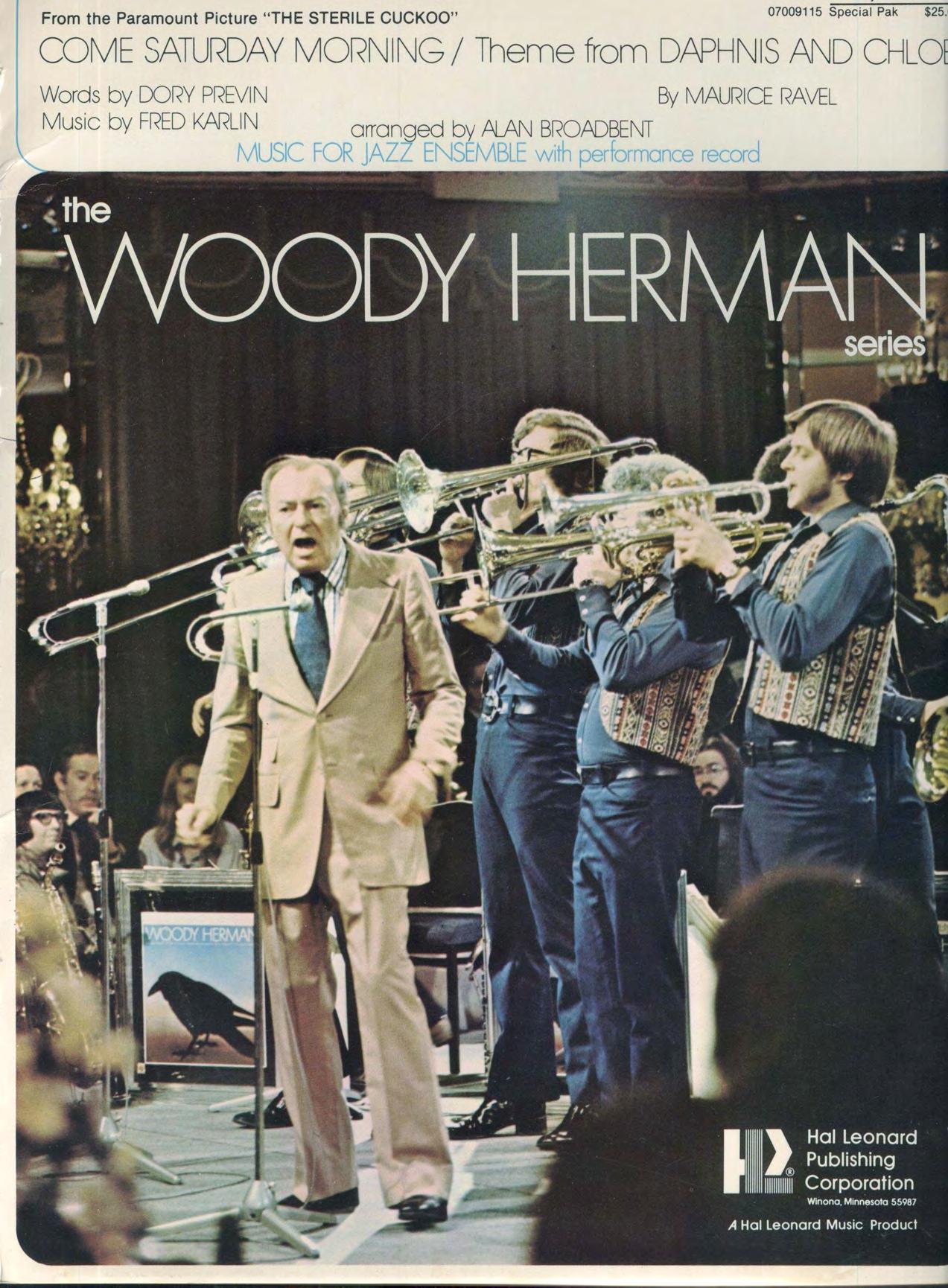
Come Saturday Morning (A.Broadbent)
Composed by Dory Previn
Arranged by Woody Herman
- Ensemble: Big Band
- Pages: 45
- Instruments (18): Sax 1 (lead alto) Flute, Sax 2 (lead tenor) Flute, Sax 3 (opt. alto) Flute, Sax 3 (tenor) Flute, Sax 4 (tenor), Sax 5 (baritone), Trombone 1, Trombone 2, Trombone 3 (Opt.), Trombone 4, Trumpet 1, Trumpet 2, Trumpet 3 (Opt. flugelhorn), Trumpet 4 (Opt. flugelhorn), Electric Piano, Bass, Drums, Vibes
- Difficulty: medium
- Content: Individual Parts
- Format: PDF Download (Instant)
- Price: $24.99
Dory Previn and Fred Karlin’s hauntingly reflective "Come Saturday Morning"—originally introduced in the 1969 film *The Sterile Cuckoo* and famously popularized by The Sandpipers and Liza Minnelli—occupies a unique space where cinematic nostalgia meets sophisticated lyricism. While conceived as a pop-film ballad, the composition’s sophisticated underlying harmony and poignant melodic contour naturally invited the attention of jazz interpreters, ultimately cementing its status as a late-20th-century standard. Within the Woody Herman library, this interpretation captures the legendary bandleader’s unique ability to infuse lyrical vulnerability into a powerhouse big band framework, balancing lush harmonic sophistication with the unmistakable warmth of a swinging ensemble. Unfolding at a relaxed, introspective ballad tempo with a gentle, floating pulse, this arrangement anchors itself in a lush harmonic landscape characterized by extended chords, subtle chromatic passing tones, and rich woodwind doublings. The emotional trajectory moves from a quiet, solitary contemplation to sweeping, cinematic crescendos, evoking a bittersweet sense of youthful longing and fleeting time. The scoring treats the ensemble not merely as an accompanying force, but as an interactive chamber orchestra where inner voices shift constantly, creating a shimmering textural backdrop that supports the primary melodic delivery without ever feeling overcrowded or static. Woody Herman’s signature approach shines through in the clever use of sectional contrast and dynamic pacing. The chart utilizes transparent, contemporary voicings in the brass and saxophones, steering clear of dated clichés in favor of fresh, modernistic colorations that reflect the progressive tastes of Herman’s late-period aggregations. Instead of a standard heavy shout chorus, the arrangement builds intensity through a meticulously orchestrated developmental section, where interlocking countermelodies in the trombones and saxophones weave around the thematic core, creating a rich tapestry of sound before receding into a delicate, whispering resolution. The frontline features prominent moments for the saxophone section, with the melody initially introduced by a solo voice before expanding into lush, full-ensemble solis that demand exceptional breath control, intonation, and blend. Technical demands center less on raw velocity and much more on tone production, rubato-like phrasing within a steady macro-tempo, and precise control over soft dynamics. Advanced high school, collegiate, and professional jazz ensembles will find this chart an exceptional vehicle for developing lyrical maturity, sophisticated listening skills, and stylistic sensitivity, making it an unforgettable centerpiece for any sophisticated concert program. Succeeding with this arrangement requires a disciplined approach to restraint, balance, and rubato-infused micro-timing within a controlled tempo framework. Conductors should emphasize horizontal linear movement over vertical chord punching; the dense, contemporary harmonies require immaculate internal tuning to achieve the desired warmth. The rhythm section must maintain an ultra-subtle, feather-light pulse—avoiding heavy ride-cymbal bashing or rigid hi-hat pressure on two and four. Saxophone section players should focus on matching vibrato widths and seamless blend during the exposed soli passages, ensuring that no single voice sticks out awkwardly. Brass players need to exercise extreme care with dynamic control, utilizing warm, rounded tones even at pianissimo levels, and executing any required mutes with precision to maintain proper intonation. Rehearsal time is best spent isolating the transitional modulations and dynamic swells, ensuring the ensemble transitions smoothly between intimate chamber-like textures and towering, full-ensemble climaxes without forcing the sound. Q: What instruments and parts are included in this big band arrangement? A: The chart is scored for a standard 8-instrument core structure expanding out to a full big band instrumentation, featuring Alto Saxophone, Tenor Saxophone, Baritone Saxophone, Trumpet, Trombone, and a complete rhythm section rhythm support over 45 comprehensive pages of manuscript. Q: What is the difficulty level of this arrangement? A: This piece is rated as advanced-intermediate to advanced, primarily due to its sophisticated harmonic language, requirement for exquisite breath control, and the need for mature intonation and stylistic sensitivity rather than high-velocity technical dexterity. Q: What is the style and historical context of this arrangement? A: Written in a jazz ballad and reflective mood, this chart adapts Dory Previn’s cinematic standard through the lens of Woody Herman’s sophisticated, late-era big band style, blending modern jazz harmony with rich, expressive lyricism. Q: What makes this specific arrangement unique compared to standard big band charts? A: Rather than relying on a traditional heavy shout chorus, this arrangement utilizes transparent, contemporary voicings, intricate countermelodies, and shifting inner voices that treat the big band more like a dynamic, expressive jazz chamber orchestra. Q: What is the recommended performance duration and tempo feel for this piece? A: The piece is designed to be performed at a relaxed, flowing ballad tempo with a subtle, breathing pulse, creating a spacious and emotionally resonant performance lasting approximately 4 to 5 minutes.
Questions and answers
- What is included in the Come Saturday Morning (A.Broadbent) PDF?
- The verified current file contains a conductor score and individual parts across 45 pages.
- How many instruments or parts are listed for Come Saturday Morning (A.Broadbent)?
- The verified instrumentation list contains 18 entries for this Big Band arrangement.
- Who is credited for Come Saturday Morning (A.Broadbent)?
- Composer: Dory Previn. Arranger: Woody Herman.
- What difficulty is listed for Come Saturday Morning (A.Broadbent)?
- The verified difficulty level is medium.
- Can I preview Come Saturday Morning (A.Broadbent) before buying?
- Yes. The product page provides a preview generated from the current PDF file.
- How is Come Saturday Morning (A.Broadbent) delivered?
- After successful payment, the digital PDF is made available for download. The displayed price is $24.99.
Musicians Also Search For
Come Saturday Morning Woody Herman PDF • Come Saturday Morning Woody Herman sheet music • Come Saturday Morning arranged by Woody Herman • Woody Herman big band charts • Woody Herman jazz arrangements PDF • Come Saturday Morning Dory Previn sheet music • Come Saturday Morning Dory Previn big band arrangements • Dory Previn big band charts • Come Saturday Morning big band arrangements • Come Saturday Morning big band PDF download • Come Saturday Morning jazz sheet music • big band sheet music download • Come Saturday Morning conductor score PDF • Come Saturday Morning individual parts download • Come Saturday Morning sheet music PDF • buy Come Saturday Morning sheet music • download Come Saturday Morning PDF • Come Saturday Morning jazz charts • best Woody Herman big band arrangements • Dory Previn arranged by Woody Herman • Come Saturday Morning printable sheet music • big band repertoire PDF