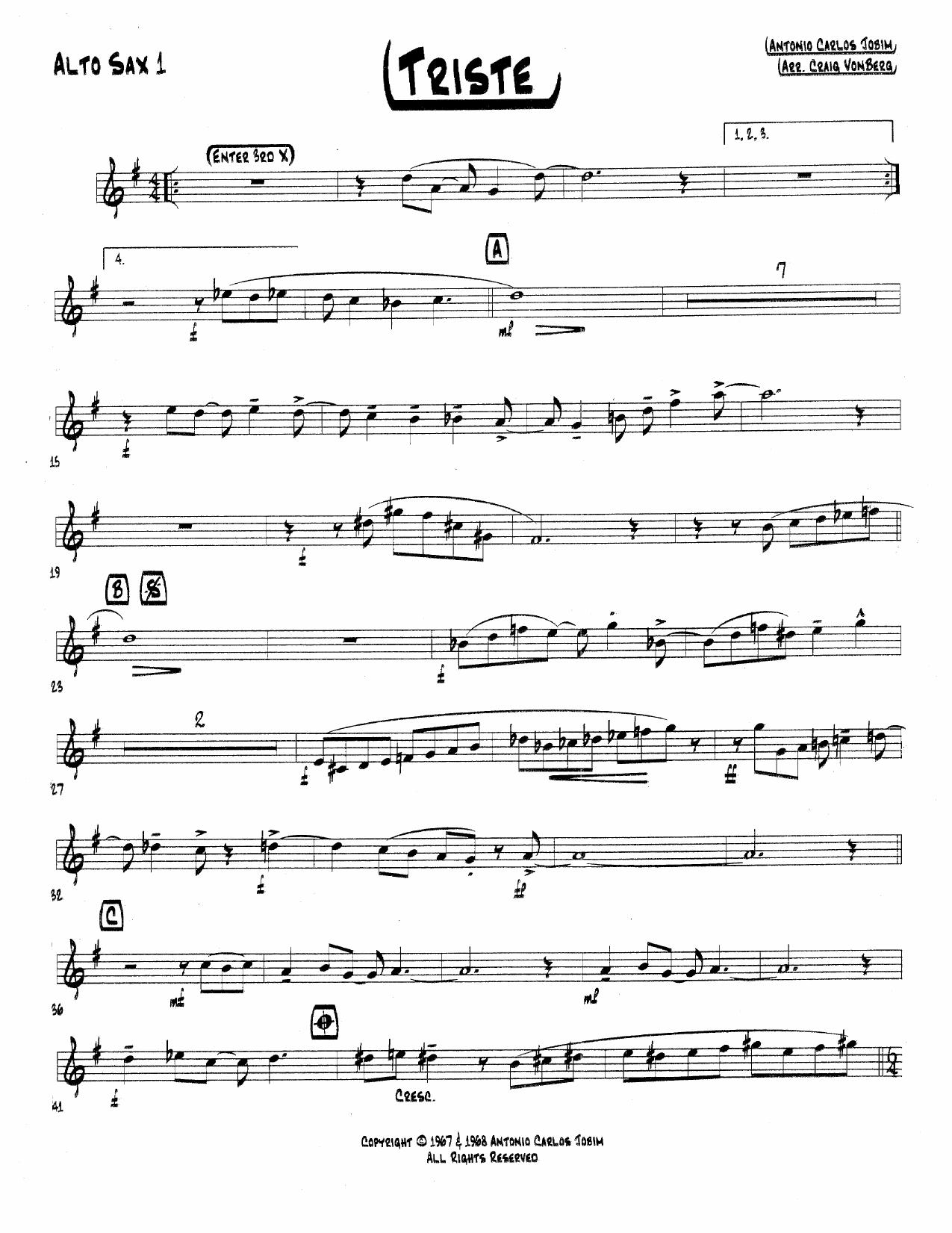
Triste (C.Vonberg) sheet music preview

Triste (C.Vonberg)

Composed by Antônio Carlos Jobim

Arranged by Craig Vonberg

  • Ensemble: Big Band
  • Style: Jazz Standard
  • Pages: 50
  • Instruments (16): Alto Sax 1, Alto Sax 2, Tenor Sax 1, Tenor Sax 2, Baritone Sax, Trumpet 1, Trumpet 2, Trumpet 3, Trumpet 4, Trombone 1, Trombone 2, Trombone 3, Trombone 4, Drums, Bass, Piano
  • Difficulty: advanced
  • Content: Individual Parts
  • Format: PDF Download (Instant)
  • Price: $24.99

Antônio Carlos Jobim’s timeless masterpiece "Triste" stands as one of the crown jewels of the bossa nova canon, capturing the gentle melancholy and sophisticated harmonic palette that defined the genre's mid-1960s golden era. First introduced to the global jazz consciousness through various definitive recordings following its composition, this iconic tune bridges the gap between traditional Brazilian folk idioms and advanced American jazz harmony. The title—meaning "sad" in Portuguese—belies a song of exquisite lyrical beauty, where major-seventh resolutions and descending chromatic lines evoke a bittersweet nostalgia that continues to captivate audiences worldwide. Craig Vonberg’s sophisticated big band interpretation transforms Jobim's intimate bossa nova blueprint into a lush, dynamic orchestral canvas while preserving the essential rhythmic integrity of the style. Set at a relaxed, flowing medium bossa groove, the arrangement opens with a delicate acoustic guitar and piano vamp before introducing the melody in the saxophone section, enriched by subtle, contemporary harmonic colorations. Vonberg expertly balances transparent, shimmering textural passages with full-ensemble swells, utilizing rich chord voicings in the brass that echo the sophisticated aesthetic of standard West Coast cool jazz arrangers. The mood shifts effortlessly from introspective and lyrical to warm and exuberant, building toward a harmonically adventurous transitional passage that showcases the ensemble's collective sensitivity to dynamic shading. Featured solos for alto saxophone and piano sit at the heart of the chart, providing ample space for improvisers to explore the modal shifts and extended extensions inherent in Jobim's changes. The background figures behind the soloists are meticulously crafted, featuring muted brass and sustained sax pads that maintain forward momentum without crowding the soloist. Rather than relying on a bombastic, high-energy shout chorus, Vonberg crafts a gorgeous, harmonically rich developmental section that builds intensity through thickening textures and rising countermelodies, ultimately returning to a tender restatement of the primary theme. The chart requires exceptional breath control from the woodwinds, precise intonation in the upper-register brass voicings, and a rhythm section that understands the subtle interplay between the understated Brazilian clave and traditional jazz swing phrasing. Advanced high school, collegiate, and professional jazz ensembles will find this chart an exceptionally rewarding addition to their repertoire. It provides an ideal vehicle for teaching stylistic versatility, forcing players to step away from heavy swing-eighth dynamics and embrace the relaxed, behind-the-beat articulation vital to authentic bossa nova performance. Conductor and ensemble alike will appreciate how Vonberg’s thoughtful orchestration highlights every section of the 16-instrument lineup, creating a textured masterpiece that contrasts effectively against standard up-tempo burners on any concert program. Achieving an authentic reading of Craig Vonberg’s arrangement of "Triste" requires a disciplined approach to the foundational bossa nova groove. The rhythm section is the engine: the drummer should employ a subtle, authentic bossa feel utilizing a rim-shot or cross-stick pattern on beat two and four, while the bass player anchors the ensemble with a steady, pulsing two-beat root-fifth pattern rather than a walking line. The tempo should remain strictly locked in at a relaxed medium-slow pulse—avoiding any tendency to drag during soft ensemble passages or rush through the modulations. Technically, the primary challenge lies in ensemble intonation and blend during the dense, extended-harmony sustained pads found in the saxophones and muted trumpets. Players must carefully balance their internal dynamics so that the inner voices of the chords do not obscure the primary melodic line. Articulation should be smooth and connected (legato) throughout the head, contrasting sharply with any accented syncopations in the brass backgrounds. Rehearsal should begin with the rhythm section alone to lock in the hypnotic groove before layering in the horn sections section-by-section, paying strict attention to dynamic markings that range from a whisper-quiet *pp* to a warm, resonant *mf*. Q: What instruments and parts are included in this arrangement? A: This complete 16-instrument big band chart features parts for Alto Saxophone 1 & 2, Tenor Saxophone 1 & 2, Baritone Saxophone, Trumpets 1 through 4, Trombones 1 through 4, Piano, Guitar, Bass, and Drums, alongside a comprehensive conductor score across its 50 pages. Q: What is the difficulty level of this chart? A: This arrangement is rated as medium-advanced, making it ideally suited for capable high school jazz bands, collegiate ensembles, and professional community big bands seeking to showcase stylistic versatility and expressive control. Q: What is the musical style and historical context of the piece? A: It is a sophisticated jazz standard rooted in the Brazilian bossa nova tradition pioneered by Antônio Carlos Jobim, adapted here into a lush, contemporary big band format that emphasizes harmonic sophistication and lyrical depth. Q: What makes Craig Vonberg’s arrangement unique? A: Vonberg departs from standard high-energy big band formulas by utilizing rich, modern harmonic extensions, subtle textural contrasts, and a gorgeous developmental transition in place of a traditional loud shout chorus. Q: What is the performance duration and recommended tempo? A: The arrangement runs approximately 4 to 5 minutes in duration and should be performed at a relaxed, steady medium bossa nova tempo of around 116 to 124 beats per minute.

Questions and answers

What is included in the Triste (C.Vonberg) PDF?
The verified current file contains a conductor score and individual parts across 50 pages.
How many instruments or parts are listed for Triste (C.Vonberg)?
The verified instrumentation list contains 16 entries for this Big Band arrangement.
Who is credited for Triste (C.Vonberg)?
Composer: Antônio Carlos Jobim. Arranger: Craig Vonberg.
What difficulty is listed for Triste (C.Vonberg)?
The verified difficulty level is advanced.
What style is listed for Triste (C.Vonberg)?
The catalog lists the style as Jazz Standard.
Can I preview Triste (C.Vonberg) before buying?
Yes. The product page provides a preview generated from the current PDF file.
How is Triste (C.Vonberg) delivered?
After successful payment, the digital PDF is made available for download. The displayed price is $24.99.

Musicians Also Search For

Triste Craig Vonberg PDFTriste Craig Vonberg sheet musicTriste arranged by Craig VonbergCraig Vonberg big band chartsCraig Vonberg jazz arrangements PDFTriste Antônio Carlos Jobim sheet musicTriste Antônio Carlos Jobim big band arrangementsAntônio Carlos Jobim big band chartsTriste big band arrangementsTriste big band PDF downloadTriste jazz sheet musicbig band sheet music downloadTriste conductor score PDFTriste individual parts downloadTriste sheet music PDFTriste Jazz Standard chartsJazz Standard big band arrangementsbuy Triste sheet musicdownload Triste PDFTriste jazz chartsbest Craig Vonberg big band arrangementsAntônio Carlos Jobim arranged by Craig VonbergTriste printable sheet musicbig band repertoire PDF

All arrangements by Craig Vonberg All Antônio Carlos Jobim sheet music