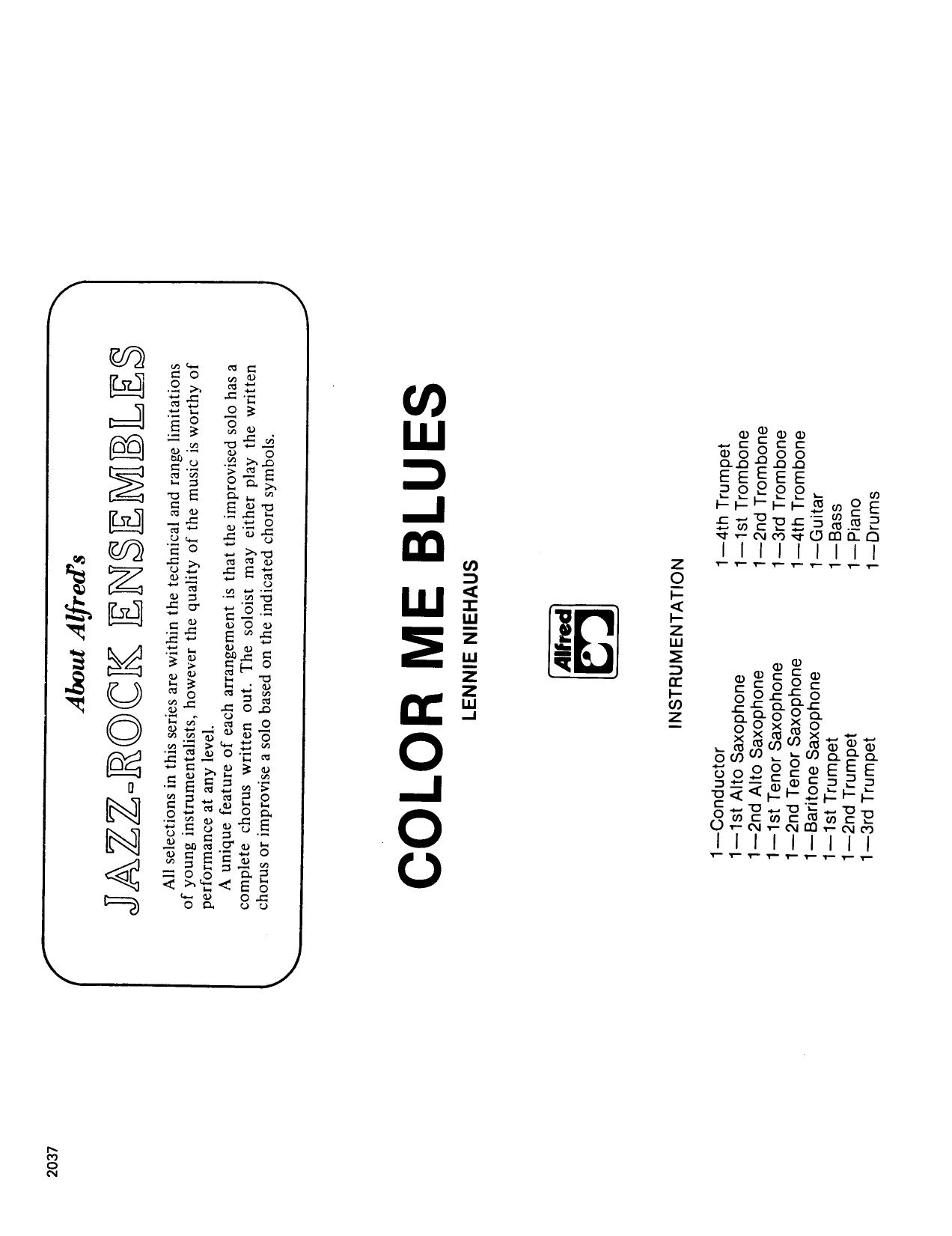
Color Me Blues (L.Niehaus)
Composed by Lennie Niehaus
Arranged by Lennie Niehaus
- Ensemble: Big Band
- Pages: 64
- Instruments (17): 1st Alto Saxophone, 2nd Alto Saxophone, 1st Tenor Saxophone, 2nd Tenor Saxophone, Baritone Saxophone, 1st Trumpet, 2nd Trumpet, 3rd Trumpet, 4th Trumpet, 1st Trombone, 2nd Trombone, 3rd Trombone, 4th Trombone, Piano, Bass, Drums, Guitar
- Difficulty: advanced
- Content: Individual Parts
- Format: PDF Download (Instant)
- Price: $24.99
Lennie Niehaus remains one of the towering architects of West Coast cool jazz, bringing his extensive experience as a foundational alto saxophonist and arranger for the historic Stan Kenton Orchestra into his prolific writing for ensemble. "Color Me Blues" encapsulates the sophisticated harmonic language, litters of counterpoint, and effortless swing that defined the California modernist movement of the 1950s and 1960s. While drawing deep inspiration from the bebop tradition, Niehaus refines the aesthetic with an emphasis on pristine intonation, crystalline horn blending, and an understated, intellectual cool that contrasts sharply with the frantic high-energy East Coast fire of the same era. Driven by an infectious, relaxed medium-swing groove in 4/4, "Color Me Blues" establishes a sophisticated, blues-inflected mood that balances urbane cool with deep-rooted swinging tradition. The harmonic framework utilizes extended extensions, subtle chromatic passing tones, and tight, linear voice-leading that avoids dense, thunderous brass walls in favor of nimble, agile textures. The emotional landscape shifts gracefully between playful insouciance and driving momentum, evoking the smoky, intimate atmosphere of a West Coast jazz club where every nuance of articulation and dynamic shading is brought to the forefront. True to the signature Lennie Niehaus methodology, the arrangement places heavy emphasis on transparent saxophone solis and interlocking horn countermelodies that showcase brilliant linear writing. The 16-instrument big band instrumentation is deployed with economical brilliance; rather than constantly playing at full volume, Niehaus creates dynamic contrast by pitting the sections against one another in clever call-and-response patterns. The melodic weight is shared fluidly across the ensemble, featuring tightly integrated reed solis where the two altos and two tenors lock in unison and tight four-part harmony, anchored by the baritone sax. Solos are thoughtfully designated for featured improvisers, supported by crisp, understated background figures that maintain forward momentum without ever crowding the soloist. Executing this chart successfully requires exceptional stylistic unity, particularly regarding articulation, light swing eighth-notes, and subtle dynamic control. Because the scoring is transparent, rhythmic precision across the rhythm section and immaculate section blending are essential to capturing the West Coast flavor. Advanced high school bands with strong section players, as well as collegiate and professional jazz ensembles, will find this 64-page arrangement an immensely rewarding vehicle. It serves as a masterclass in linear writing and stylistic elegance, offering audiences a refreshing departure from heavy brass-heavy climaxes while delivering high-octane musical satisfaction. Conductors approaching "Color Me Blues" must prioritize a relaxed, buoyant medium-swing feel rather than an aggressive, heavy-handed drive. The tempo should sit comfortably in the pocket, allowing the eighth-note lines to bounce with natural, speech-like inflections rather than rigid quantization. Articulation is paramount: encourage the brass and reeds to keep tongue strokes light, utilizing standard jazz articulation where upbeats receive gentle emphasis. Key technical challenges involve navigating Niehaus’s linear, bebop-influenced lines, which frequently move through tight chromatic intervals. Horn sections should practice their passages slowly with a metronome, ensuring uniform breath support and blend across the two alto and tenor parts. Pay close attention to dynamic markings; the arrangement relies heavily on sub-tones, subtle crescendos, and sudden drop-offs to generate excitement. Reeds should focus on achieving a dry, focused tone without excessive vibrato to honor the cool jazz aesthetic. The rhythm section must keep the ride cymbal prominent and unhurried, providing a buoyant carpet beneath the horns. Q: What instruments and parts are included in this 16-instrument arrangement? A: The instrumentation features a standard big band setup including 2 alto saxophones, 2 tenor saxophones, and 1 baritone saxophone, alongside standard brass and rhythm section parts spanning 64 total pages. Q: What is the difficulty level of Lennie Niehaus's "Color Me Blues"? A: This arrangement is best suited for advanced high school, collegiate, and professional jazz ensembles due to its demands for stylistic precision, linear sight-reading, and mature swing articulation. Q: What is the musical style and historical context of this piece? A: Composed by West Coast jazz icon Lennie Niehaus, the piece embodies the sophisticated, cool-jazz aesthetic of the 1950s and 1960s, blending bebop harmonic sophistication with relaxed, pristine ensemble textures. Q: What makes this specific arrangement unique? A: It distinguishes itself through Niehaus's signature linear counterpoint, transparent saxophone solis, and an economical use of orchestration that favors intricate horn interleaving over dense, continuous brass climaxes. Q: What is the recommended tempo and performance duration for this arrangement? A: The arrangement is set to a relaxed, medium-swing tempo in 4/4 time, making it an ideal mid-concert feature with a duration typically spanning around 4 to 5 minutes depending on solo rotations.
Questions and answers
- What is included in the Color Me Blues (L.Niehaus) PDF?
- The verified current file contains a conductor score and individual parts across 64 pages.
- How many instruments or parts are listed for Color Me Blues (L.Niehaus)?
- The verified instrumentation list contains 17 entries for this Big Band arrangement.
- Who is credited for Color Me Blues (L.Niehaus)?
- Composer: Lennie Niehaus. Arranger: Lennie Niehaus.
- What difficulty is listed for Color Me Blues (L.Niehaus)?
- The verified difficulty level is advanced.
- Can I preview Color Me Blues (L.Niehaus) before buying?
- Yes. The product page provides a preview generated from the current PDF file.
- How is Color Me Blues (L.Niehaus) delivered?
- After successful payment, the digital PDF is made available for download. The displayed price is $24.99.
Musicians Also Search For
Color Me Blues Lennie Niehaus PDF • Color Me Blues Lennie Niehaus sheet music • Color Me Blues arranged by Lennie Niehaus • Lennie Niehaus big band charts • Lennie Niehaus jazz arrangements PDF • Color Me Blues Lennie Niehaus big band arrangements • Color Me Blues big band arrangements • Color Me Blues big band PDF download • Color Me Blues jazz sheet music • big band sheet music download • Color Me Blues conductor score PDF • Color Me Blues individual parts download • Color Me Blues sheet music PDF • buy Color Me Blues sheet music • download Color Me Blues PDF • Color Me Blues jazz charts • best Lennie Niehaus big band arrangements • Color Me Blues printable sheet music • big band repertoire PDF